
Solution Manual For Essentials of Economics by Bradley Schiller and Karen Gebhardt Updated 2026
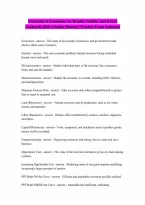
Essentials of Economics by Bradley Schiller and Karen Gebhardt 2026 Solution Manual | Practice Exam Solutions Economics - answer - The study of how people, businesses, and governments make choices about scarce resources. Scarcity - answer - The core economic problem: limited resources facing unlimited human wants and needs. Microeconomics - answer - Studies individual parts of the economy like consumers, firms, and specific markets. Macroeconomics - answer - Studies the economy as a whole, including GDP, inflation, and unemployment. Marginal Analysis Rule - answer - Take an action only when marginal benefit is greater than or equal to marginal cost. Land (Resources) - answer - Natural resources used in production, such as oil, water, forests, and minerals. Labor (Resources) - answer - Human effort contributed by workers, teachers, engineers, and others. Capital (Resources) - answer - Tools, equipment, and machinery used to produce goods; money itself is excluded. Entrepreneurship - answer - Organizing resources and taking risks to create and run a business. Opportunity Cost - answer - The value of the next-best alternative given up when making a choice. Increasing Opportunity Cost - answer - Producing more of one good requires sacrificing increasingly larger amounts of another. PPF Point ON the Curve - answer - Efficient and attainable; resources are fully utilized. PPF Point INSIDE the Curve - answer - Attainable but inefficient, indicating unemployment or wasted resources. PPF Point OUTSIDE the Curve - answer - Currently unattainable due to insufficient resources or technology. Outward PPF Shift - answer - Represents economic growth caused by increased resources, capital, or better technology. Bowed-Out PPF Shape - answer - Represents increasing opportunity cost. Comparative Advantage - answer - The ability to produce a good at a lower opportunity cost than a competitor. Specialization - answer - Focusing production on the good with the lower opportunity cost, then trading. Change in Quantity Demanded - answer - Movement along the demand curve caused by a change in the good's own price. Change in Demand - answer - Shift of the entire demand curve caused by a non-price factor. Substitutes - answer - Goods that can be used in place of each other, like Coke and Pepsi. Complements - answer - Goods generally consumed together, like cars and gasoline. Change in Quantity Supplied - answer - Movement along the supply curve caused by a change in the good's own price. Change in Supply - answer - Shift of the entire supply curve caused by a non-price factor like input prices. Market Equilibrium - answer - The state where quantity demanded equals quantity supplied, clearing the market. Demand Increase Result - answer - Price increases and quantity increases. Demand Decrease Result - answer - Price decreases and quantity decreases. Supply Increase Result - answer - Price decreases and quantity increases. Supply Decrease Result - answer - Price increases and quantity decreases. Price Ceiling - answer - A legal maximum price; binding only when below equilibrium, creating a shortage. Price Floor - answer - A legal minimum price; binding only when above equilibrium, creating a surplus. Gross Domestic Product (GDP) - answer - Market value of all final goods and services produced domestically within a period. Excluded from GDP - answer - Used goods, intermediate goods, financial transactions, transfer payments, and unpaid household work.
Document information
- Uploaded on
- October 20, 2026
- Number of pages
- 3
- Written in
- 2026/2027
- Type
- Exam (elaborations)
- Contains
- Questions & answers


