
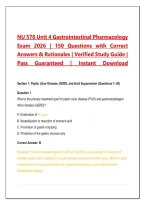
NU 578 Unit 4 Gastrointestinal Pharmacology
Exam 2026 | 150 Questions with Correct
Answers & Rationales | Verified Study Guide |
Pass Guaranteed | Instant Download
Section 1: Peptic Ulcer Disease, GERD, and Acid Suppression (Questions 1–30)
Question 1
What is the primary treatment goal for peptic ulcer disease (PUD) and gastroesophageal
reflux disease (GERD)?
A. Eradication of H. pylori
B. Neutralization or reduction of stomach acid
C. Promotion of gastric emptying
D. Protection of the gastric mucosa only
Correct Answer: B
Rationale: The main treatment goal for PUD and GERD is neutralization or reduction of
stomach acid to allow healing of mucosal damage and prevent further injury. While H. pylori
eradication and mucosal protection are important components, acid reduction is the
foundational strategy .
,Question 2
A patient with chronic GERD has been on omeprazole 20 mg daily for 8 weeks with
incomplete relief. Which consideration is MOST relevant when switching to another PPI?
A. Pantoprazole has higher bioavailability than omeprazole.
B. Esomeprazole undergoes less hepatic metabolism via CYP2C19, leading to higher
systemic exposure.
C. Lansoprazole has a shorter half-life and requires twice-daily dosing.
D. Rabeprazole is acid-labile and must be given with a prokinetic.
Correct Answer: B
Rationale: Esomeprazole (the S-isomer of omeprazole) is metabolized less by CYP2C19,
resulting in higher AUC and more consistent acid suppression, especially in CYP2C19
extensive metabolizers. Pantoprazole actually has higher bioavailability than omeprazole,
and lansoprazole does not require twice-daily dosing for GERD .
Question 3
Which PPI is least affected by CYP2C19 poor metabolizer status?
A. Omeprazole
B. Lansoprazole
C. Rabeprazole
D. Esomeprazole
Correct Answer: C
,Rationale: Rabeprazole is less dependent on CYP2C19 for metabolism compared with
omeprazole and lansoprazole, making it a reasonable choice in patients who are CYP2C19
poor metabolizers .
Question 4
A patient with a peptic ulcer is prescribed triple therapy with amoxicillin, clarithromycin, and
omeprazole but reports a penicillin allergy. What is the MOST appropriate modification?
A. Replace amoxicillin with metronidazole.
B. Replace clarithromycin with doxycycline.
C. Replace omeprazole with ranitidine.
D. Add bismuth subsalicylate and continue all three.
Correct Answer: A
Rationale: In penicillin-allergic patients, amoxicillin is typically replaced with metronidazole
in H. pylori eradication regimens. Clarithromycin is a key component and is not typically
replaced with doxycycline. PPIs are more effective than H2 blockers for eradication .
Question 5
Which antacid is most likely to cause constipation?
A. Magnesium hydroxide
B. Aluminum hydroxide
, C. Calcium carbonate
D. Sodium bicarbonate
Correct Answer: B
Rationale: Aluminum-based antacids commonly cause constipation, whereas magnesium-
based antacids tend to cause diarrhea. Calcium carbonate can also cause constipation, but
aluminum is more classically associated with it .
Question 6
Which antacid should be avoided in pregnancy?
A. Calcium carbonate
B. Aluminum hydroxide
C. Magnesium salts
D. Sodium bicarbonate
Correct Answer: C
Rationale: Magnesium salts are generally avoided in pregnancy due to potential effects on
the fetus and maternal GI motility. Calcium and aluminum-based antacids are preferred .
Question 7
A patient with cirrhosis and refractory ascites is started on spironolactone. After one week,


