(&(Y&*&%Y&*(@)&$(&%*&%*&(&%@&*($#(*&98oBIOL
ps://www.stuvia.com/user/????????????????????"OP@)(@)(*#@(#*@#&*$^&)(*@)$*$(&(Y&*&%Y&*(@)&$(&%*&%*&(&%@&*($#(*&98
Page 1 of 710/20/2026https://www.stuvia.com/user/????????????????????"OP@)(@)(*#@(#*@#&*$^&)(*@)$*$(&(Y&*&%Y&*(@
2460 - chapter 15 - PARKS - MICROBIOLOGY.pdf10/20/2026, 4:09:33 AM
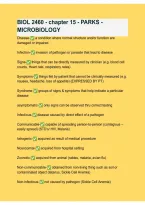
BIOL 2460 - chapter 15 - PARKS -
MICROBIOLOGY
Disease- ✅
a condition where normal structure and/or function are
damaged or impaired
Infection- invasion of pathogen or parasite that lead to disease
Signs- things that can be directly measured by clinician (e.g. blood cell
counts, Heart rate, respiratory rates)
Symptoms-
things felt by patient that cannot be clinically measured (e.g.
nausea, headache, loss of appetite) (EXPRESSED BY PT)
Syndrome- groups of signs & symptoms that help indicate a particular
disease
asymptomatic- only signs can be observed thru correct testing
disease caused by direct effect of a pathogen
Infectious-
Communicable- capable of spreading person-to-person (contagious –
easily spread) (STD’s/ HIV, Malaria)
acquired as result of medical procedure
Iatrogenic-
Nosocomial- acquired from hospital setting
Zoonotic- acquired from animal (rabies, malaria, avian flu)
Non-communicable- obtained from non-living thing such as soil or
contaminated object (tetanus, Sickle Cell Anemia)
Non-infectious- not caused by pathogen (Sickle Cell Anemia)
???????????????????"OP@)(@)(*#@(#*@#&*$^&)(*@)$*$(&(Y&*&%Y&*(@)&$(&%*&%*&(&%@&*($#(*&98oBIOL
(&(Y&*&%Y&*(@)&$(&%*&%*&(&%@&*($#(*&98oBIOL
BIOL 2460 - chapter 15 - PARKS - MICROBIOLOGY.pdfPage
2460 - chapter
1 15
of 710/20/2026https://www.stuvia.com/user/???????????????????
- PARKS - MICROBIOLOGY.pdf10/20/2026, 2460
4:09:33
- chapter
AM 15 - P
,(&(Y&*&%Y&*(@)&$(&%*&%*&(&%@&*($#(*&98oBIOL
ps://www.stuvia.com/user/????????????????????"OP@)(@)(*#@(#*@#&*$^&)(*@)$*$(&(Y&*&%Y&*(@)&$(&%*&%*&(&%@&*($#(*&98
Page 2 of 710/20/2026https://www.stuvia.com/user/????????????????????"OP@)(@)(*#@(#*@#&*$^&)(*@)$*$(&(Y&*&%Y&*(@
2460 - chapter 15 - PARKS - MICROBIOLOGY.pdf10/20/2026, 4:09:33 AM
Infectious disease follow 5 stages:- ✅ Incubation, Prodromal, Illness,
Decline, Convalescence
Incubation- initial entry of pathogen; replication begins; no signs or
symptoms
Prodromal- Replication continues; host shows signs & symptoms
Illness-
signs & symptoms are most severe in host (respiratory)
(HIGHEST # OF PATHOGENS)
Decline- pathogen no. start to decrease; host’s immune system is weak
and vulnerable to secondary infection (immunocompromised)
Convalescence- host starts to recover
Acute- relatively short (hours, days, week) (flu)
Chronic- longer time (months, years, lifetime) (TB, HIV, Hepatitis)
Latent- comes in episodes; pathogen replicates when disease is active
(chickenpox and herpes)
Koch’s Postulates- determine whether a particular microorganism is a
pathogen
The suspected pathogen must be found every case of disease and not be
found in healthy individuals
The suspected pathogen can be isolated and grown in pure culture
A healthy test subject infected with the suspected pathogen must develop
the same signs and symptoms of disease as seen in postulate 1
The pathogen must be re-isolated from the new host and must be identical
to the pathogen from postulate 2
???????????????????"OP@)(@)(*#@(#*@#&*$^&)(*@)$*$(&(Y&*&%Y&*(@)&$(&%*&%*&(&%@&*($#(*&98oBIOL
(&(Y&*&%Y&*(@)&$(&%*&%*&(&%@&*($#(*&98oBIOL
BIOL 2460 - chapter 15 - PARKS - MICROBIOLOGY.pdfPage
2460 - chapter
2 15
of 710/20/2026https://www.stuvia.com/user/???????????????????
- PARKS - MICROBIOLOGY.pdf10/20/2026, 2460
4:09:33
- chapter
AM 15 - P
ps://www.stuvia.com/user/????????????????????"OP@)(@)(*#@(#*@#&*$^&)(*@)$*$(&(Y&*&%Y&*(@)&$(&%*&%*&(&%@&*($#(*&98
Page 1 of 710/20/2026https://www.stuvia.com/user/????????????????????"OP@)(@)(*#@(#*@#&*$^&)(*@)$*$(&(Y&*&%Y&*(@
2460 - chapter 15 - PARKS - MICROBIOLOGY.pdf10/20/2026, 4:09:33 AM
BIOL 2460 - chapter 15 - PARKS -
MICROBIOLOGY
Disease- ✅
a condition where normal structure and/or function are
damaged or impaired
Infection- invasion of pathogen or parasite that lead to disease
Signs- things that can be directly measured by clinician (e.g. blood cell
counts, Heart rate, respiratory rates)
Symptoms-
things felt by patient that cannot be clinically measured (e.g.
nausea, headache, loss of appetite) (EXPRESSED BY PT)
Syndrome- groups of signs & symptoms that help indicate a particular
disease
asymptomatic- only signs can be observed thru correct testing
disease caused by direct effect of a pathogen
Infectious-
Communicable- capable of spreading person-to-person (contagious –
easily spread) (STD’s/ HIV, Malaria)
acquired as result of medical procedure
Iatrogenic-
Nosocomial- acquired from hospital setting
Zoonotic- acquired from animal (rabies, malaria, avian flu)
Non-communicable- obtained from non-living thing such as soil or
contaminated object (tetanus, Sickle Cell Anemia)
Non-infectious- not caused by pathogen (Sickle Cell Anemia)
???????????????????"OP@)(@)(*#@(#*@#&*$^&)(*@)$*$(&(Y&*&%Y&*(@)&$(&%*&%*&(&%@&*($#(*&98oBIOL
(&(Y&*&%Y&*(@)&$(&%*&%*&(&%@&*($#(*&98oBIOL
BIOL 2460 - chapter 15 - PARKS - MICROBIOLOGY.pdfPage
2460 - chapter
1 15
of 710/20/2026https://www.stuvia.com/user/???????????????????
- PARKS - MICROBIOLOGY.pdf10/20/2026, 2460
4:09:33
- chapter
AM 15 - P
,(&(Y&*&%Y&*(@)&$(&%*&%*&(&%@&*($#(*&98oBIOL
ps://www.stuvia.com/user/????????????????????"OP@)(@)(*#@(#*@#&*$^&)(*@)$*$(&(Y&*&%Y&*(@)&$(&%*&%*&(&%@&*($#(*&98
Page 2 of 710/20/2026https://www.stuvia.com/user/????????????????????"OP@)(@)(*#@(#*@#&*$^&)(*@)$*$(&(Y&*&%Y&*(@
2460 - chapter 15 - PARKS - MICROBIOLOGY.pdf10/20/2026, 4:09:33 AM
Infectious disease follow 5 stages:- ✅ Incubation, Prodromal, Illness,
Decline, Convalescence
Incubation- initial entry of pathogen; replication begins; no signs or
symptoms
Prodromal- Replication continues; host shows signs & symptoms
Illness-
signs & symptoms are most severe in host (respiratory)
(HIGHEST # OF PATHOGENS)
Decline- pathogen no. start to decrease; host’s immune system is weak
and vulnerable to secondary infection (immunocompromised)
Convalescence- host starts to recover
Acute- relatively short (hours, days, week) (flu)
Chronic- longer time (months, years, lifetime) (TB, HIV, Hepatitis)
Latent- comes in episodes; pathogen replicates when disease is active
(chickenpox and herpes)
Koch’s Postulates- determine whether a particular microorganism is a
pathogen
The suspected pathogen must be found every case of disease and not be
found in healthy individuals
The suspected pathogen can be isolated and grown in pure culture
A healthy test subject infected with the suspected pathogen must develop
the same signs and symptoms of disease as seen in postulate 1
The pathogen must be re-isolated from the new host and must be identical
to the pathogen from postulate 2
???????????????????"OP@)(@)(*#@(#*@#&*$^&)(*@)$*$(&(Y&*&%Y&*(@)&$(&%*&%*&(&%@&*($#(*&98oBIOL
(&(Y&*&%Y&*(@)&$(&%*&%*&(&%@&*($#(*&98oBIOL
BIOL 2460 - chapter 15 - PARKS - MICROBIOLOGY.pdfPage
2460 - chapter
2 15
of 710/20/2026https://www.stuvia.com/user/???????????????????
- PARKS - MICROBIOLOGY.pdf10/20/2026, 2460
4:09:33
- chapter
AM 15 - P