*#@(#*@#&*$^&)(*@)$*$(&(Y&*&%Y&*(@)&$(&%*&%*&(&%@&*($#(*&98oBIOL
1910/20/2026https://www.stuvia.com/user/????????????????????"OP@)(@)(*#@(#*@#&*$^&)(*@)$*$(&(Y&*&%Y&*(@)&$(&%*&%*&(&%@&*($#(*&98oBIOL
Page 1 of 1910/20/2026https://www.stuvia.com/user/????????????????????"OP@)(@)(*#@(#*@#&*$^&)(*@)$*$(&(Y&*&%Y&*(@)&$(&%*&%*&(&%@&*($#(*&9
2460 - EXAM 3 REVIEW - PARKS - MICROBIOLOGY.pdf10/20/2026, 4:09:33 AM
2460 - EXA
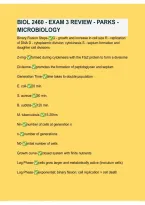
BIOL 2460 - EXAM 3 REVIEW - PARKS -
MICROBIOLOGY
✅
Binary Fission Steps- G - growth and increase in cell size R - replication
of DNA D - cytoplasmic division; cytokinesis S - septum formation and
daughter cell divisions
Z-ring- formed during cytokinesis with the FtsZ protein to form a divisome
Divisome-promotes the formation of peptidoglycan and septum
Generation Time-time takes to double population
E. coli-20 min.
S. aureus-30 min.
B. subtilis-120 min.
M. tuberculosis-15-20hrs
Nn-number of cells at generation n
n-number of generations
N0-initial number of cells
Growth curve-closed system with finite nutrients
Lag Phase-cells grow larger and metabotically active (inoculum cells)
Log Phase-exponential; binary fission; cell replication > cell death
*#@(#*@#&*$^&)(*@)$*$(&(Y&*&%Y&*(@)&$(&%*&%*&(&%@&*($#(*&98oBIOL
ia.com/user/????????????????????"OP@)(@)(*#@(#*@#&*$^&)(*@)$*$(&(Y&*&%Y&*(@)&$(&%*&%*&(&%@&*($#(*&98oBIOL
Page 1 of 1910/20/2026https://www.stuvia.com/user/????????????????????"OP@)(@)(*#@(#*@#&*$^&)(*@)$*$(&(Y&*&%Y&*(@)&$(&%*&%*&(&%@&*($#(*&9
2460 - EXAM 3 REVIEW - PARKS - MICROBIOLOGY.pdf10/20/2026,
2460 - EXAM 3 REVIEW
4:09:33
- PARKS
AM - MICR
,*#@(#*@#&*$^&)(*@)$*$(&(Y&*&%Y&*(@)&$(&%*&%*&(&%@&*($#(*&98oBIOL
1910/20/2026https://www.stuvia.com/user/????????????????????"OP@)(@)(*#@(#*@#&*$^&)(*@)$*$(&(Y&*&%Y&*(@)&$(&%*&%*&(&%@&*($#(*&98oBIOL
Page 2 of 1910/20/2026https://www.stuvia.com/user/????????????????????"OP@)(@)(*#@(#*@#&*$^&)(*@)$*$(&(Y&*&%Y&*(@)&$(&%*&%*&(&%@&*($#(*&9
2460 - EXAM 3 REVIEW - PARKS - MICROBIOLOGY.pdf10/20/2026, 4:09:33 AM
2460 - EXA
✅
Stationary Phase- cells enter survival mode and < less susceptible to
antibiotics; cell replication = cell death
Death Phase- cell replication < cell death; endospores; persisters
surviving cells with slow metabolism (tuberculosis)
Persisters-
Sustainable Growth-Open system cultures have infinite resources
Chemostat-used to maintain a continuous culture in which nutrients are
supplied at a steady rate
Direct microscopic cc- cells are counted under a microscope; CANNOT
distinguish between live or dead cells; Known volume is transferred to a
calibrated slide (Petroff-Hausser chamber) and cells are manually counted
Fluorescence Staining- cells are counted under a microscope or flow
cytometer; Red stain binds to damaged cells to indicate DEAD cells
Coulter counter- detects electrical resistance change due to cell density;
CANNOT differentiate live/dead
Viable plate counts- count of live cells; samples are diluted and grown on
solid media;
300 - TNTC; Limited only to easily cultured species; serial dilution is plated
and counted via pour plate or spread plate technique
Pour Plate Method- bacterial sample mixed with warm agar - > sample
poured onto sterile plate -> sample swirled to mix, allowed to solidify ->
plate incubated until bacterial colonies grow
Spread Plate Method- sample poured onto solid medium -> spread
sample evenly over the surface -> plate incubated until bacterial colonies
grow on the surface of the medium
*#@(#*@#&*$^&)(*@)$*$(&(Y&*&%Y&*(@)&$(&%*&%*&(&%@&*($#(*&98oBIOL
ia.com/user/????????????????????"OP@)(@)(*#@(#*@#&*$^&)(*@)$*$(&(Y&*&%Y&*(@)&$(&%*&%*&(&%@&*($#(*&98oBIOL
Page 2 of 1910/20/2026https://www.stuvia.com/user/????????????????????"OP@)(@)(*#@(#*@#&*$^&)(*@)$*$(&(Y&*&%Y&*(@)&$(&%*&%*&(&%@&*($#(*&9
2460 - EXAM 3 REVIEW - PARKS - MICROBIOLOGY.pdf10/20/2026,
2460 - EXAM 3 REVIEW
4:09:33
- PARKS
AM - MICR
,*#@(#*@#&*$^&)(*@)$*$(&(Y&*&%Y&*(@)&$(&%*&%*&(&%@&*($#(*&98oBIOL
1910/20/2026https://www.stuvia.com/user/????????????????????"OP@)(@)(*#@(#*@#&*$^&)(*@)$*$(&(Y&*&%Y&*(@)&$(&%*&%*&(&%@&*($#(*&98oBIOL
Page 3 of 1910/20/2026https://www.stuvia.com/user/????????????????????"OP@)(@)(*#@(#*@#&*$^&)(*@)$*$(&(Y&*&%Y&*(@)&$(&%*&%*&(&%@&*($#(*&9
2460 - EXAM 3 REVIEW - PARKS - MICROBIOLOGY.pdf10/20/2026, 4:09:33 AM
2460 - EXA
✅
Optical Density (turbidity)- Measured w/ spectrophotometer; light is
passed through culture and is measured on other side
Alternate Patterns of Growth- fragmentation in cyanobacteria and
budding in planctomycetes: Gemmata obscuriglobus
Biofilm Formation- Attachment of planktonic cells to a substrate
Attachment becomes irreversible; cells become sessile
Growth & division on substrate
Production of extracellular polymeric substance (EPS)
Attachment of secondary colonizers & dispersion of microbes to new
locations
Extracellular polymeric substances (EPS)- Hydrated polysaccharide gel
with other macromolecules and channels (sugar-gel) EX: (rivers, pipelines,
oral cavity) (cuts and wounds, lungs, intestines)
Quorum Sensing- cell to cell communication
Autoinducer- small molecules are produced to induce various actions
(positive-feedback)
Biofilm and Human Health- Cells in deep layers may
be metabolically inactive
EPS may slow diffusion of
biocidal agents
Provide optimal environment
for sharing of plasmids
Optimal oxygen concentration- ideal concentration of O2 (best for
growth)
Minimum permissive oxygen concentration- lowest O2 concentration
allowing growth
*#@(#*@#&*$^&)(*@)$*$(&(Y&*&%Y&*(@)&$(&%*&%*&(&%@&*($#(*&98oBIOL
ia.com/user/????????????????????"OP@)(@)(*#@(#*@#&*$^&)(*@)$*$(&(Y&*&%Y&*(@)&$(&%*&%*&(&%@&*($#(*&98oBIOL
Page 3 of 1910/20/2026https://www.stuvia.com/user/????????????????????"OP@)(@)(*#@(#*@#&*$^&)(*@)$*$(&(Y&*&%Y&*(@)&$(&%*&%*&(&%@&*($#(*&9
2460 - EXAM 3 REVIEW - PARKS - MICROBIOLOGY.pdf10/20/2026,
2460 - EXAM 3 REVIEW
4:09:33
- PARKS
AM - MICR
1910/20/2026https://www.stuvia.com/user/????????????????????"OP@)(@)(*#@(#*@#&*$^&)(*@)$*$(&(Y&*&%Y&*(@)&$(&%*&%*&(&%@&*($#(*&98oBIOL
Page 1 of 1910/20/2026https://www.stuvia.com/user/????????????????????"OP@)(@)(*#@(#*@#&*$^&)(*@)$*$(&(Y&*&%Y&*(@)&$(&%*&%*&(&%@&*($#(*&9
2460 - EXAM 3 REVIEW - PARKS - MICROBIOLOGY.pdf10/20/2026, 4:09:33 AM
2460 - EXA
BIOL 2460 - EXAM 3 REVIEW - PARKS -
MICROBIOLOGY
✅
Binary Fission Steps- G - growth and increase in cell size R - replication
of DNA D - cytoplasmic division; cytokinesis S - septum formation and
daughter cell divisions
Z-ring- formed during cytokinesis with the FtsZ protein to form a divisome
Divisome-promotes the formation of peptidoglycan and septum
Generation Time-time takes to double population
E. coli-20 min.
S. aureus-30 min.
B. subtilis-120 min.
M. tuberculosis-15-20hrs
Nn-number of cells at generation n
n-number of generations
N0-initial number of cells
Growth curve-closed system with finite nutrients
Lag Phase-cells grow larger and metabotically active (inoculum cells)
Log Phase-exponential; binary fission; cell replication > cell death
*#@(#*@#&*$^&)(*@)$*$(&(Y&*&%Y&*(@)&$(&%*&%*&(&%@&*($#(*&98oBIOL
ia.com/user/????????????????????"OP@)(@)(*#@(#*@#&*$^&)(*@)$*$(&(Y&*&%Y&*(@)&$(&%*&%*&(&%@&*($#(*&98oBIOL
Page 1 of 1910/20/2026https://www.stuvia.com/user/????????????????????"OP@)(@)(*#@(#*@#&*$^&)(*@)$*$(&(Y&*&%Y&*(@)&$(&%*&%*&(&%@&*($#(*&9
2460 - EXAM 3 REVIEW - PARKS - MICROBIOLOGY.pdf10/20/2026,
2460 - EXAM 3 REVIEW
4:09:33
- PARKS
AM - MICR
,*#@(#*@#&*$^&)(*@)$*$(&(Y&*&%Y&*(@)&$(&%*&%*&(&%@&*($#(*&98oBIOL
1910/20/2026https://www.stuvia.com/user/????????????????????"OP@)(@)(*#@(#*@#&*$^&)(*@)$*$(&(Y&*&%Y&*(@)&$(&%*&%*&(&%@&*($#(*&98oBIOL
Page 2 of 1910/20/2026https://www.stuvia.com/user/????????????????????"OP@)(@)(*#@(#*@#&*$^&)(*@)$*$(&(Y&*&%Y&*(@)&$(&%*&%*&(&%@&*($#(*&9
2460 - EXAM 3 REVIEW - PARKS - MICROBIOLOGY.pdf10/20/2026, 4:09:33 AM
2460 - EXA
✅
Stationary Phase- cells enter survival mode and < less susceptible to
antibiotics; cell replication = cell death
Death Phase- cell replication < cell death; endospores; persisters
surviving cells with slow metabolism (tuberculosis)
Persisters-
Sustainable Growth-Open system cultures have infinite resources
Chemostat-used to maintain a continuous culture in which nutrients are
supplied at a steady rate
Direct microscopic cc- cells are counted under a microscope; CANNOT
distinguish between live or dead cells; Known volume is transferred to a
calibrated slide (Petroff-Hausser chamber) and cells are manually counted
Fluorescence Staining- cells are counted under a microscope or flow
cytometer; Red stain binds to damaged cells to indicate DEAD cells
Coulter counter- detects electrical resistance change due to cell density;
CANNOT differentiate live/dead
Viable plate counts- count of live cells; samples are diluted and grown on
solid media;
300 - TNTC; Limited only to easily cultured species; serial dilution is plated
and counted via pour plate or spread plate technique
Pour Plate Method- bacterial sample mixed with warm agar - > sample
poured onto sterile plate -> sample swirled to mix, allowed to solidify ->
plate incubated until bacterial colonies grow
Spread Plate Method- sample poured onto solid medium -> spread
sample evenly over the surface -> plate incubated until bacterial colonies
grow on the surface of the medium
*#@(#*@#&*$^&)(*@)$*$(&(Y&*&%Y&*(@)&$(&%*&%*&(&%@&*($#(*&98oBIOL
ia.com/user/????????????????????"OP@)(@)(*#@(#*@#&*$^&)(*@)$*$(&(Y&*&%Y&*(@)&$(&%*&%*&(&%@&*($#(*&98oBIOL
Page 2 of 1910/20/2026https://www.stuvia.com/user/????????????????????"OP@)(@)(*#@(#*@#&*$^&)(*@)$*$(&(Y&*&%Y&*(@)&$(&%*&%*&(&%@&*($#(*&9
2460 - EXAM 3 REVIEW - PARKS - MICROBIOLOGY.pdf10/20/2026,
2460 - EXAM 3 REVIEW
4:09:33
- PARKS
AM - MICR
,*#@(#*@#&*$^&)(*@)$*$(&(Y&*&%Y&*(@)&$(&%*&%*&(&%@&*($#(*&98oBIOL
1910/20/2026https://www.stuvia.com/user/????????????????????"OP@)(@)(*#@(#*@#&*$^&)(*@)$*$(&(Y&*&%Y&*(@)&$(&%*&%*&(&%@&*($#(*&98oBIOL
Page 3 of 1910/20/2026https://www.stuvia.com/user/????????????????????"OP@)(@)(*#@(#*@#&*$^&)(*@)$*$(&(Y&*&%Y&*(@)&$(&%*&%*&(&%@&*($#(*&9
2460 - EXAM 3 REVIEW - PARKS - MICROBIOLOGY.pdf10/20/2026, 4:09:33 AM
2460 - EXA
✅
Optical Density (turbidity)- Measured w/ spectrophotometer; light is
passed through culture and is measured on other side
Alternate Patterns of Growth- fragmentation in cyanobacteria and
budding in planctomycetes: Gemmata obscuriglobus
Biofilm Formation- Attachment of planktonic cells to a substrate
Attachment becomes irreversible; cells become sessile
Growth & division on substrate
Production of extracellular polymeric substance (EPS)
Attachment of secondary colonizers & dispersion of microbes to new
locations
Extracellular polymeric substances (EPS)- Hydrated polysaccharide gel
with other macromolecules and channels (sugar-gel) EX: (rivers, pipelines,
oral cavity) (cuts and wounds, lungs, intestines)
Quorum Sensing- cell to cell communication
Autoinducer- small molecules are produced to induce various actions
(positive-feedback)
Biofilm and Human Health- Cells in deep layers may
be metabolically inactive
EPS may slow diffusion of
biocidal agents
Provide optimal environment
for sharing of plasmids
Optimal oxygen concentration- ideal concentration of O2 (best for
growth)
Minimum permissive oxygen concentration- lowest O2 concentration
allowing growth
*#@(#*@#&*$^&)(*@)$*$(&(Y&*&%Y&*(@)&$(&%*&%*&(&%@&*($#(*&98oBIOL
ia.com/user/????????????????????"OP@)(@)(*#@(#*@#&*$^&)(*@)$*$(&(Y&*&%Y&*(@)&$(&%*&%*&(&%@&*($#(*&98oBIOL
Page 3 of 1910/20/2026https://www.stuvia.com/user/????????????????????"OP@)(@)(*#@(#*@#&*$^&)(*@)$*$(&(Y&*&%Y&*(@)&$(&%*&%*&(&%@&*($#(*&9
2460 - EXAM 3 REVIEW - PARKS - MICROBIOLOGY.pdf10/20/2026,
2460 - EXAM 3 REVIEW
4:09:33
- PARKS
AM - MICR