2026https://www.stuvia.com/user/????????????????????"OP@)(@)(*#@(#*@#&*$^&)(*@)$*$(&(Y&*&%Y&*(@)&$(&%*&%*&(&%@&*($#(*&98oChapter
https://www.stuvia.com/user/????????????????????"OP@)(@)(*#@(#*@#&*$^&)(*@)$*$(&(Y&*&%Y&*(@)&$(&%*&%*&(&%@&*($#(*&98o
10/20/2026https://www.stuvia.com/user/????????????????????"OP@)(@)(*#@(#*@#&*$^&)(*@)$*$(&(Y&*&%Y&*(@)&$(&%*&%*&(&%@&*($#(*&98o
12 Food Microbiol
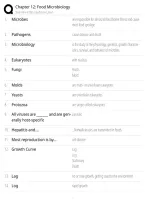
Chapter 12: Food Microbiology
Study online at https://quizlet.com/_hoev1
1. Microbes are responsible for almost all food borne illness and cause
most food spoilage
2. Pathogens cause disease and death
3. Microbiology is the study of the physiology, genetics, growth character-
istics, survival, and behavior of microbes
4. Eukaryotes with nucleus
5. Fungi Yeasts
Mold
6. Molds are multi- or unicellular eukaryotes
7. Yeasts are unicellular eukaryotes
8. Protozoa are single-celled eukaryotes
9. All viruses are _______ and are gen- parasitic
erally host-specific
10. Hepatitis and.... ...Norwalk viruses are transmitted in foods
11. Most reproduction is by... cell division
12. Growth Curve Lag
Log
Stationary
Death
13. Lag no or slow growth, getting used to the environment
14. Log rapid growth
1/4
??????????????"OP@)(@)(*#@(#*@#&*$^&)(*@)$*$(&(Y&*&%Y&*(@)&$(&%*&%*&(&%@&*($#(*&98oChapter
Page 1https://www.stuvia.com/user/????????????????????"OP@)(@)(*#@(#*@#&*$^&)(*@)$*$(&(Y&*&%Y&*(@)&$(&%*&%*&(&%@&*($#(*&98o
of 410/20/2026https://www.stuvia.com/user/????????????????????"OP@)(@)(*#@(#*@#&*$^&)(*@)$*$(&(Y&*&%Y&*(@)&$(&%*&%*&(&%@&*($#(*&98
12 Food Microbiology.pdf10/20/2026, 4:09:33 AM