
A & D (EKG INTERPRETATION PART 1) LATEST ACTUAL
EXAM WITH VERIFIED QUESTIONS & CORRECT
ANSWERS
Question 1.
What are the first and second rule of EKG interpretation
ANSWER
1. Recognize a normal ECG (old EKG to determine normal for the patient)
2. Caution on relying on electronic interpretation
Question 2.
What are the normal conduction pathways and rates of the heart?
ANSWER
i. SA Node - 60-100 bpm
ii. AV Node- 40-60 bpm
iii. Purkinje Fibers- < 40 bpm
Question 3.
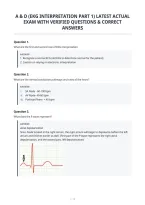
What does the P wave represent?
ANSWER
atrial depolarization
Sinus Node located in the right atrium, the right atrium will begin to depolarize before the left
atrium and finishes earlier as well. (First part of the P wave represents the right atrial
depolarization, and the second part, left depolarization)
,Question 4.
What does the QRS wave represent and how are the different parts identified?
ANSWER
i. Ventricular depolarization (with atrial repolarization hidden inside)
ii. First deflection downward = Q wave
iii. First upward deflection = R wave
iv. If a second upward deflection = R' (r-prime)
v. First downward deflection following an upward deflection = S wave
Question 5.
What does the T wave represent?
ANSWER
ventricular repolarization
proceeded by a short refractory period which follows the QRS wave
, Question 6.
What is PR interval?
What is its normal morphology?
ANSWER
i. start of atrial depolarization to the start of ventricular depolarization
ii. 0.12-0.20 seconds
iii. P should fit within the large box in front of QRS
Question 7.
What is an ST segment?
What is its normal morphology?
ANSWER
the end of ventricular depolarization to the start of ventricular repolarization 0.05-0.10
seconds
Should fit within half a large box


