
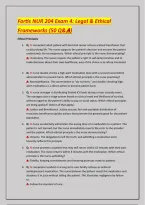
Fortis NUR 204 Exam 4: Legal & Ethical
Frameworks (50 Q&A)
Ethical Principles
1. Q: A competent adult patient with terminal cancer refuses a blood transfusion that
could prolong life. The nurse supports the patient's decision and ensures the patient
understands the consequences. Which ethical principle is the nurse demonstrating?
A: Autonomy. The nurse respects the patient's right to self-determination and to
make decisions about their own healthcare, even if the choice is to refuse treatment
.
2. Q: A nurse double-checks a high-alert medication dose with a second nurse before
administration to prevent harm. Which ethical principle is the nurse practicing?
A: Nonmaleficence. The commitment to "do no harm," and double-checking high-
alert medications is a direct action to prevent patient harm .
3. Q: A nurse manager is distributing limited ICU beds during a mass casualty event.
The manager uses a triage system based on clinical need and likelihood of survival,
without regard to the patient's ability to pay or social status. Which ethical principles
are being applied? (Select all that apply.)
A: Justice and Beneficence. Justice ensures fair and equitable distribution of
resources; beneficence guides actions that promote the greatest good for the patient
population .
4. Q: A nurse accidentally administers the wrong dose of a medication to a patient. The
patient is not harmed, but the nurse immediately reports the error to the provider
and the patient. Which ethical principle is the nurse demonstrating?
A: Veracity. The obligation to tell the truth, and admitting a medication error
honestly reflects this principle .
5. Q: A nurse promises a patient that they will return within 10 minutes with their pain
medication. The nurse returns within 8 minutes with the medication. Which ethical
principle is the nurse upholding?
A: Fidelity. Keeping commitments and honoring promises made to patients .
6. Q: A competent resident in a long-term care facility refuses an ordered
antidepressant medication. The nurse believes the patient needs the medication and
dissolves it in juice without telling the patient. This illustrates negligence by failure
to:
A: Follow the standard of care .
, 7. Q: A nurse is turning a bedfast patient to prevent pressure ulcers. The patient
complains that the process is painful. The nurse explains the reason for the turning
schedule and completes the task. This is an example of the ethical principle of:
A: Nonmaleficence .
8. Q: A nurse who advocates for a longer stay when a medically indigent patient is
being prematurely discharged due to an inability to pay for care is applying which
ethical principle?
A: Beneficence .
9. Q: Which ethical principle is the nurse upholding when they ensure that a patient has
been fully informed of the risks and benefits of a procedure before signing a consent
form?
A: Autonomy. Informed consent is a practical application of respecting a patient's
autonomy .
10. Q: Which of the following describes the ethical principle of 'Nonmaleficence'?
A: The commitment to do no harm. It requires nurses to avoid causing unnecessary
pain or injury .
Malpractice & Negligence
11. Q: What are the four elements required to prove malpractice?
A: Duty, breach of duty, causation (proximate cause), and damages (actual harm) .
12. Q: A nurse fails to document a patient's changing condition, and the patient
subsequently suffers a respiratory arrest. The patient's family sues for malpractice.
Which element must be proven to establish a direct link between the nurse's
omission and the patient's harm?
A: Proximate cause (causation). It establishes the direct link between the nurse's
breach of duty and the patient's injury .
13. Q: A nurse mistakenly administers the wrong dose of a medication, but the patient
suffers no ill effects. Which element of professional negligence is missing if the
patient were to file a lawsuit?
A: Actual injury or damages. If no harm occurred, the lawsuit lacks a necessary
component .
14. Q: A nurse does not notify the physician when a patient's blood pressure drops to
dangerously low levels. The patient goes into shock as a result. Which element of
malpractice is present in this case?
A: All of the above (Duty, breach of duty, causation). All elements of malpractice are
met .


