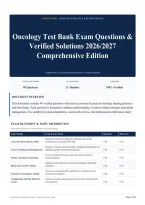
[STUDY GUIDE] • HIGH-YIELD PRACTICE & REVIEW EDITION
Oncology Test Bank Exam Questions &
Verified Solutions 2026/2027
Comprehensive Edition
Comprehensive Examination Question Bank • Concept Mapping
TOTAL QUESTIONS EXAM TOPICS ANSWERS
98 Questions 11 Modules 100% Verified
DOCUMENT OVERVIEW
This document contains 98 verified questions with correct answers focused on oncology nursing practices
and knowledge. Each question is designed to enhance understanding of cancer-related concepts and patient
management. It is suitable for exam preparation, coursework review, and professional certification study.
EXAM BLUEPRINT & TOPIC DISTRIBUTION
Systematic breakdown of subject domains and exam coverage.
Topic Module Scope & Core Focus Questions Share (%)
Questions related to the diagnosis, treatment, and nursing
Acute Myeloid Leukemia (AML) considerations for patients with AML. 9 Qs 9.2%
Focuses on various cancer treatments, including chemotherapy and
Cancer Treatment and Management radiation, and their associated nursing care. 9 Qs 9.2%
Covers assessment techniques and observations relevant to
Patient Assessment in Oncology oncology patients. 9 Qs 9.2%
Addresses cancer risk factors, prevention strategies, and health
Risk Factors and Prevention promotion. 9 Qs 9.2%
Focuses on nursing principles and practices in hospice care for
Nursing Care in Hospice Settings terminal cancer patients. 9 Qs 9.2%
Complications and Side Effects of Discusses common complications and side effects experienced by
Cancer cancer patients. 9 Qs 9.2%
Confidential • Student Study Edition • Practice & Review Guide Page 1 of 48
,STUDENT STUDY & MASTERY EDITION PRACTICE & REVIEW GUIDE
Covers specific types of cancer, including their characteristics and
Types of Cancer treatment options. 9 Qs 9.2%
Communication and Patient Emphasizes the importance of effective communication and
Education education strategies for oncology patients. 9 Qs 9.2%
Focuses on nutritional considerations and interventions for patients
Nutrition in Oncology undergoing cancer treatment. 9 Qs 9.2%
Palliative Care and Symptom Addresses palliative care approaches and symptom management
Management strategies for oncology patients. 9 Qs 9.2%
Explores various forms of leukemia and their unique nursing
Leukemia and Related Disorders considerations. 8 Qs 8.2%
Total Exam Coverage 11 Integrated Topic Modules 98 Qs 100.0%
TOPIC 1: ACUTE MYELOID LEUKEMIA (AML)
9 Questions • 9.2% of Exam • Questions related to the diagnosis, treatment, and nursing considerations for patients with AML.
QUESTION 1
A 77-year-old male is admitted to a unit with a suspected diagnosis of acute myeloid leukemia
(AML). When planning this patients care, the nurse should be aware of what epidemiologic fact?
A)Early diagnosis is associated with good outcomes.
B)Five-year survival for older adults is approximately 50%.
C)Five-year survival for patients over 75 years old is less than 2%.
D)Survival rates are wholly dependent on the patients pre-illness level of health.
Answer: C - The 5-year survival rate for patients with AML who are 50 years of age or younger is 43%; it drops to 19%
for those between 50 and 64 years, and drops to1.6% for those older than 75 years. Early diagnosis is beneficial, but is
nonetheless not associated with good outcomes or high survival rates. Preillness health is significant, but not the most
important variable.
Confidential • Student Study Edition • Practice & Review Guide Page 2 of 48
,STUDENT STUDY & MASTERY EDITION PRACTICE & REVIEW GUIDE
QUESTION 2
The nurse is performing an initial assessment of an older adult resident who has just relocated to
the long-term care facility.
During the nurses interview with the patient, she admits that she drinks around 20 ounces of
vodka every evening. What types of cancer does this put her at risk for? Select all that apply.
A)Malignant melanoma
B)Brain cancer
C)Breast cancer
D)Esophageal cancer
E)Liver cancer
Answer: C,D,E - Dietary substances that appear to increase the risk of cancer include fats, alcohol, salt-cured or smoked
meats, nitrateand nitrite-containing foods, and red and processed meats. Alcohol increases the risk of cancers of the
mouth, pharynx, larynx, esophagus, liver, colorectum, and breast.
QUESTION 3
A patient diagnosed with acute myelogenous leukemia has just been admitted to the oncology
unit. When writing this patients care plan, what potential complication should the nurse address?
A)Pancreatitis
B)Hemorrhage
C)Arteritis
D)Liver dysfunction
Answer: B - Pancreatitis, arteritis, and liver dysfunction are generally not complications of leukemia. However, the
patient faces a high risk of hemorrhage.
QUESTION 4
An oncology patient has begun to experience skin reactions to radiation therapy, prompting the
nurse to make the diagnosis Impaired Skin Integrity: erythematous reaction to radiation therapy.
What intervention best addresses this nursing diagnosis?
A)Apply an ice pack or heating pad PRN to relieve pain and pruritis
B)Avoid skin contact with water whenever possible
C)Apply phototherapy PRN
D)Avoid rubbing or scratching the affected area
Answer: D - Rubbing and or scratching will lead to additional skin irritation, damage, and increased risk of infection.
Extremes of hot, cold, and light should be avoided. No need to avoid contact with water.
Confidential • Student Study Edition • Practice & Review Guide Page 3 of 48
, STUDENT STUDY & MASTERY EDITION PRACTICE & REVIEW GUIDE
QUESTION 5
A nursing student is caring for a patient with acute myeloid leukemia who is preparing to
undergo induction therapy. In preparing a plan of care for this patient, the student should assign
the highest priority to which nursing diagnoses?
A)Activity Intolerance
B)Risk for Infection
C)Acute Confusion
D)Risk for Spiritual Distress
Answer: B - Induction therapy places the patient at risk for infection, thus this is the priority nursing diagnosis. During
the time of induction therapy, the patient is very ill, with bacterial, fungal, and occasional viral infections; bleeding and
severe mucositis, which causes diarrhea; and marked decline in the ability to maintain adequate nutrition. Supportive
care consists of administering blood products and promptly treating infections. Immobility, confusion, and spiritual
distress are possible, but infection is the patients most acute physiologic threat.
QUESTION 6
A patient with a diagnosis of acute myeloid leukemia (AML) is being treated with induction
therapy on the oncology unit. What nursing action should be prioritized in the patients care plan?
A)Protective isolation and vigilant use of standard precautions
B)Provision of a high-calorie, low-texture diet and appropriate oral hygiene
C)Including the family in planning the patients activities of daily living
D)Monitoring and treating the patients pain
Answer: A - Induction therapy causes neutropenia and a severe risk of infection. This risk must be addressed directly in
order to ensure the patients survival. For this reason, infection control would be prioritized over nutritional interventions,
family care, and pain, even though each of these are important aspects of nursing care.
QUESTION 7
A nurse is caring for a patient who has a diagnosis of acute leukemia. What assessment most
directly addresses the most common cause of death among patients with leukemia?
A)Monitoring for infection
B)Monitoring nutritional status
C)Monitor electrolyte levels
D)Monitoring liver function
Answer: A - In patients with acute leukemia, death typically occurs from infection or bleeding. Compromised nutrition,
electrolyte imbalances, and impaired liver function are all plausible, but none is among the most common causes of death
in this patient population.
Confidential • Student Study Edition • Practice & Review Guide Page 4 of 48