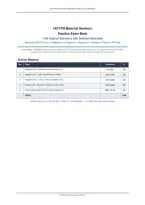
VATI PN MATERNAL NEWBORN | PRACTICE EXAM BANK
VATI PN Maternal Newborn
Practice Exam Bank
1100 Original Questions with Detailed Rationales
Balanced A/B/C/D Keys • Antepartum • Intrapartum • Postpartum • Newborn • Pharm & PN Role
DISCLAIMER – ORIGINAL educational practice resource for VATI PN Maternal Newborn themes. NOT an official ATI/VATI exam and NOT
proprietary test content. PN scope: data collection, reinforce teaching, report abnormal findings. Not clinical advice.
Section Mapping
Sec Topic Questions N
1 Antepartum Care – Prenatal Assessment, Nutrition & H Q1-Q220 220
2 Intrapartum Care – Labor, Fetal Monitoring & Obstetr Q221-Q440 220
3 Postpartum Care – Fundus, Lochia, Complications & Ad Q441-Q660 220
4 Newborn Care – Assessment, Feeding, Jaundice & Safet Q661-Q880 220
5 Pharmacology, Safety & PN Role in Maternal-Newborn C Q881-Q1100 220
TOTAL 1100
Answer key mix: A=198, B=396, C=396, D=110 (balanced — A is NOT the only correct option)
Original Study Resource | Page 1
, VATI PN MATERNAL NEWBORN | PRACTICE EXAM BANK
Section 1: Antepartum Care – Prenatal Assessment, Nutrition & High-Risk Cues
Q1: A client at 12 weeks gestation reports nausea. Which instruction is most appropriate?
A. Skip breakfast and eat one large evening meal only
B. Eat small, frequent meals and dry carbohydrates on arising [CORRECT]
C. Take any over-the-counter antiemetic without asking the provider
D. Restrict all fluids until evening
Correct Answer: B
Rationale: Small frequent meals and dry carbs often reduce morning nausea.
Q2: Which finding in a prenatal client should the PN report immediately?
A. Mild ankle edema at the end of the day
B. Linea nigra on the abdomen
C. Blurred vision and epigastric pain at 34 weeks [CORRECT]
D. Increased vaginal discharge without odor
Correct Answer: C
Rationale: Blurred vision and epigastric pain can signal preeclampsia.
Q3: Expected total weight gain for a client with normal prepregnancy BMI is approximately:
A. 5 to 10 lb
B. 50 to 60 lb
C. 25 to 35 lb [CORRECT]
D. No weight gain
Correct Answer: C
Rationale: About 25–35 lb for normal BMI.
Original Study Resource | Page 2
, VATI PN MATERNAL NEWBORN | PRACTICE EXAM BANK
Q4: Folic acid supplementation is recommended mainly to reduce risk of:
A. Gestational diabetes only
B. Neural tube defects [CORRECT]
C. Postpartum depression exclusively
D. Placenta previa only
Correct Answer: B
Rationale: Folic acid reduces neural tube defects.
Q5: A urine pregnancy test detects which hormone?
A. Progesterone only
B. Estrogen only
C. Oxytocin
D. Human chorionic gonadotropin (hCG) [CORRECT]
Correct Answer: D
Rationale: hCG is detected on pregnancy tests.
Q6: Quickening is usually first felt by a primigravida around:
A. 16 to 20 weeks [CORRECT]
B. 6 to 8 weeks
C. 32 to 34 weeks
D. 40 weeks only
Correct Answer: A
Rationale: Primigravidas often feel movement ~16–20 weeks.
Q7: Which immunization is contraindicated during pregnancy?
A. Inactivated influenza
B. Tdap in the third trimester when recommended
C. MMR (live attenuated) [CORRECT]
D. Hepatitis B when indicated
Correct Answer: C
Rationale: Live vaccines such as MMR are contraindicated.
Original Study Resource | Page 3
, VATI PN MATERNAL NEWBORN | PRACTICE EXAM BANK
Q8: For suspected placenta previa, the PN should avoid:
A. Monitoring maternal vital signs
B. Counting fetal movements as taught
C. Performing a digital vaginal examination [CORRECT]
D. Reporting painless bright red bleeding
Correct Answer: C
Rationale: No digital vaginal exams with suspected previa.
Q9: Rho(D) immune globulin is indicated for an Rh-negative client after:
A. Only cesarean birth always
B. Potential fetal-maternal hemorrhage events and at designated gestational times as ordered
[CORRECT]
C. Every prenatal visit regardless of blood type
D. Only if the newborn is Rh-negative
Correct Answer: B
Rationale: Given for Rh-negative clients per protocol (e.g., 28 weeks, after bleeding, postpartum if infant
Rh-positive).
Q10: A nonstress test is considered reactive when there are:
A. No fetal heart rate accelerations in 40 minutes
B. Late decelerations with every contraction
C. Adequate accelerations meeting gestational criteria within the testing window [CORRECT]
D. A flat baseline without variability
Correct Answer: C
Rationale: Reactive NST shows adequate accelerations.
Original Study Resource | Page 4