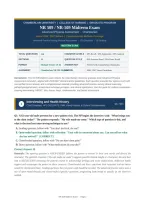
CHAMBERLAIN UNIVERSITY | COLLEGE OF NURSING | GRADUATE PROGRAM
NR 509 / NR-509 Midterm Exam
Advanced Physical Assessment - Chamberlain
Latest Edition | Comprehensive Midterm Coverage
Advanced Practice Nursing Physical Assessment - 120 Questions - 10 Sections
MIDTERM EXAM
TOTAL QUESTIONS 120 COGNITIVE LEVELS 30% Recall / 50% Application / 20% Analysis
SECTIONS 10 QUESTION STYLE 80% Scenario-Based / 20% Direct Recall
FORMAT Multiple Choice (A-D) ANSWER KEY Verified with Comprehensive Rationales
ALIGNMENT EDITION
Chamberlain NR 509 Midterm Latest Curriculum
Instructions: This NR 509 Midterm exam reflects the Chamberlain University graduate-level Advanced Physical
Assessment curriculum, aligned with 2026/2027 clinical practice guidelines. Each question presents four options (A-D) with
one verified correct answer and a comprehensive rationale providing advanced practice nursing clinical reasoning,
pathophysiological basis, assessment technique principles, and clinical significance. Use this guide for midterm preparation
covering interviewing, HEENT, skin, thorax, lungs, cardiovascular, and breast assessment.
Interviewing and Health History
1 Q1 - Q15
Chief Complaint, HPI, OLDCARTS, PMH, Family History, & Cultural Considerations
Q1: A 62-year-old male presents for a new-patient visit. The NP begins the interview with: "What brings you
to the clinic today?" The patient responds: "My wife made me come." Which type of question is this, and
what is the next best interviewing technique to use?
A. Leading question; follow with "You don't feel sick, do you?"
B. Open-ended question; follow with reflection: "Your wife is concerned about you. Can you tell me what
she has noticed?" [CORRECT]
C. Closed-ended question; follow with "Do you have chest pain?"
D. Direct question; follow with "What medications do you take?"
Correct Answer: B
Rationale: The opening question is OPEN-ENDED (allows the patient to answer in their own words and directs the
interview). The patient's response ("My wife made me come") suggests possible limited insight or reluctance; the next best
step is REFLECTION (restating the patient's words to acknowledge feelings and invite elaboration). Reflection builds
rapport and encourages the patient to share concerns. Closed-ended and direct questions limit responses and are better
suited for clarification later. Leading questions bias responses and should be avoided. The advanced practice nurse uses a
mix of open-ended (broad) and closed-ended (specific) questions, progressing from broad to specific as the interview
unfolds.
NR 509 Midterm Exam - Page 1
,NR 509 Advanced Physical Assessment Midterm | Chamberlain | 2026/2027 Graduate Nursing
Q2: A 45-year-old female presents with chronic headaches. Using the OLDCARTS mnemonic, the NP asks:
"On a scale of 0 to 10, how would you rate your pain at its worst?" Which letter of OLDCARTS does this
question address?
A. S (Severity) [CORRECT]
B. C (Character)
C. T (Timing)
D. O (Onset)
Correct Answer: A
Rationale: OLDCARTS: O = Onset (when did it start, sudden or gradual), L = Location (where is it, does it radiate), D =
Duration (how long does it last), C = Character (sharp, dull, throbbing, burning), A = Aggravating factors (what makes it
worse), R = Relieving factors (what makes it better), T = Timing (constant, intermittent, frequency, pattern), S = Severity
(0-10 scale, mild/moderate/severe). Asking the patient to rate pain on a 0-10 scale addresses Severity (S). Each letter
provides diagnostic clues—onset and character suggest etiology (sudden thunderclap = SAH; throbbing = migraine),
aggravating/relieving factors suggest mechanism (worse with light = migraine; better with food = duodenal ulcer).
Comprehensive OLDCARTS characterization is foundational to differential diagnosis in advanced practice.
Q3: A 35-year-old male presents with chest pain. Which of the following OLDCARTS responses is the
strongest RED FLAG requiring immediate emergency evaluation?
A. Sudden, severe "tearing" pain radiating to the back between the shoulder blades, reaching maximum
intensity within seconds [CORRECT]
B. Sharp pain that worsens with deep breathing, relieved by sitting forward
C. Pressure-like pain that worsens with movement and palpation
D. Dull, aching pain that worsens after meals and is relieved by antacids
Correct Answer: A
Rationale: Sudden, severe "tearing" or "ripping" pain radiating to the back between the shoulder blades is the classic
presentation of acute AORTIC DISSECTION—a life-threatening emergency requiring immediate CT angiography and
surgical consultation. The pain reaches maximum intensity at onset (unlike MI which builds), and the "tearing" quality is
pathognomonic. Risk factors: hypertension, age 60-80, male, connective tissue disease (Marfan, Ehlers-Danlos), bicuspid
aortic valve. The other options describe pericarditis (sharp, pleuritic, relieved by sitting forward), GERD (postprandial,
antacid relief), and musculoskeletal pain (reproducible with palpation). Recognizing red flags is a core competency for
advanced practice nurses—delayed diagnosis of aortic dissection has high mortality (1-2% per hour without treatment for
Type A).
Q4: A 50-year-old female from a non-English-speaking background presents for a complete history and
physical. The NP needs to obtain informed consent for a procedure. Which approach is MOST appropriate?
A. Have the patient sign the consent form without explanation since she is being accompanied by family
B. Use the patient's 12-year-old daughter to interpret
C. Speak louder and use hand gestures
D. Use a qualified medical interpreter (in person, telephonic, or video), document the interpreter's name/ID,
and use teach-back to confirm understanding [CORRECT]
Correct Answer: D
Rationale: Per Title VI of the Civil Rights Act and Section 1557 of the ACA, healthcare providers receiving federal funding
MUST provide QUALIFIED medical interpreter services at no cost to patients with limited English proficiency (LEP).
NR 509 Midterm Exam - Page 2
,NR 509 Advanced Physical Assessment Midterm | Chamberlain | 2026/2027 Graduate Nursing
Family members (especially minors) should NOT be used as interpreters due to accuracy concerns, confidentiality issues,
potential coercion, and emotional burden. Use a qualified interpreter (in-person preferred for complex encounters;
telephonic or video acceptable), document the interpreter's name/ID, and use teach-back ("Can you explain in your own
words what we discussed?") to confirm understanding. Cultural competence also requires awareness of health beliefs,
modesty preferences, and family involvement in decision-making—ASK rather than ASSUME. Speaking louder does not
help comprehension, and signing a form without understanding invalidates consent.
Q5: A 28-year-old female presents with chronic fatigue. The NP is conducting a comprehensive Review of
Systems (ROS). Which statement BEST describes the purpose of ROS?
A. ROS is the same as the physical examination
B. ROS only covers the system related to the chief complaint
C. ROS is a systematic interrogation of signs and symptoms across all body systems that the patient may
have forgotten to mention or didn't think was relevant, aiding differential diagnosis [CORRECT]
D. ROS is the same as the past medical history
Correct Answer: C
Rationale: The Review of Systems (ROS) is a systematic interrogation of signs and symptoms across all body systems
(Constitutional, Eyes, Ears/Nose/Mouth/Throat, Cardiovascular, Respiratory, GI, GU, Musculoskeletal, Skin, Neurologic,
Psychiatric, Endocrine, Hematologic/Lymphatic, Allergic/Immunologic). ROS is distinct from the physical examination
(which is objective hands-on assessment) and the past medical history (which captures prior diagnoses, hospitalizations,
surgeries). ROS may reveal problems the patient forgot to mention or didn't think was relevant (e.g., a patient presenting
for fatigue who also reports intermittent vision changes, suggesting possible multiple sclerosis). ROS also assesses
pertinent positives and negatives relevant to the differential. Although CMS 2021 E/M revisions replaced ROS with
Medical Decision Making complexity for outpatient coding, ROS remains a clinical best practice for thorough evaluation.
Q6: A 60-year-old male presents with chronic cough. The NP is taking the social history. Which element of
social history is MOST important to assess in this patient?
A. Tobacco use (type, amount in pack-years, duration, quit attempts), occupational exposures (asbestos,
silica, dust, fumes), and environmental exposures (secondhand smoke, radon) [CORRECT]
B. Religious affiliation only
C. Marital status only
D. Number of children only
Correct Answer: A
Rationale: Comprehensive social history for chronic cough must capture: (1) Tobacco use (cigarettes—calculate
pack-years: packs/day × years smoked; chewing tobacco, vaping; secondhand exposure; quit attempts—important for
lung cancer screening eligibility per USPSTF: age 50-80, >=20 pack-year history, current smoker or quit <15 years). (2)
Occupational exposures (asbestos—mesothelioma, lung cancer, pleural plaques; silica—silicosis; coal dust—COPD;
chemical fumes—asthma). (3) Environmental exposures (radon—second leading cause of lung cancer; biomass fuel
smoke; air pollution). (4) Other relevant: illicit drugs (cocaine, inhaled), alcohol, recent travel (TB exposure), sick
contacts, HIV risk (opportunistic infections). Social determinants of health (housing, food security, transportation) also
impact health. NR509 emphasizes that the social history captures lifestyle and exposure factors essential for risk
stratification and differential diagnosis.
NR 509 Midterm Exam - Page 3
, NR 509 Advanced Physical Assessment Midterm | Chamberlain | 2026/2027 Graduate Nursing
Q7: A 35-year-old patient has limited health literacy. The NP explains a new diagnosis of hypertension and
prescribes lisinopril. Which technique BEST assesses the patient's understanding?
A. Ask "Do you understand?"
B. Ask the patient to read the medication label aloud
C. Provide a written handout and assume the patient will read it
D. Use teach-back: "To make sure I explained things clearly, can you tell me in your own words how you will
take this medication and what side effects to watch for?" [CORRECT]
Correct Answer: D
Rationale: Teach-back (or "show-me") is a health literacy universal precaution. The NP asks the patient to explain back
the information in their own words, framing it as "to make sure I explained clearly" (placing responsibility on the
provider, not the patient). This approach confirms comprehension, identifies gaps, and reinforces key information. Avoid
yes/no questions ("Do you understand?")—patients often say "yes" to avoid embarrassment, even when they don't
understand. Handouts supplement but do not replace verbal teach-back. Reading a label aloud only tests literacy, not
comprehension. Health literacy is a stronger predictor of health outcomes than age, income, education, or race; low
health literacy is associated with higher hospitalization rates, poorer chronic disease control, and lower medication
adherence. Use plain language (no jargon), focus on 2-3 key points, and repeat until the patient can accurately describe
the information.
Q8: A 16-year-old female presents for a confidential visit without a parent. The NP is interviewing her using
the HEEADSSS framework. Which of the following is NOT one of the HEEADSSS categories?
A. Home and Environment
B. Activities
C. Criminal History [CORRECT]
D. Education and Employment
Correct Answer: C
Rationale: HEEADSSS is a psychosocial screening tool for adolescents: H = Home and Environment (living situation,
family relationships, safety), E = Education and Employment (school performance, goals, work), E = Eating (nutrition,
body image, eating disorders), A = Activities (peer relationships, hobbies, exercise, screen time), D = Drugs (substance
use—alcohol, tobacco, marijuana, prescription misuse, other drugs), S = Sexuality (sexual orientation, partners,
practices, contraception, STI risk), S = Suicide and Depression (mood, self-harm, suicidal ideation), S = Safety (seat belts,
helmets, violence, firearms, online safety). "Criminal History" is NOT a HEEADSSS category. Begin with a confidentiality
statement: "Everything we discuss is confidential—except in three situations: if you tell me someone is hurting you (abuse),
if you're planning to hurt someone else, or if you're thinking about hurting yourself." Always verify state laws regarding
minor consent and confidentiality.
Q9: A 70-year-old male with multiple chronic conditions presents for follow-up. The NP is reconciling his
medications. Which approach BEST ensures comprehensive medication reconciliation?
A. Ask only about medications prescribed by you
B. Only review the electronic medical record medication list
C. Ask about ALL medications: prescription, OTC, herbal supplements, vitamins, topical, inhalers, eye
drops, and "as-needed" medications; reconcile with the medical record and pharmacy; assess adherence,
side effects, and affordability [CORRECT]
D. Ask only about prescription medications
NR 509 Midterm Exam - Page 4