
NURS 4322 | MATERNAL–NEWBORN NURSING | 2026–2027
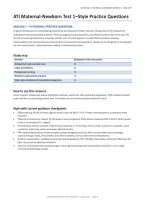
ATI Maternal-Newborn Test 1–Style Practice Questions
2026–2027 | 110 ORIGINAL PRACTICE QUESTIONS
Original ATI-style practice emphasizing assessment and antepartum/labor decision-making. Not an ATI assessment.
Independent educational study material. These are original practice questions, not official Southern Utah University, ATI,
faculty, or licensing examination materials. Similar core concepts appear in multiple files to reinforce learning.
Clinical safety note: Use institutional protocols and current professional guidance. Questions are designed for learning and
are not a substitute for medical decision-making or individualized orders.
Study map
Domain Questions in this document
Antepartum and prenatal care 43
Labor and delivery 33
Postpartum nursing 10
Newborn assessment and care 10
High-risk and obstetric/neonatal emergencies 14
How to use this resource
Cover the green answer and yellow-highlighted rationale, select A–D, then review the explanation. Mark missed concepts
and revisit the corresponding clinical area. The answer key at the end provides a rapid self-check.
High-yield current guidance checkpoints
• GBS screening: ACOG universal vaginal–rectal culture at 36 0/7–37 6/7 weeks, with intrapartum prophylaxis when
indicated.
• Maternal immunization: Tdap at 27–36 weeks in every pregnancy; Pfizer Abrysvo maternal RSV at 32 0/7–36 6/7 weeks
in the recommended U.S. season.
• Preeclampsia: systolic pressure ≥160 mm Hg or diastolic ≥110 mm Hg is severe range; monitor for headache, visual
symptoms, pulmonary edema and upper-abdominal pain.
• PPH: assess objectively and treat promptly using an integrated protocol; WHO recommends uterine massage,
oxytocic therapy, fluids, IV tranexamic acid when indicated, source assessment and escalation.
• Newborn resuscitation: ventilate for persistent apnea/gasping or HR <100 after initial steps; compress if HR stays <60
after 30 seconds of effective ventilation.
• Jaundice: use bilirubin level, postnatal age in hours, gestational age and neurotoxicity risk factors—not a single
universal phototherapy number.
INDEPENDENT PRACTICE RESOURCE • NURS 4322 • Page 1
, NURS 4322 | MATERNAL–NEWBORN NURSING | 2026–2027
Practice Questions with Answers & Rationales
Questions 1–25
1. Why is fetal anomaly screening discussed using shared decision-making?
A. A positive screen proves a diagnosis
B. Only clinicians determine whether screening is permitted
C. Screening estimates risk and patients should understand benefits, limits, and choices
D. A negative screen excludes every disorder
Correct Answer: C. Screening estimates risk and patients should understand benefits, limits, and choices
Rationale: Informed discussion separates screening from diagnostic testing and supports patient preferences.
Incorrect options: A (A positive screen proves a diagnosis); B (Only clinicians determine whether screening is permitted); D (A
negative screen excludes every disorder). These do not best answer the clinical cue; Informed discussion separates screening
from diagnostic testing and supports patient preferences.
2. Why is a fetal scalp electrode not appropriate for every laboring patient?
A. It always eliminates pain
B. It is invasive and requires consideration of membranes, dilation, and infection risks
C. It measures maternal oxygen saturation
D. It is a routine home device
Correct Answer: B. It is invasive and requires consideration of membranes, dilation, and infection risks
Rationale: Internal monitoring has indications and contraindications, including concerns with certain infections.
Incorrect options: A (It always eliminates pain); C (It measures maternal oxygen saturation); D (It is a routine home device). These
do not best answer the clinical cue; Internal monitoring has indications and contraindications, including concerns with certain
infections.
3. Painless bright-red bleeding in the second half of pregnancy raises concern for which condition?
A. Breast engorgement
B. Uncomplicated uterine afterpains
C. Normal show after birth
D. Placenta previa
Correct Answer: D. Placenta previa
Rationale: Placental tissue near or over the cervical os can bleed; digital cervical examination may provoke
hemorrhage.
Incorrect options: A (Breast engorgement); B (Uncomplicated uterine afterpains); C (Normal show after birth). These do not best
answer the clinical cue; Placental tissue near or over the cervical os can bleed; digital cervical examination may provoke
hemorrhage.
4. Which prenatal statement about alcohol is best supported?
A. Beer is safe because it is low alcohol
B. Only binge drinking poses any risk
C. Avoid alcohol during pregnancy because no safe amount is established
D. Alcohol is harmless after organogenesis
Correct Answer: C. Avoid alcohol during pregnancy because no safe amount is established
Rationale: Prenatal alcohol exposure can harm fetal development; abstinence is recommended.
Incorrect options: A (Beer is safe because it is low alcohol); B (Only binge drinking poses any risk); D (Alcohol is harmless after
organogenesis). These do not best answer the clinical cue; Prenatal alcohol exposure can harm fetal development; abstinence is
recommended.
INDEPENDENT PRACTICE RESOURCE • NURS 4322 • Page 2
, NURS 4322 | MATERNAL–NEWBORN NURSING | 2026–2027
5. Which strategy supports patient-centered prenatal teaching for someone with limited English proficiency?
A. Rely on a young child to interpret complex consent
B. Speak faster and louder in English
C. Use a qualified medical interpreter and teach-back
D. Skip informed-consent discussion
Correct Answer: C. Use a qualified medical interpreter and teach-back
Rationale: Qualified interpretation and teach-back improve accurate understanding and consent.
Incorrect options: A (Rely on a young child to interpret complex consent); B (Speak faster and louder in English); D (Skip informed-
consent discussion). These do not best answer the clinical cue; Qualified interpretation and teach-back improve accurate
understanding and consent.
6. Why should newborn hearing screening occur before discharge or through an arranged pathway?
A. It replaces physical examination
B. It confirms absence of all neurologic disorders
C. It determines maternal blood type
D. Early identification supports timely hearing and language intervention
Correct Answer: D. Early identification supports timely hearing and language intervention
Rationale: Screening facilitates diagnosis and intervention for hearing impairment during early development.
Incorrect options: A (It replaces physical examination); B (It confirms absence of all neurologic disorders); C (It determines
maternal blood type). These do not best answer the clinical cue; Screening facilitates diagnosis and intervention for hearing
impairment during early development.
7. Which effect is expected from intravenous opioid labor analgesia?
A. Permanent elimination of all obstetric pain
B. No fetal or maternal monitoring needs
C. Guaranteed neonatal alertness
D. Maternal pain relief with possible newborn respiratory depression near birth
Correct Answer: D. Maternal pain relief with possible newborn respiratory depression near birth
Rationale: Systemic opioids can cross the placenta, so timing and newborn respiratory assessment matter.
Incorrect options: A (Permanent elimination of all obstetric pain); B (No fetal or maternal monitoring needs); C (Guaranteed
neonatal alertness). These do not best answer the clinical cue; Systemic opioids can cross the placenta, so timing and newborn
respiratory assessment matter.
8. Which maternal symptom suggests cardiac decompensation rather than ordinary pregnancy
breathlessness?
A. Slight exertional breathlessness with normal assessment
B. Transient thirst
C. Dyspnea at rest with hypoxemia and new crackles
D. Mild nasal stuffiness
Correct Answer: C. Dyspnea at rest with hypoxemia and new crackles
Rationale: Resting dyspnea with abnormal oxygenation or pulmonary findings warrants urgent evaluation.
Incorrect options: A (Slight exertional breathlessness with normal assessment); B (Transient thirst); D (Mild nasal stuffiness).
These do not best answer the clinical cue; Resting dyspnea with abnormal oxygenation or pulmonary findings warrants urgent
evaluation.
INDEPENDENT PRACTICE RESOURCE • NURS 4322 • Page 3


