
Solution Manual For Statistics Informed Decisions Using Data by Michael Sullivan Updated 2026
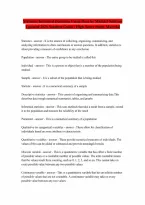
Statistics Informed Decisions Using Data by Michael Sullivan Updated 2026 Solution Guide | High-Score Study Material Statistics - answer - It is the science of collecting, organizing, summarizing, and analyzing information to draw conclusions or answer questions. In addition, statistics is about providing a measure of confidence in any conclusion. Population - answer - The entire group to be studied is called this. Individual - answer - This is a person or object that is a member of the population being studied. Sample - answer - It is a subset of the population that is being studied Statistic - answer - It is a numerical summary of a sample Descriptive statistics - answer - This consist of organizing and summarizing data.This describes data trough numerical summaries, tables, and graphs Inferential statistics - answer - This uses methods that take a result from a sample, extend it to the population,and measure the reliability of the result Parameter - answer - This is a numerical summary of a population Qualitative (or categorical) variables - answer - These allow for classification of individuals based on some attribute or characteristic Quantitative variables - answer - These provide numerical measures of individuals. The values of this can be added or subtracted and provide meaningful results. Discrete variable - answer - This is a quantitative variable that has either a finite number of possible values or a countable number of possible values. The term countable means that the values result from counting, such as 0, 1, 2, 3, and so on. This cannot take on every possible value between any two possible values. Continuous variable - answer - This is a quantitative variable that has an infinite number of possible values that are not countable. A continuous variable may take on every possible value between any two values. Nominal level - answer - A variable is at this level if the values of the variable name, label, or categorize. In addition, the naming scheme does not allow for the values of the variable to be arranged in a ranked or specific order Ordinal level - answer - A variable is at this level if it has the properties of the nominal level, however the naming scheme allows for the values of the variable to be arranged in a ranked or specific order Interval level - answer - A variable is at this level if it has the properties of the ordinal level of measurement and the differences in the values of the variable have meaning. A value of zero does not mean the absence of the quantity. Arithmetic operations such as addition and subtraction can be performed on values of the variable. Ratio level - answer - A variable is at this level if it has the properties of the interval level and the ratios of the values of the variable have meaning. A value of zero means the absence of the quantity. Arithmetic operations such as multiplication and division can be performed on the values of the variable. Observational study - answer - This study measures the value of the response variable without attempting to influence the value of either the response or explanatory variables. That is, in this kind of study, the researcher observes the behavior of the individuals without trying to influence the outcome of the study Designed experiment - answer - If a researcher assigns the individuals in a study to a certain group, intentionally changes the value of an explanatory variable, and then records the value of the response variable for each group, the study is this kind of study Confounding - answer - This occurs in a study when the effects of two or more explanatory variables are not separated. therefore, any relation that may exist between and explanatory variable and the response variable may be due to some other variable or variables not accounted for in the study Lurking variable - answer - This is an explanatory variable that was not considered in a study, but that affects the value of the response variable in the stud
Document information
- Uploaded on
- October 19, 2026
- Number of pages
- 5
- Written in
- 2026/2027
- Type
- Exam (elaborations)
- Contains
- Questions & answers


