
10/18/26, 11:27 PM BIO305-FinalExam-Answers
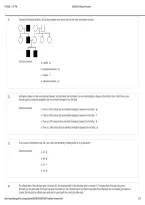
1 Complete the following sentence. The following pedigree chart shows that the trait under examination would be:
Choose one answer. a. X-linked.
b. incomplete dominant.
c. Y-linked.
d. autosomal recessive.
2 Huntington’s disease is a late onset dominant disorder. Joe Doe’s father has Huntington’s; no one has Huntington’s disease on the mother’s side of Joe’s family. Use a
Punnett Square to predict the probability that Joe inherited Huntington’s from his father.
Choose one answer. a. There is a 25% chance that Joe inherited Huntington’s disease from his father.
b. There is a 50% chance that Joe inherited Huntington’s disease from his father.
c. There is a 75% chance that Joe inherited Huntington’s disease from his father.
d. There is a 100% chance that Joe inherited Huntington’s disease from his father.
3 If you conduct a monohybrid cross, (Aa x Aa), what is the probability of getting either AA or Aa genotypes?
Choose one answer. a. 2/3
b. 4/4
c. 3/4
d. 1/4
4 The inflated allele of the pod shape gene is dominant (F); the constricted allele of the pod shape gene is recessive (f). The green allele of the pod color gene is
dominant (G); the yellow allele of the pod color gene is recessive (g). Use a Punnett Square to predict the genotype of the offspring if two true breeding pea plants are
crossed: the first plant has inflated green pods and the second plant has constricted yellow pods.
https://saylordotorg.github.io/LegacyExams/BIO/BIO305/BIO305-FinalExam-Answers.html 1/33
,10/18/26, 11:27 PM BIO305-FinalExam-Answers
Choose one answer. a. The genotype of all offspring is Ff Gg.
b. 12.5% of the offspring has FfGg genotype.
c. The offspring has parental genotype.
d. The genotypic ratio is 3:1.
5 The inflated allele of the pod shape gene is dominant (F); the constricted allele of the pod shape gene is recessive (f). The green allele of the pod color gene is
dominant (G); the yellow allele of the pod color gene is recessive (g). Use Punnett Square to predict the genotype of the offspring of self pollinating FfGg pea plants.
Choose one answer. a. The genotype of all offspring is Ff Gg.
b. 12.5% of the offspring has FfGg genotype.
c. The offspring has parental genotype.
d. The genotypic ratio is 3:1.
6 What are the genotypes of A, B, and C individuals in the following family pedigree? Use F for the dominant alleles and f for the recessive alleles.
Choose one answer. a. The genotypes of individuals A and B are ff, and C is Ff.
b. The genotype of individual A is Ff, B is ff, and C is FF.
c. The genotypes of individuals A and B are Ff, and C is ff.
d. The genotype of individuals A and B are FF, and C is ff.
https://saylordotorg.github.io/LegacyExams/BIO/BIO305/BIO305-FinalExam-Answers.html 2/33
,10/18/26, 11:27 PM BIO305-FinalExam-Answers
7 What fraction of the offspring will express at least two recessive traits, if a pea plant that is heterozygous for the flower color (purple is dominant and white is
recessive), for the seed color (yellow is dominant and green is recessive) and for the pod color (green is dominant and yellow is recessive) is self-pollinating?
Choose one answer. a. 3/4
b. 1/8
c. 3/32
d. 7/64
8 What fraction of the offspring will express two recessive traits, if a pea plant that is heterozygous for the flower color (purple is dominant and white is recessive), for
the seed color (yellow is dominant and green is recessive), and for the pod color (green is dominant and yellow is recessive) is self-pollinating?
Choose one answer. a. 3/32
b. 1/16
c. 3/8
d. 1/4
9 What percentage of the offspring is a homozygote if both parents are heterozygotes? Use a Punnett Square to answer this question.
Choose one answer. a. 0%
b. 25%
c. 50%
d. 75%
10 You open your first greenhouse, and you are eager to create new hybrid plants to sell. You cross a true-breeding tall, purple-flowered rose with a true-breeding short,
white-flowered rose. All of your offspring are short, pink-flowered roses. What does this tell you about the phenotypic expression of these characteristics?
Choose one answer. a. The purple and the white alleles exhibit incomplete dominance, while the short allele is dominant to the tall allele.
b. The purple and the short alleles are dominant; otherwise, the offspring would be white and tall.
c. The pink and the white alleles are codominant; the short allele is dominant to the tall allele.
d. The purple and white alleles are recessive; the tall allele is subject to X-inactivation.
https://saylordotorg.github.io/LegacyExams/BIO/BIO305/BIO305-FinalExam-Answers.html 3/33
, 10/18/26, 11:27 PM BIO305-FinalExam-Answers
11 Complete the following sentence. If you had a monohybrid cross between two different individuals, you would expect the genotypic ratio to be:
Choose one answer. a. 1:2:1.
b. 9:3:3:1.
c. 3:1.
d. 4:0.
12 Complete the following sentence. During the process of mitosis, a plant daughter cell that starts out with 50 chromosomes will end up with:
Choose one answer. a. 100 chromosomes.
b. 25 chromosomes.
c. 75 chromosomes.
d. 50 chromosomes.
13 Complete the following sentence. If you compare female and male gametogeneses in humans, you can determine that:
Choose one answer. a. female and male gametogeneses are homologous throughout: both result in four different gametes derived from the primary
gametocyte through meiotic cell division.
b. female and male gametogeneses are homologous, because both result in the production of gametes through meiosis; however,
while one primary spermatocyte gives rise to four sperm cells, one primary oocyte gives rise to only one oocyte.
c. female and male gametogeneses are not homologous, because one primary spermatocyte gives rise to four sperm cells, while
one primary oocyte gives rise to only one oocyte.
d. female and male gametogeneses are not homologous, because one primary spermatocyte gives rise to four sperm cells through
meiosis; one primary oocyte gives rise to the secondary oocyte through meiosis, but the oocyte is the result of mitotic cell division.
14 Cystic fibrosis is an inherited autosomal recessive disease. Assume that a mother has cystic fibrosis and that there is a technique to analyze the polar bodies for the
presence of the cystic fibrosis alleles. Is it possible to determine if the oocyte has a cystic fibrosis allele through the analysis of the polar bodies? Why, or why not?
Choose one answer. a. Yes, it is possible, because the polar bodies and the oocyte are daughter cells that are derived from the parental primary oocyte
through cell division.
b. Yes, it is possible but only from the second polar body, because it is genetically identical to the oocyte.
c. No, it is not possible, because the polar bodies and the oocyte are daughter cells that are derived from the parental primary
oocyte through meiosis.
https://saylordotorg.github.io/LegacyExams/BIO/BIO305/BIO305-FinalExam-Answers.html 4/33


