
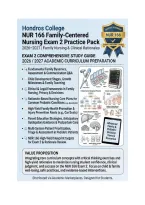
,Hondros College NUR 166 Family-Centered
Nursing Exam 2 Practice Pack 2026–2027 |
Family Nursing & Clinical Rationales
Q1. A nurse is caring for a client who is 1 hour postpartum following a vaginal delivery. The
client's fundus is boggy, located above the umbilicus and deviated to the right, and the
perineal pad is saturated with blood. Which action should the nurse take first?
A. Notify the provider and prepare for blood transfusion
B. Massage the fundus and encourage the client to void
C. Insert an indwelling urinary catheter and administer oxytocin
D. Document the findings and reassess in 15 minutes
Correct Answer: B. Massage the fundus and encourage the client to void
Rationale: The client is experiencing uterine atony with bladder distention. The fundus is
boggy, elevated, and deviated to the right, indicating a full bladder preventing contraction.
The first action is to massage the fundus and encourage voiding. If the client cannot void,
catheterization may be needed. Notifying the provider and preparing for transfusion are
appropriate if bleeding continues, but immediate intervention is massage and emptying the
bladder. Documenting and reassessing would delay care.
Key Takeaway: Boggy fundus deviated right means full bladder; massage and void first.
Q2. A nurse is assessing a newborn at 12 hours of life who has a yellow discoloration of the
skin and sclera. Which action should the nurse take first?
A. Document the finding as normal
B. Notify the provider immediately
C. Encourage breastfeeding
D. Place the newborn under phototherapy
Correct Answer: B. Notify the provider immediately
,Rationale: Jaundice appearing within the first 24 hours of life is pathologic and requires
immediate evaluation. The nurse should notify the provider for further testing and possible
treatment. Documenting as normal is incorrect. Encouraging breastfeeding is appropriate but
does not address the urgency. Phototherapy requires a provider order.
Key Takeaway: Jaundice in the first 24 hours means notify the provider.
Q3. A nurse is assessing a 6-month-old infant during a well-child visit. Which finding should
the nurse report to the provider immediately?
A. The infant has a positive Moro reflex
B. The infant's anterior fontanel is sunken
C. The infant can sit with support
D. The infant has a heart rate of 130 beats per minute
Correct Answer: B. The infant's anterior fontanel is sunken
Rationale: A sunken anterior fontanel is a sign of dehydration in an infant and requires
immediate evaluation. The Moro reflex is normally present until about 4 to 6 months and may
still be present at 6 months. Sitting with support is an expected milestone at 6 months. A
heart rate of 130 is within normal limits for an infant.
Key Takeaway: Sunken fontanel in an infant means dehydration until proven otherwise.
Q4. A nurse is assessing a 6-year-old child with asthma. Which finding indicates the child is
experiencing an acute exacerbation?
A. Respiratory rate of 22 breaths per minute
B. Peak expiratory flow rate of 80% of personal best
C. Use of accessory muscles
D. Oxygen saturation of 95% on room air
Correct Answer: C. Use of accessory muscles
Rationale: Use of accessory muscles indicates increased work of breathing and is a sign of an
acute asthma exacerbation. A respiratory rate of 22 is normal for a 6-year-old. A peak flow of
, 80% of personal best is in the yellow zone, indicating caution but not severe. Oxygen
saturation of 95% is acceptable. The nurse should administer a bronchodilator as prescribed.
Key Takeaway: Accessory muscle use in asthma means exacerbation.
Q5. A nurse is assessing a child with tetralogy of Fallot. Which finding should the nurse
expect?
A. Cyanosis
B. Hypertension
C. Bradycardia
D. Strawberry tongue
Correct Answer: A. Cyanosis
Rationale: Tetralogy of Fallot is a cyanotic congenital heart defect. It is characterized by
cyanosis, clubbing, and squatting. Hypertension and bradycardia are not typical. Strawberry
tongue is seen in Kawasaki disease. The nurse should monitor for hypoxic spells.
Key Takeaway: Tetralogy of Fallot means cyanosis.
Q6. A nurse is teaching a parent about the care of a child with tetralogy of Fallot. Which
instruction should the nurse include?
A. Place the child in a knee-chest position during a hypoxic spell
B. Encourage strenuous activity
C. Withhold oxygen during spells
D. Avoid all fluids
Correct Answer: A. Place the child in a knee-chest position during a hypoxic spell
Rationale: The knee-chest position increases systemic vascular resistance and improves
pulmonary blood flow during a hypoxic spell. Strenuous activity should be avoided. Oxygen
should be administered during spells. Fluids should be encouraged.
Key Takeaway: Knee-chest position for tetralogy spells.


