
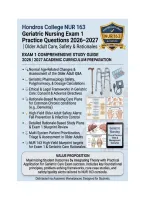
,Hondros College NUR 163 Geriatric Nursing
Exam 1 Practice Questions 2026–2027 | Older
Adult Care, Safety & Rationales
Q1. A nurse is caring for an 82-year-old client who was admitted with a fractured hip after a
fall at home. The client is confused and repeatedly tries to climb out of bed. Which action
should the nurse take first?
A. Apply a vest restraint to keep the client in bed
B. Place the bed in the lowest position and activate the bed alarm
C. Administer a prescribed sedative to calm the client
D. Ask the family to stay with the client at all times
Correct Answer: B. Place the bed in the lowest position and activate the bed alarm
Rationale: The client is at high risk for falls due to confusion and a fractured hip. The first
priority is to implement the least restrictive safety measures, which include placing the bed in
the lowest position and activating the bed alarm to alert staff if the client attempts to get up.
Restraints are a last resort and require a provider order and frequent monitoring. Sedatives
increase the risk of falls and delirium. Family presence is helpful but cannot substitute for
nursing safety interventions.
Key Takeaway: Lowest bed and alarm first; restraints are a last resort.
Q2. A nurse is assessing an older adult client who reports constipation. Which age-related
change is the most likely cause?
A. Increased gastric acid secretion
B. Decreased peristalsis
C. Increased intestinal motility
D. Decreased stomach capacity
Correct Answer: B. Decreased peristalsis
,Rationale: Aging slows gastrointestinal motility, leading to decreased peristalsis and
constipation. Gastric acid secretion often decreases with age, not increases. Intestinal motility
decreases, not increases. Stomach capacity does not decrease significantly with age. The
nurse should encourage fluids, fiber, and activity to promote bowel elimination.
Key Takeaway: Aging slows peristalsis, causing constipation.
Q3. A nurse is teaching an older adult client about medication safety. Which statement by the
client indicates a need for further teaching?
A. "I will use a pill organizer to help me remember my medications."
B. "I will keep a list of all my medications in my wallet."
C. "I will take my medications with grapefruit juice to help absorption."
D. "I will ask my pharmacist to review my medications for interactions."
Correct Answer: C. "I will take my medications with grapefruit juice to help absorption."
Rationale: Grapefruit juice interacts with many medications, including statins, calcium
channel blockers, and some psychiatric medications, by inhibiting the CYP3A4 enzyme and
increasing drug levels. Older adults should avoid grapefruit juice unless specifically approved
by their provider. Pill organizers, medication lists, and pharmacist reviews are all appropriate
safety strategies.
Key Takeaway: Grapefruit juice interacts with many drugs; avoid it.
Q4. A nurse is assessing an older adult client for dehydration. Which finding is most
concerning?
A. Dry mucous membranes
B. Poor skin turgor
C. Confusion
D. Decreased urine output
Correct Answer: C. Confusion
Rationale: Confusion in an older adult is a critical sign of dehydration and can indicate
impending delirium or shock. Dry mucous membranes, poor skin turgor, and decreased urine
, output are also signs of dehydration, but confusion reflects inadequate perfusion to the brain
and requires immediate intervention. Older adults are at higher risk for dehydration due to
decreased thirst sensation and decreased renal concentrating ability.
Key Takeaway: New confusion in an older adult means dehydration until proven otherwise.
Q5. A nurse is caring for an older adult client who has been taking diphenhydramine for
insomnia. Which finding should the nurse report to the provider immediately?
A. Dry mouth
B. Urinary retention
C. Drowsiness
D. Blurred vision
Correct Answer: B. Urinary retention
Rationale: Diphenhydramine is an anticholinergic medication that can cause urinary retention,
which is a medical emergency if untreated. Older adults are particularly susceptible to
anticholinergic effects due to age-related changes in renal function and prostate enlargement
in men. Dry mouth, drowsiness, and blurred vision are common side effects but are not
immediately life-threatening. The nurse should monitor for urinary retention and report it
promptly.
Key Takeaway: Anticholinergics cause urinary retention in older adults.
Q6. A nurse is reviewing the laboratory values for an older adult client. Which finding should
the nurse expect as an age-related change?
A. Hemoglobin of 10 g/dL
B. Serum creatinine of 0.8 mg/dL
C. White blood cell count of 15,000/mm3
D. Platelet count of 100,000/mm3
Correct Answer: B. Serum creatinine of 0.8 mg/dL
Rationale: Older adults have decreased muscle mass, which leads to lower baseline serum
creatinine levels. A creatinine of 0.8 mg/dL may appear normal but could indicate significantly


