
lOMoAR cPSD| 6861666
D265 Task 1: Thinking Critically Task 1 Template
WGU D265 Task 1: Analyzing Arguments
and Fallacies in Case Study with
Complete Solutions
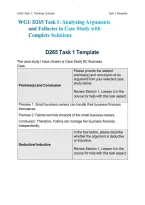
D265 Task 1 Template
The case study I have chosen is Case Study #2: Business
Case.
Please provide the labeled
premise(s) and conclusion of an
argument from your selected case
study below.
Premise(s) and Conclusion
Review Section 1, Lesson 2 in the
course for help with this task aspect.
Premise 1: Small business owners can handle their business finances
themselves.
Premise 2: Fatima reminds Amanda of the small business owners.
Conclusion: Therefore, Fatima can manage her business finances
independently.
In the box below, please describe
whether the argument is deductive
or inductive.
Deductive/ Inductive
Review Section 1, Lesson 4 in the
course for help with this task aspect.
, lOMoAR cPSD| 6861666
D265 Task 1: Thinking Critically Task 1 Template
Amanda’s argument is clearly inductive. While a deductive argument
seeks to guarantee its conclusion, an inductive argument focuses on the
probability of the argument being true. Amanda is making an argument by
analogy, which assumes that because Fatima is like the small business
owners, it is probable that she can do what they can do.
However, Amanda is not attempting to guarantee her claim.
Validity/ Strength In the box below, please describe
the argument.
For a deductive argument, explain
whether it is valid or invalid.
For an inductive argument, explain
whether it is strong or weak.
Review Section 1, Lesson 4 in the
course for help with this task aspect.
Amanda’s argument is weak because the premises do not give much
support to the conclusion. Fatima reminding Amanda of the business
owners is too vague and offers no support to the probability of the
conclusion’s truth. She did not give any support to Fatima’s skills or
experience in this field.
D265 Task 1: Thinking Critically Task 1 Template
WGU D265 Task 1: Analyzing Arguments
and Fallacies in Case Study with
Complete Solutions
D265 Task 1 Template
The case study I have chosen is Case Study #2: Business
Case.
Please provide the labeled
premise(s) and conclusion of an
argument from your selected case
study below.
Premise(s) and Conclusion
Review Section 1, Lesson 2 in the
course for help with this task aspect.
Premise 1: Small business owners can handle their business finances
themselves.
Premise 2: Fatima reminds Amanda of the small business owners.
Conclusion: Therefore, Fatima can manage her business finances
independently.
In the box below, please describe
whether the argument is deductive
or inductive.
Deductive/ Inductive
Review Section 1, Lesson 4 in the
course for help with this task aspect.
, lOMoAR cPSD| 6861666
D265 Task 1: Thinking Critically Task 1 Template
Amanda’s argument is clearly inductive. While a deductive argument
seeks to guarantee its conclusion, an inductive argument focuses on the
probability of the argument being true. Amanda is making an argument by
analogy, which assumes that because Fatima is like the small business
owners, it is probable that she can do what they can do.
However, Amanda is not attempting to guarantee her claim.
Validity/ Strength In the box below, please describe
the argument.
For a deductive argument, explain
whether it is valid or invalid.
For an inductive argument, explain
whether it is strong or weak.
Review Section 1, Lesson 4 in the
course for help with this task aspect.
Amanda’s argument is weak because the premises do not give much
support to the conclusion. Fatima reminding Amanda of the business
owners is too vague and offers no support to the probability of the
conclusion’s truth. She did not give any support to Fatima’s skills or
experience in this field.


