
N A P L E X H I G H - Y I E L D C L I N I C A L & C A LC U L AT I O N S T U DY G U I D E • V O L U M E 1 O F 4 ( PA G E S 1 – 1 0 )
PHARMACEUTICAL CALCULATIONS, PK/PD &
CARDIOVASCULAR
Complete Formulas, Clinical Pearls, Boxed Warnings, Dosing Equivalents & Board-Style Worked Problems
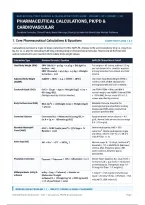
1. Core Pharmaceutical Calculations & Equations COMPETENCY AREA 1 & 2
Calculations represent a make-or-break component of the NAPLEX. Always verify unit consistency (mg vs. mcg, lb vs.
kg, mL vs. L) prior to executing multi-step compounding or clinical dosing formulas. Round only at the final step
unless instructed to use rounded intermediate body weight values.
Calculation Type Standard Formula / Equation NAPLEX Clinical Rule & Cutoff
Ideal Body Weight (IBW) IBW (Male) = 50 kg + 2.3 kg × (Height in For heights < 60 inches, subtract 2.3 kg
inches − 60) per inch below 60 in. Used for acyclovir,
IBW (Female) = 45.5 kg + 2.3 kg × (Height aminoglycosides (non-obese), and tidal
in inches − 60) volume.
Adjusted Body Weight AdjBW = IBW + 0.4 × (TBW − IBW) Use when Total Body Weight (TBW) ≥
(AdjBW) 120% to 130% of IBW. Standard for
aminoglycosides and CrCl in obesity.
Cockcroft-Gault (CrCl) CrCl = [(140 − Age) × Weight (kg)] ÷ [72 × Use TBW if TBW < IBW; use IBW if
SCr (mg/dL)] normal weight; use AdjBW if obese (TBW
(Multiply result by 0.85 for females) ≥ 120% IBW). Do not round SCr to 1.0
unless specified by protocol.
Body Surface Area (BSA) BSA (m2) = √([Height (cm) × Weight (kg)] Mosteller formula. Essential for
÷ 3600) oncology dosing and pediatric scaling.
Always use TBW unless institutional
protocol specifies IBW.
Corrected Calcium Corrected Ca = Measured Ca (mg/dL) + Apply whenever serum albumin < 4.0
[0.8 × (4.0 − Albumin g/dL)] g/dL. Normal total serum calcium range:
8.5–10.5 mg/dL.
Absolute Neutrophil ANC = WBC (cells/mm3) × [(% Segs + % Severe neutropenia: ANC < 500
Count (ANC) Bands) ÷ 100] cells/mm3. Febrile neutropenia: single
oral temp ≥ 38.3°C (101°F) or ≥ 38.0°C
(100.4°F) for ≥ 1 hr.
Anion Gap (AG) AG = Na+ − (Cl− + HCO3−) Normal range: 8–12 mEq/L (without K+).
Elevated (> 12) in MUDPILES (Methanol,
Uremia, DKA, Propylene glycol, INH,
Lactic acidosis, Ethylene glycol,
Salicylates).
Phenytoin Correction Cnormal = Cobserved ÷ [(X × Albumin) + 0.1] Winter-Tozer equation: X = 0.2 if CrCl ≥
10 mL/min; X = 0.1 if CrCl < 10 mL/min
or hemodialysis. Therapeutic total: 10–
20 mcg/mL (Free: 1–2 mcg/mL).
Milliequivalents (mEq) & mEq = [mg × Valence] ÷ Atomic or 1 mEq K+ ≈ 74.5 mg KCl (10% KCl oral
mOsmol Molecular Weight
mOsmol/L = [Weight (g/L) ÷ MW (g/mol)]
liquid = 20 mEq/15 mL). 0.9% NaCl = 154
× (# of particles) × 1000 mEq Na+/L (308 mOsm/L).
WORKED EXAM PROBLEM 1.1 — OBESITY DOSING & RENAL CLEARANCE
NAPLEX Master Study Guide — Part 1: Calculations, PK/PD & Cardiovascular Page 1
, 2. Compounding, Allegation, Isotonicity & TPN Parenteral Nutrition CALCULATIONS II
Parenteral nutrition and extemporaneous compounding questions require mastery of percentage concentrations (%
w/v = grams per 100 mL; % w/w = grams per 100 g; % v/v = mL per 100 mL), ratio strengths, sodium chloride
equivalents (E-values), and caloric density constants.
ALLIGATION ALTERNATE GRID (Example: 70% & 10% → 25%) TPN MACRONUTRIENT CALORIC DENSITIES
Dextrose (Hydrous IV) Amino Acids (Protein)
70% (High) 15 parts (of 70%)
3.4 kcal / gram 4.0 kcal / gram
25%
10% IV Fat Emulsion 20% / 30% Fat Emulsion
10% (Low) 45 parts (of 10%)
1.1 kcal / mL (10 kcal/g) 2.0 kcal/mL • 3.0 kcal/mL
Total = 60 parts (1 : 3)
Figure 2.1 — Alligation Alternate Setup & Standard TPN Caloric Conversion Factors (Note: Propofol 1% is formulated in 10%
lipid emulsion = 1.1 kcal/mL).
Concentration, Dilution & Ratio Formulas Isotonicity (E-Value) & Nitrogen Balance
Dilution Equation: C1 × Q1 = C2 × Q2 (Ensure NaCl Equivalent (E-Value) Method:
units of concentration and quantity match on both 1. Total NaCl needed for volume V: 0.009 × V
sides). (mL) = X g NaCl.
2. NaCl represented by drug(s): Drug (g) × E-
Parts Per Million (ppm): 1 ppm = 1 g per value = Y g NaCl.
1,000,000 mL = 1 mg/L = 0.0001% w/v. 3. Additional NaCl to add: X − Y = Z g NaCl (If
Specific Gravity (SG): SG = Weight of
substance (g) ÷ Weight of equal volume of using boric acid [E = 0.52] as tonicity agent
instead of NaCl, divide Z by 0.52).
water (mL). Water SG = 1.0 g/mL. Therefore, Grams of Nitrogen: Grams of Protein (AA) ÷
Grams = Milliliters × SG. 6.25.
Powder Volume (PV): PV = Final
Reconstituted Volume − Diluent Volume Nitrogen Balance: Nintake − (Urine Urea
Added. Nitrogen [g/24h] + 4).
WORKED EXAM PROBLEM 2.1 — TOTAL PARENTERAL NUTRITION (TPN) & NPC:N RATIO
Case: A patient receives a 24-hour TPN bag containing 500 mL of D50W, 600 mL of 10% Amino Acids, and 250
mL of 20% Lipid Emulsion. Calculate (A) Total daily kilocalories, (B) Grams of nitrogen provided, and (C) The
Non-Protein Calorie to Nitrogen (NPC:N) ratio.
1. Dextrose: 500 mL × (50 g / 100 mL) = 250 g Dextrose → 250 g × 3.4 kcal/g = 850 kcal (Non-
Protein).
2. Lipids: 250 mL of 20% Lipids × 2.0 kcal/mL = 500 kcal (Non-Protein). Total NPC = 850 + 500 =
1,350 kcal.
3. Amino Acids (Protein): 600 mL × (10 g / 100 mL) = 60 g Protein → 60 g × 4.0 kcal/g = 240 kcal.
Answers: (A) Total kcal = 1,350 + 240 = 1,590 kcal. (B) Grams of N = 60 g ÷ 6.25 = 9.6 g N. (C) NPC:N
Ratio = 1,350 kcal ÷ 9.6 g N = 140.6 : 1 (or 141 : 1).
CALCIUM-PHOSPHATE PRECIPITATION & ELEMENTAL SALT CONVERSIONS
TPN Compatibility Rule: To prevent fatal pulmonary microvascular emboli in TPN compounding, always use
Calcium Gluconate (organic salt, 0.465 mEq/mL in 10% solution) rather than Calcium Chloride (inorganic salt,
1.36 mEq/mL), add Phosphate first, mix thoroughly, and add Calcium last near the end of compounding. Total
[Ca mEq/L + PO4 mEq/L] generally should not exceed 45 mEq/L.
Elemental Iron Content: Ferrous Sulfate = 20% (325 mg tab = 65 mg elemental Fe; dried = 30%); Ferrous
Gluconate = 12%; Ferrous Fumarate = 33%.
Elemental Calcium Content: Calcium Carbonate = 40% (requires acidic gastric pH; take with food); Calcium
Citrate = 21% (acid-independent; preferred in patients on PPIs or after bariatric surgery).
NAPLEX Master Study Guide — Part 1: Calculations, PK/PD & Cardiovascular Page 2



