
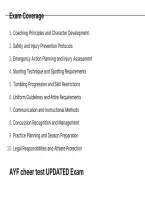
Exam Coverage
1. Coaching Principles and Character Development
2. Safety and Injury Prevention Protocols
3. Emergency Action Planning and Injury Assessment
4. Stunting Technique and Spotting Requirements
5. Tumbling Progression and Skill Restrictions
6. Uniform Guidelines and Attire Requirements
7. Communication and Instructional Methods
8. Concussion Recognition and Management
9. Practice Planning and Season Preparation
10. Legal Responsibilities and Athlete Protection
AYF cheer test UPDATED Exam
,1. During a competition routine, the squad transitions from a pyramid into a
basket toss. The flyer executes a perfect toe touch before being caught. What
term describes the gymnastic-based skills performed on the performing
surface?
A) Stunting
B) Tumbling
C) Chanting
D) Choreography
Answer: B
Rationale: Tumbling refers to gymnastics-based skills such as flips, rolls, and
handsprings performed directly on the performing surface, which distinguishes it
from stunting that involves the elevation of athletes by other squad members.
,2. Coach Martinez is teaching her squad a new stunt where the flyer stands on
one foot with the other leg extended behind her at hip level. What is this
specific stunt called?
A) Extension
B) Cupie
C) Lib
D) Elevator
Answer: C
Rationale: A lib is a stunt in which the flyer stands on one foot while the other leg
is extended behind her, requiring significant balance and core strength from both
the flyer and the bases supporting her.
3. During a game, a squad member complains of sharp pain in her ankle after
landing awkwardly from a jump. What should be the coach's first action
, according to emergency protocol?
A) Apply ice immediately to the affected area
B) Call the parent to inform them of the injury
C) Assess the injury and level of consciousness
D) Continue the routine and evaluate after the game
Answer: C
Rationale: The first step in any emergency plan is to assess the squad member's
injury and level of consciousness to determine the severity of the situation and
the appropriate next steps for care.
4. Which of the following demonstrates a coach with good character who
positively influences squad members through their actions?
A) The coach uses the "do as I say, not as I do" philosophy
B) The coach is a perfect example of health and leadership
1. Coaching Principles and Character Development
2. Safety and Injury Prevention Protocols
3. Emergency Action Planning and Injury Assessment
4. Stunting Technique and Spotting Requirements
5. Tumbling Progression and Skill Restrictions
6. Uniform Guidelines and Attire Requirements
7. Communication and Instructional Methods
8. Concussion Recognition and Management
9. Practice Planning and Season Preparation
10. Legal Responsibilities and Athlete Protection
AYF cheer test UPDATED Exam
,1. During a competition routine, the squad transitions from a pyramid into a
basket toss. The flyer executes a perfect toe touch before being caught. What
term describes the gymnastic-based skills performed on the performing
surface?
A) Stunting
B) Tumbling
C) Chanting
D) Choreography
Answer: B
Rationale: Tumbling refers to gymnastics-based skills such as flips, rolls, and
handsprings performed directly on the performing surface, which distinguishes it
from stunting that involves the elevation of athletes by other squad members.
,2. Coach Martinez is teaching her squad a new stunt where the flyer stands on
one foot with the other leg extended behind her at hip level. What is this
specific stunt called?
A) Extension
B) Cupie
C) Lib
D) Elevator
Answer: C
Rationale: A lib is a stunt in which the flyer stands on one foot while the other leg
is extended behind her, requiring significant balance and core strength from both
the flyer and the bases supporting her.
3. During a game, a squad member complains of sharp pain in her ankle after
landing awkwardly from a jump. What should be the coach's first action
, according to emergency protocol?
A) Apply ice immediately to the affected area
B) Call the parent to inform them of the injury
C) Assess the injury and level of consciousness
D) Continue the routine and evaluate after the game
Answer: C
Rationale: The first step in any emergency plan is to assess the squad member's
injury and level of consciousness to determine the severity of the situation and
the appropriate next steps for care.
4. Which of the following demonstrates a coach with good character who
positively influences squad members through their actions?
A) The coach uses the "do as I say, not as I do" philosophy
B) The coach is a perfect example of health and leadership


