
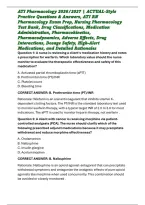
ATI Pharmacology 2026/2027 | ACTUAL-Style
Practice Questions & Answers, ATI RN
Pharmacology Exam Prep, Nursing Pharmacology
Test Bank, Drug Classifications, Medication
Administration, Pharmacokinetics,
Pharmacodynamics, Adverse Effects, Drug
Interactions, Dosage Safety, High-Alert
Medications, and Detailed Rationales
Question 1: A nurse is reviewing a client's medication history and notes
a prescription for warfarin. Which laboratory value should the nurse
monitor to evaluate the therapeutic effectiveness and safety of this
medication?
A. Activated partial thromboplastin time (aPTT)
B. Prothrombin time (PT)/INR
C. Platelet count
D. Bleeding time
CORRECT ANSWER: B. Prothrombin time (PT)/INR
Rationale: Warfarin is an oral anticoagulant that inhibits vitamin K-
dependent clotting factors. The PT/INR is the standard laboratory test used
to monitor warfarin therapy, with a typical target INR of 2.0 to 3.0 for most
indications. The aPTT is used to monitor heparin therapy, not warfarin .
Question 2: A client with cancer is receiving morphine via patient-
controlled analgesia (PCA). The nurse should clarify which of the
following prescribed adjunct medications because it may precipitate
withdrawal and reduce morphine effectiveness?
A. Ondansetron
B. Nalbuphine
C. Insulin glargine
D. Acetaminophen
CORRECT ANSWER: B. Nalbuphine
Rationale: Nalbuphine is an opioid agonist-antagonist that can precipitate
withdrawal symptoms and antagonize the analgesic effects of pure opioid
agonists like morphine when used concurrently. This combination should
be avoided or closely monitored .
,Question 3: A nurse is preparing to administer medications to a client
with renal failure. Which pharmacokinetic process should the nurse
expect to be most significantly affected?
A. Absorption
B. Distribution
C. Metabolism
D. Excretion
CORRECT ANSWER: D. Excretion
Rationale: The kidneys are the primary organs responsible for drug
excretion. Impaired renal function leads to decreased drug clearance and
increased risk for toxicity. Dosage adjustments are often required for
renally eliminated medications .
Question 4: A nurse is reviewing a medication order for a drug with a
narrow therapeutic index. The nurse understands this means:
A. The drug is very safe and can be given in a wide range of doses
B. There is a small margin between the effective dose and the toxic dose,
requiring close monitoring
C. The drug has no adverse effects
D. The drug can be administered without laboratory monitoring
CORRECT ANSWER: B. There is a small margin between the effective
dose and the toxic dose, requiring close monitoring
Rationale: A narrow therapeutic index means there is a small margin
between the therapeutic dose and the toxic dose. Medications such as
digoxin, warfarin, and phenytoin require close monitoring of serum drug
levels to ensure safety and efficacy .
Question 5: A client is taking a highly protein-bound medication such
as warfarin. The nurse understands that administering another highly
protein-bound medication can result in:
A. Increased therapeutic effect of the first medication
B. Displacement of the first medication, increasing its risk of toxicity
C. Enhanced metabolism of the first medication by the liver
D. Increased excretion of the first medication by the kidneys
,CORRECT ANSWER: B. Displacement of the first medication, increasing
its risk of toxicity
Rationale: When two highly protein-bound drugs are administered
concurrently, they compete for binding sites on plasma proteins. The drug
with higher affinity can displace the other, leading to a sudden increase in
the free (active) concentration of the displaced drug, raising toxicity risk .
Question 6: A nurse is preparing to administer enalapril to a client. The
nurse should instruct the client to monitor for which adverse effect of
this medication?
A. Hypokalemia
B. Blurred vision
C. Tremors
D. Dry cough
CORRECT ANSWER: D. Dry cough
Rationale: A persistent dry, nonproductive cough is a common adverse
effect of ACE inhibitors like enalapril. It results from the accumulation of
bradykinin. The client should notify the provider if this occurs .
Question 7: A nurse is reinforcing teaching with a client about the
adverse effects of simvastatin. For which of the following should the
nurse instruct the client to notify the provider immediately?
A. Muscle pain
B. Fine hand tremors
C. Urinary retention
D. Double vision
CORRECT ANSWER: A. Muscle pain
Rationale: Muscle pain, tenderness, or weakness can indicate
rhabdomyolysis, a serious adverse effect of statins like simvastatin. Clients
should notify the provider immediately if these symptoms develop .
Question 8: A nurse is caring for a client taking pioglitazone for type 2
diabetes. The client asks how the medication works. Which response
by the nurse is appropriate?
A. "This medication will trigger your body to make more insulin."
B. "Your body will decrease the amount of glucose that it makes."
, C. "Your body should become more sensitive to insulin."
D. "This medication will delay the absorption of sugar from your
gastrointestinal tract."
CORRECT ANSWER: C. "Your body should become more sensitive to
insulin."
Rationale: Pioglitazone is a thiazolidinedione that works by increasing
insulin sensitivity in target tissues. It does not stimulate insulin production
or delay glucose absorption .
Question 9: A nurse is reinforcing teaching about metoprolol with a
newly licensed nurse. Which condition should the nurse include as a
contraindication for this medication?
A. Peripheral vascular disease
B. Diabetes mellitus
C. Bradycardia
D. Chronic kidney disease
CORRECT ANSWER: C. Bradycardia
Rationale: Metoprolol is a beta-blocker that slows conduction through the
AV node. It is contraindicated in clients with bradycardia (heart rate
consistently less than 60/min) .
Question 10: A client with terminal cancer reports pain as 5 on a scale
of 0 to 10. The client has a prescription for morphine 15 mg orally every
4 hours. The client's family expresses concern that the client is
receiving too much medication. Which response by the nurse is
appropriate?
A. "Clients who receive this medication orally have a lower risk for
addiction."
B. "Additional doses will not be needed because this medication is given on
a fixed schedule."
C. "The dose should remain constant to prevent breakthrough pain."
D. "Fixed dosing around the clock offers the best pain control for severe
and persistent pain."
CORRECT ANSWER: D. "Fixed dosing around the clock offers the best
pain control for severe and persistent pain."


