
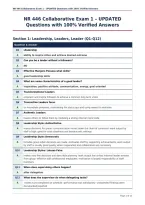
NR 446 Collaborative Exam 1 – UPDATED Questions with 100% Verified Answers
NR 446 Collaborative Exam 1 – UPDATED
Questions with 100% Verified Answers
Section 1: Leadership, Leaders, Leader (Q1–Q12)
Question & Answer
Q1 LEadership
A ability to inspire othes and achieve desired outcome
Q2 Can you be a leader without a followers?
A NO
Q3 Effective Mangers Possess what skills?
A good leadership skills
Q4 What are some characteristics of a good leader?
A inspiration, positive attitude, communication, energy, goal oriented
Q5 Transformational Leaders
A empower and inspire followers to achieve a common long term vision
Q6 Transaction Leaders focus
A on immediate problems, maintaining the status quo and using reward to motivate
Q7 Authentic Leaders
A inspire others to follow them by modeling a strong internal moral code
Q8 Leadership Style: Authoritative
A makes decisions for group -communication moves down the chain of command -work output by
staff is high: good for crisis situations and bureaucratic settings
Q9 Leadership Style: Democratic
A includes group when decisions are made -motivates staff by supporting achievements -work output
by staff is usually good quality when cooperation and collaboration are necessary
Q10 Leadership Styles: Laissez-Faire
A makes very few decisions and does little planning -work output low unless informal leader evolves
from group -effective with professional employees -motivation is largely responsibility of staff
members
Q11 When does supervising others happen?
A after delegation
Q12 What does the supervisor do when delegating tasks?
A -makes sure completed on schedule -performance was satisfactory -unexpected findings were
documented/reported
Page 1 of 13
, NR 446 Collaborative Exam 1 – UPDATED Questions with 100% Verified Answers
Section 2: Leave, Leaving, Client (Q13–Q24)
Question & Answer
Q13 Emotional Intelligence
A ability of individual to perceive and manage the emotions of self and others -important
characteristic of successful nurse leader -can be done with self regulation, active listening and
reflection
Q14 What qualities does the emotionally intelligent leader possess?
A insight of emotions of team, understand perspective of others, encourages criticism, new ideas,
committed to delivery of high quality care flow
Q15 Documentation includes what?
A flow sheets, graphic records trending assessment, nurses notes that describe changes in client
status, client care summaries
Q16 Chain of Command
A nurses should use formal chain of command to verbalize concerns r/t asisgnment in light of legal
scope of practice, job description and area of competence
Q17 Good Sam Act
A vary from state to state, provider emergency assistance outside employment location. Care must
be reasonable and prudent
Q18 The goal of ANA Code of Ethics:
A outlines important general values, duties and responsibilities that flow from specific role of being a
nurse, functions as highest ethical practice standards for nurses and an aid for moral thinking
Q19 Leaving AMA
A client who leaves facility without a prescription for discharge from the provider is considered
leaving against medical advice
Q20 Who has the right to leave AMA at any time?
A client who is legally competent
Q21 What should the individual sign when wanting to leave AMA?
A relinquishing form assuming responsibility for any complications that rise from discontinuing care
Q22 What charges can the nurse face when preventing a client from leaving AMA?
A battery, assault and false imprisonment
Q23 What is the nurses role when a client wants to leave AMA
A provide written summary: type of discharge, data and time, how client transported, discharge
destination, summary of clients condition at discharge, any unresolved problems and follow up
plans, disposition of values, medications brought form home, copy of client discharge instructions
Q24 Advocacy
A refers to nurse's role in supporting client by ensuring that they are properly informed that their
rights are respected and that they are receiving the proper level of care
Page 2 of 13


