GALEN COLLEGE OF NURSING | NUR 210 PRINCIPLES OF PHARMACOLOGY | EXAMS 1–4
Galen College of Nursing
NUR 210 – Principles of Pharmacology
Exams 1–4 Practice Bank
1240 Original Questions with Detailed Rationales | Mixed A/B/C/D Keys
DISCLAIMER – ORIGINAL educational practice resource for Galen College of Nursing NUR 210 (Principles of Pharmacology) themes. NOT an official
Galen exam, NOT proprietary test content, and NOT a substitute for McCuistion course materials or faculty guidance. Verify drug facts with current
references.
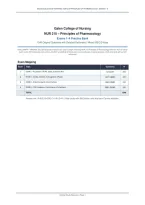
Exam Mapping
Exam Topic Questions N
1 EXAM 1 – Foundations: PK/PD, Safety, Autonomic Princ Q1-Q310 310
2 EXAM 2 – Cardiac, Diuretics, Anticoagulants & Respir Q311-Q620 310
3 EXAM 3 – Endocrine Agents & Anti-Infectives Q621-Q930 310
4 EXAM 4 – CNS, Analgesics, Psychotropics & Comprehens Q931-Q1240 310
TOTAL 1240
Answer mix: A=825, B=208, C=146, D=61 | Align study with McCuistion units and your Canvas modules.
Original Study Resource | Page 1
, GALEN COLLEGE OF NURSING | NUR 210 PRINCIPLES OF PHARMACOLOGY | EXAMS 1–4
EXAM 1 – Foundations: PK/PD, Safety, Autonomic Principles
Q1: Pharmacokinetics includes which set of processes?
A. Absorption, distribution, metabolism, and excretion [CORRECT]
B. Only receptor activation
C. Only therapeutic labeling
D. Only tablet color selection
Correct Answer: A
Rationale: ADME defines pharmacokinetics.
Q2: The primary organ of drug metabolism for many medications is the:
A. Spleen exclusively
B. Liver [CORRECT]
C. Lens of the eye
D. Hair follicle
Correct Answer: B
Rationale: Hepatic metabolism is common.
Q3: Drug excretion most frequently involves the:
A. Kidneys [CORRECT]
B. Teeth only
C. Nails only
D. Cartilage exclusively
Correct Answer: A
Rationale: Renal excretion is a major route.
Original Study Resource | Page 2
, GALEN COLLEGE OF NURSING | NUR 210 PRINCIPLES OF PHARMACOLOGY | EXAMS 1–4
Q4: Half-life is the time needed to:
A. Double the prescribed dose
B. Eliminate all adverse effects
C. Reduce plasma concentration by approximately one-half [CORRECT]
D. Guarantee zero drug remains after 10 minutes
Correct Answer: C
Rationale: t1/2 definition.
Q5: A narrow therapeutic index means:
A. Wide safety margin with no monitoring needs
B. Toxic and effective levels are relatively close—monitor carefully [CORRECT]
C. The drug cannot cause harm
D. Only OTC status is allowed
Correct Answer: B
Rationale: Less room for error.
Q6: An agonist:
A. Only blocks a receptor without activation
B. Never produces a tissue response
C. Only increases urine output in every case
D. Binds a receptor and activates it [CORRECT]
Correct Answer: D
Rationale: Affinity plus efficacy.
Q7: A competitive antagonist:
A. Can often be overcome by increasing agonist concentration [CORRECT]
B. Always destroys the receptor permanently
C. Has no effect on dose-response curves
D. Works only on vitamins
Correct Answer: A
Rationale: Surmountable antagonism.
Original Study Resource | Page 3
, GALEN COLLEGE OF NURSING | NUR 210 PRINCIPLES OF PHARMACOLOGY | EXAMS 1–4
Q8: First-pass effect is most relevant to:
A. IV drugs that bypass the gut
B. Oral drugs metabolized before full systemic circulation [CORRECT]
C. Topical creams with no absorption
D. Inhaled gases only
Correct Answer: B
Rationale: Hepatic extraction after oral dosing.
Q9: Before administering a medication, the nurse should:
A. Skip identification if the face looks familiar
B. Verify patient identity, allergies, and pertinent assessments [CORRECT]
C. Crush all extended-release tablets without checking
D. Borrow doses from another patient
Correct Answer: B
Rationale: Safety verification.
Q10: The rights of medication administration are intended to:
A. Replace critical thinking entirely
B. Speed charting only
C. Reduce medication errors and protect patients [CORRECT]
D. Eliminate assessment needs
Correct Answer: C
Rationale: Error-reduction framework.
Original Study Resource | Page 4