NUR 210 – PRINCIPLES OF PHARMACOLOGY | EXAMS 1–4 PRACTICE BANK
NUR 210 – Principles of Pharmacology
Exams 1–4 Practice Bank
1100 Original Questions with Detailed Rationales
Mixed A/B/C/D Keys • Foundations • Cardiac/Resp • Endocrine/ID • CNS & Safety
DISCLAIMER – ORIGINAL educational resource structured as Exams 1–4 for common NUR 210 pharmacology themes (e.g., Galen-style Principles
of Pharmacology). NOT an official school exam and NOT proprietary test content. Course content varies by school—follow your syllabus. Verify drug
facts with current references.
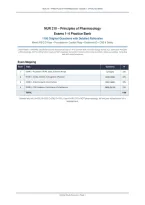
Exam Mapping
Exam Topic Questions N
1 EXAM 1 – Foundations: PK/PD, Safety, Autonomic Principl Q1-Q275 275
2 EXAM 2 – Cardiac, Diuretics, Anticoagulants & Respirato Q276-Q550 275
3 EXAM 3 – Endocrine Agents & Anti-Infectives Q551-Q825 275
4 EXAM 4 – CNS, Analgesics, Psychotropics & Comprehensive Q826-Q1100 275
TOTAL 1100
Answer key mix: A=332, B=329, C=256, D=183 | If your NUR 210 is NOT pharmacology, tell me your school focus for a
tailored bank.
Original Study Resource | Page 1
, NUR 210 – PRINCIPLES OF PHARMACOLOGY | EXAMS 1–4 PRACTICE BANK
EXAM 1 – Foundations: PK/PD, Safety, Autonomic Principles
Q1: The pharmacokinetic process that moves a drug from the administration site into the
blood is:
A. Absorption [CORRECT]
B. Only receptor binding
C. Only tissue toxicity
D. Only excretion into bile
Correct Answer: A
Rationale: Absorption is the entry step into systemic circulation.
Q2: Distribution of a drug is influenced by:
A. Nothing except tablet color
B. Blood flow, protein binding, and membrane permeability [CORRECT]
C. Only the bottle label
D. Only the time of day with no physiologic factors
Correct Answer: B
Rationale: Classic distribution factors.
Q3: Most drug metabolism occurs primarily in the:
A. Skeletal muscle exclusively
B. Skin only
C. Liver [CORRECT]
D. Hair follicles
Correct Answer: C
Rationale: Hepatic metabolism is primary for many drugs.
Original Study Resource | Page 2
, NUR 210 – PRINCIPLES OF PHARMACOLOGY | EXAMS 1–4 PRACTICE BANK
Q4: Drug excretion most often involves the:
A. Lens of the eye only
B. Teeth
C. Pancreas exclusively for all drugs
D. Kidneys [CORRECT]
Correct Answer: D
Rationale: Renal excretion is a major route.
Q5: A drug’s half-life is the time required to:
A. Reduce plasma concentration by about 50% [CORRECT]
B. Double the dose automatically
C. Eliminate all side effects
D. Guarantee zero residual drug after one hour always
Correct Answer: A
Rationale: t½ definition.
Q6: The therapeutic index compares:
A. Only brand and generic prices
B. Measures of toxicity with measures of effectiveness [CORRECT]
C. Only tablet size to capsule size
D. Only IV to oral color
Correct Answer: B
Rationale: Safety margin concept.
Q7: An agonist:
A. Only blocks receptors without activation
B. Only increases urine output always
C. Binds and activates a receptor [CORRECT]
D. Never produces a clinical effect
Correct Answer: C
Rationale: Affinity with efficacy.
Original Study Resource | Page 3
, NUR 210 – PRINCIPLES OF PHARMACOLOGY | EXAMS 1–4 PRACTICE BANK
Q8: A competitive antagonist:
A. Can often be overcome by increasing agonist concentration [CORRECT]
B. Always destroys the receptor permanently
C. Has no effect on dose-response curves
D. Only works on vitamins
Correct Answer: A
Rationale: Surmountable blockade.
Q9: The “rights” of medication administration exist to:
A. Speed charting only
B. Replace all critical thinking
C. Eliminate the need for assessment
D. Reduce medication errors and protect patients [CORRECT]
Correct Answer: D
Rationale: Safety framework.
Q10: Before giving a medication, the nurse should always:
A. Skip identification if the patient looks familiar
B. Verify patient identity and relevant assessments/allergies [CORRECT]
C. Crush all long-acting tablets without checking
D. Borrow another patient’s dose
Correct Answer: B
Rationale: Identity + assessment.
Original Study Resource | Page 4