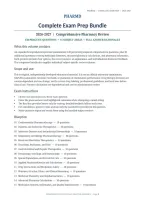
PHARMD | COMPLETE EXAM PREP | 2026–2027
PHARMD
Complete Exam Prep Bundle
2026–2027 | Comprehensive Pharmacy Review
150 PRACTICE QUESTIONS • 15 SUBJECT AREAS • FULL ANSWER RATIONALES
What this volume contains
An expanded comprehensive practice examination: 120 previously prepared comprehensive questions, plus 30
additional questions covering medicinal chemistry, advanced pharmacy calculations, and pharmacy informatics.
Each question includes four options, the correct answer, an explanation, and individualized distractor feedback.
The companion bundle also supplies individual subject-specific review volumes.
Scope and use
This is original, independently developed educational material. It is not an official university examination,
NAPLEX examination, licensure test bank, or guarantee of examination performance. Drug therapy decisions are
context-dependent and can change; verify current drug labeling, professional guidelines, and local laws before
clinical use. Practice calculations are hypothetical and are not administration orders.
Exam instructions
Choose one best answer (A–D) for each question.
Cover the green answers and highlighted rationales while attempting a timed sitting.
The final key provides letters only for scoring; detailed feedback follows each item.
For calculations, preserve units and use only the parameters provided in the question.
Mark uncertain topics and revisit them using the bundled subject reviews.
Blueprint
01 Cardiovascular Pharmacotherapy — 10 questions
02 Diabetes and Endocrine Therapeutics — 10 questions
03 Infectious Diseases and Antimicrobial Stewardship — 10 questions
04 Respiratory and Allergy Pharmacotherapy — 10 questions
05 Renal and Electrolyte Therapeutics — 10 questions
06 Neurology, Psychiatry, and Pain — 10 questions
07 Gastrointestinal and Hepatic Therapeutics — 10 questions
08 Hematology, Oncology, and Immunology — 10 questions
09 Special Populations and Preventive Care — 10 questions
10 Applied Pharmacokinetics and Calculations — 10 questions
11 Drug Interactions and Medication Safety — 10 questions
12 Pharmacy Practice, Ethics, and Clinical Reasoning — 10 questions
13 Medicinal Chemistry and Biopharmaceutics — 10 questions
14 Advanced Pharmacy Calculations — 10 questions
15 Medication Systems, Informatics, and Quality Improvement — 10 questions
INDEPENDENT EDUCATIONAL PRACTICE RESOURCE • Page 1
, PHARMD | COMPLETE EXAM PREP | 2026–2027
01 Cardiovascular Pharmacotherapy
1. A 67-year-old with symptomatic HFrEF (LVEF 30%) takes an ACE inhibitor and evidence-based beta
blocker; eGFR is 66 mL/min/1.73 m2 and potassium 4.3 mEq/L. Which addition has an established outcome
benefit?
A. Spironolactone
B. Diltiazem
C. Flecainide
D. Hydrochlorothiazide alone
Correct answer: A. Spironolactone
Detailed rationale: Mineralocorticoid receptor antagonism reduces death and heart-failure hospitalizations
in appropriately selected HFrEF patients; monitor potassium and renal function.
Why the other options are incorrect:
B. Its negative inotropic effect makes it unsuitable as routine disease-modifying HFrEF therapy.
C. This antiarrhythmic has no established HFrEF survival benefit and may be harmful with structural
heart disease.
D. A thiazide may help selected patients with blood pressure or volume but is not a substitute for disease-
modifying HFrEF therapy.
2. A patient taking lisinopril for hypertension develops persistent dry cough; there is no history of
angioedema. Which substitute usually avoids the same cough mechanism?
A. Enalapril
B. Captopril
C. Benazepril
D. Losartan
Correct answer: D. Losartan
Detailed rationale: An angiotensin receptor blocker avoids ACE-inhibitor-mediated bradykinin
accumulation while inhibiting angiotensin II signaling.
Why the other options are incorrect:
A. Another ACE inhibitor may reproduce the bradykinin-associated cough.
B. This ACE inhibitor has the same class-related cough mechanism.
C. Switching within the ACE-inhibitor class generally does not remove the mechanism causing cough.
3. A patient is prescribed apixaban for nonvalvular atrial fibrillation. Which counseling instruction is most
appropriate?
A. Schedule weekly INR-guided dosing
B. Take a vitamin K supplement to reverse bleeding
C. Report unusual bleeding and check before adding NSAIDs
D. Stop the drug whenever a minor bruise occurs
Correct answer: C. Report unusual bleeding and check before adding NSAIDs
Detailed rationale: Apixaban inhibits factor Xa and increases bleeding risk; concurrent NSAIDs can further
increase that risk.
Why the other options are incorrect:
A. Routine INR-based dose titration is used for warfarin, not apixaban.
B. Vitamin K does not reverse direct factor Xa inhibitor anticoagulation.
INDEPENDENT EDUCATIONAL PRACTICE RESOURCE • Page 2
, PHARMD | COMPLETE EXAM PREP | 2026–2027
D. Unilateral discontinuation can expose the patient to stroke risk; bleeding concerns require clinical
evaluation.
4. A patient treated with warfarin has an INR of 1.4 when the prescribed target is 2.0 to 3.0. What does this
value indicate?
A. The INR is within target
B. Anticoagulation is below the prescribed target
C. The patient has excessive anticoagulation
D. The INR is irrelevant to warfarin
Correct answer: B. Anticoagulation is below the prescribed target
Detailed rationale: An INR of 1.4 is subtherapeutic for a target range of 2.0 to 3.0 and may warrant
adherence and dosing assessment.
Why the other options are incorrect:
A. 1.4 is numerically below the specified lower boundary of 2.0.
C. Excessive warfarin effect would generally be reflected by an INR above the target range.
D. INR monitoring is the standard method for assessing warfarin anticoagulant intensity.
5. After a recent myocardial infarction, a patient is prescribed atorvastatin 80 mg daily. What is the
principal goal of this intensity?
A. Rapid relief of chest pain within minutes
B. Substantial LDL cholesterol reduction and fewer future cardiovascular events
C. Replacement for all antiplatelet therapy
D. Immediate dissolution of coronary thrombus
Correct answer: B. Substantial LDL cholesterol reduction and fewer future cardiovascular events
Detailed rationale: High-intensity statin therapy reduces atherogenic LDL cholesterol and supports
secondary prevention after acute coronary syndrome.
Why the other options are incorrect:
A. Statins do not function as acute antianginal rescue medications.
C. Lipid lowering and antiplatelet treatment address different secondary prevention needs.
D. Statins do not directly lyse an existing clot.
6. A 58-year-old has atrial fibrillation with rapid ventricular response and stable blood pressure. The
clinician requests a medication for ventricular rate control; LVEF is 60%. Which option is reasonable?
A. Metoprolol
B. Atropine
C. Dobutamine
D. Adenosine as chronic monotherapy
Correct answer: A. Metoprolol
Detailed rationale: A beta blocker slows AV nodal conduction and can control ventricular rate in stable
atrial fibrillation when not contraindicated.
Why the other options are incorrect:
B. Atropine increases sinus/AV nodal activity and is used for symptomatic bradycardia, not AF rate
slowing.
C. Beta-agonist inotropic stimulation can worsen tachycardia instead of controlling rate.
INDEPENDENT EDUCATIONAL PRACTICE RESOURCE • Page 3
, PHARMD | COMPLETE EXAM PREP | 2026–2027
D. Adenosine is a short-acting drug for selected supraventricular tachycardias, not sustained AF rate
control.
7. A patient with exertional angina is prescribed sublingual nitroglycerin. Which interaction creates a
major risk of severe hypotension?
A. Concurrent ezetimibe
B. Concurrent topical clotrimazole
C. Concurrent low-dose aspirin
D. Recent sildenafil use
Correct answer: D. Recent sildenafil use
Detailed rationale: Combining organic nitrates with phosphodiesterase-5 inhibitors can cause a dangerous
drop in blood pressure.
Why the other options are incorrect:
A. Ezetimibe has no typical severe nitrate-related vasodilatory interaction.
B. Topical antifungal therapy does not generally cause the same systemic vasodilation interaction.
C. Aspirin does not share the nitrate-PDE5 inhibitor hypotensive mechanism.
8. An adult with uncomplicated hypertension is started on amlodipine. Which adverse effect should be
anticipated and monitored?
A. Severe hypoglycemia as the expected effect
B. Tendon rupture
C. Peripheral ankle edema
D. Dry cough from bradykinin accumulation
Correct answer: C. Peripheral ankle edema
Detailed rationale: Dihydropyridine calcium channel blockade causes arteriolar dilation that can produce
dependent edema.
Why the other options are incorrect:
A. Amlodipine does not lower glucose by stimulating insulin release.
B. Tendon injury is not a characteristic dihydropyridine calcium channel blocker adverse effect.
D. Bradykinin-associated cough is characteristic of ACE inhibitors rather than amlodipine.
9. A patient on furosemide develops muscle cramps and a potassium concentration of 3.0 mEq/L. Which
mechanism best accounts for this?
A. Suppression of aldosterone synthesis as the primary action
B. Direct potassium retention in the collecting duct
C. Increased renal potassium loss from loop diuresis
D. Reduced renal sodium delivery
Correct answer: C. Increased renal potassium loss from loop diuresis
Detailed rationale: Loop diuretics inhibit NKCC2 in the thick ascending limb, promoting distal sodium
delivery and potassium excretion.
Why the other options are incorrect:
A. Loop diuretics do not function by suppressing aldosterone synthesis.
B. Potassium retention would tend to raise rather than lower potassium.
D. Loop diuresis generally increases distal sodium delivery, not decreases it.
INDEPENDENT EDUCATIONAL PRACTICE RESOURCE • Page 4