
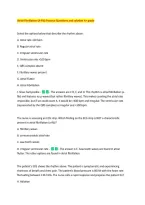
Atrial Fibrillation (A-Fib) Practice Questions and solution A+ grade
Select the options below that describe the rhythm above:
A. Atrial rate <60 bpm
B. Regular atrial rate
C. Irregular ventricular rate
D. Ventricular rate >100 bpm
E. QRS complex absent
F. Fibrillary waves present
G. Atrial Flutter
H. Atrial Fibrillation
I. Sinus Tachycardia - - The answers are C D, F, and H. This rhythm is atrial fibrillation (a-
fib) and features no p-waves (but rather fibrillary waves). This makes counting the atrial rate
impossible, but if we could count it, it would be >400 bpm and irregular. The ventricular rate
(represented by the QRS complex) is irregular and >100 bpm.
The nurse is assessing an ECG strip. Which finding on the ECG strip is NOT a characteristic
present in atrial fibrillation (a-fib)?
A. fibrillary waves
B. unmeasureable atrial rate
C. saw-tooth waves
D. irregular ventricular rate - - The answer is C. Saw-tooth waves are found in atrial
flutter. The other options are found in atrial fibrillation.
The patient's ECG shows the rhythm above. The patient is symptomatic and experiencing
shortness of breath and chest pain. The patient's blood pressure is 80/44 with the heart rate
fluctuating between 130-150s. The nurse calls a rapid response and prepares the patient for?
A. Ablation


