

Reproduction in flowering plants
Reproduction is the ability to produce a new generation of themselves.
Two types:
- Asexual: same species by one parent
- Sexual: same species by two parents
Similarities
- Both produce the same kind of organism in order to prevent their species from becoming extinct
- Both result in food production
Differences
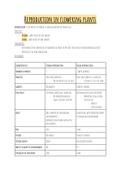
Characteristics Asexual Reproduction Sexual Reproduction
Number of parents 1 2 (with genders)
Processes One stage (mitosis) Two stages (Meiosis & mitosis)
- No fusion of cells so fast - Fusion of 2 cells so slow
Gametes No gametes Gametes formed
End result Offspring genetically identical Offspring genetically different
- No variation because - Variation as alleles are
alleles are not shuffled shuffled in:
- Meiosis
- fertilisation
Value Well adapted in unchanging Individuals with variation adapt
environment to changing environment
Reproduction possible with little
or no mates
Rate Fast Slow
Energy No energy Energy is needed
Outside agents None Pollinators needed
Ability to adapt to environment No Yes
Possibility of evolution Low Good
, Aseuxual Reproduction
Advantages
- All individuals can produce no energy for gametes or finding mate
- Simple and fast process only mitosis
- Useful in stable environment
- Favourable mutation spreads quickly
Disadvantages
- No genetic variation bad for changing environment
- Overcrowding therefore shortage of resources
Sexual Reproduction
Advantages
- Variation so:
- Evolution occurs
- Better chance of survival in unstable environment
- Prevents spread of diseases
Disadvantages
- High expenditure of energy
- Slower process formation of gametes
- Unfavourable mutations and recessive genes may be expressed
- Outside agent needed pollination
Process
- Diploid parent produces haploid gametes in gonads by meiosis
- Male and female gametes are brought together by pollination or mating
- Gametes nuclei fuse by fertilization
- New diploid zygote has 2 sets of chromosomes and grows by mitotic cell division into an individual
Gametes
- Female is quite large and not motile while male is small and motile in animals
- Animals: male - sperm; female - egg/ovum
- Plants: male is just a nucleus in a pollen grain; female is an ovum in embryo sac
Reproduction is the ability to produce a new generation of themselves.
Two types:
- Asexual: same species by one parent
- Sexual: same species by two parents
Similarities
- Both produce the same kind of organism in order to prevent their species from becoming extinct
- Both result in food production
Differences
Characteristics Asexual Reproduction Sexual Reproduction
Number of parents 1 2 (with genders)
Processes One stage (mitosis) Two stages (Meiosis & mitosis)
- No fusion of cells so fast - Fusion of 2 cells so slow
Gametes No gametes Gametes formed
End result Offspring genetically identical Offspring genetically different
- No variation because - Variation as alleles are
alleles are not shuffled shuffled in:
- Meiosis
- fertilisation
Value Well adapted in unchanging Individuals with variation adapt
environment to changing environment
Reproduction possible with little
or no mates
Rate Fast Slow
Energy No energy Energy is needed
Outside agents None Pollinators needed
Ability to adapt to environment No Yes
Possibility of evolution Low Good
, Aseuxual Reproduction
Advantages
- All individuals can produce no energy for gametes or finding mate
- Simple and fast process only mitosis
- Useful in stable environment
- Favourable mutation spreads quickly
Disadvantages
- No genetic variation bad for changing environment
- Overcrowding therefore shortage of resources
Sexual Reproduction
Advantages
- Variation so:
- Evolution occurs
- Better chance of survival in unstable environment
- Prevents spread of diseases
Disadvantages
- High expenditure of energy
- Slower process formation of gametes
- Unfavourable mutations and recessive genes may be expressed
- Outside agent needed pollination
Process
- Diploid parent produces haploid gametes in gonads by meiosis
- Male and female gametes are brought together by pollination or mating
- Gametes nuclei fuse by fertilization
- New diploid zygote has 2 sets of chromosomes and grows by mitotic cell division into an individual
Gametes
- Female is quite large and not motile while male is small and motile in animals
- Animals: male - sperm; female - egg/ovum
- Plants: male is just a nucleus in a pollen grain; female is an ovum in embryo sac




