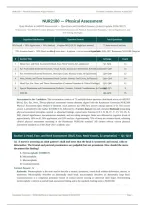
NUR2180 — Physical Assessment • Quiz Module 6 Test-Bank Complete Solutions • 2026/2027
NUR2180 — Physical Assessment
Quiz Module 6: HEENT Assessment — Questions and Verified Answers (Latest Update 2026/2027)
75 Questions • Six HEENT Content Domains • Detailed Rationales with Physical Assessment Principles, Clinical Significance, and
Test-Taking Strategies
Cognitive Distribution Question Format Total Questions
30% Recall • 50% Application • 20% Analysis 4-option MCQ (A–D, single best answer) 75 items across 6 sections
70% Scenario-based • 30% Direct recallEach item: stem + 4 options + correct answerAligned
+ rationale
with 2026–2027 Rasmussen NUR2180 blueprint
# Section Title Q Range Count
1 Head, Face, and Neck Assessment (Skull, Face, Neck Vessels, & Lymphatics) Q1–Q14 14
2 Eye Assessment (External Structures, Visual Acuity, Extraocular Movements, & Fundoscopic)Q15–Q28 14
3 Ear Assessment (External Structures, Otoscopic Exam, Hearing Acuity, & Equilibrium) Q29–Q40 12
4 Nose, Mouth, and Throat Assessment (Nasal Cavities, Sinuses, Oral Cavity, & Pharynx) Q41–Q54 14
5 Head, Eye, Ear, Nose, and Throat Abnormalities (Common Disorders & Clinical Findings) Q55–Q66 12
6 Special Populations and Documentation (Pediatric, Geriatric, Cultural Considerations, & Charting)
Q67–Q75 9
TOTAL Q1–Q75 75
Instructions to the Candidate: This examination consists of 75 multiple-choice questions distributed across six HEENT
(Head, Eye, Ear, Nose, Throat) physical assessment content domains aligned with the Rasmussen University NUR2180
Physical Assessment Quiz Module 6 blueprint. Each question has ONE best answer among options A–D. The correct
answer is identified by the marker [CORRECT], followed by a Correct Answer line and a detailed Rationale integrating
physical assessment principles, normal vs. abnormal findings, cranial nerve function (CN I, II, III, IV, V, VI, VII, IX, X,
XII), clinical significance, documentation standards, and test-taking strategies. Items are calibrated to cognitive levels of
approximately 30% recall, 50% application, and 20% analysis. Approximately 70% of items are scenario-based, reflecting
clinical physical assessment reasoning at the Rasmussen NUR2180 standard. All content reflects current physical
assessment standards as of the 2026–2027 academic year.
Section 1: Head, Face, and Neck Assessment (Skull, Face, Neck Vessels, & Lymphatics) — Q1–Q14
Q1. A nurse is assessing an adult patient's skull and notes that the head is symmetric and round, with no
deformities. The frontal and parietal prominences are palpable but not prominent. How should the nurse
document this finding?
A. Normocephalic [CORRECT]
B. Microcephalic
C. Macrocephalic
D. Craniosynostosis
Correct Answer: A
Rationale: Normocephalic is the term used to describe a normal, symmetric, round skull without deformities, masses, or
tenderness. Microcephaly describes an abnormally small head; macrocephaly describes an abnormally large head.
Craniosynostosis is a congenital premature fusion of cranial sutures causing an abnormal skull shape. Documenting
normocephalic confirms a normal head assessment finding and is the standard charting term in NUR2180.
Rasmussen University — NUR2180 Physical Assessment Quiz Module 6 (2026/2027) Page 1
,NUR2180 — Physical Assessment • Quiz Module 6 Test-Bank Complete Solutions • 2026/2027
Q2. During a facial assessment, the nurse observes that the patient's nasolabial folds are symmetric and
facial expressions are appropriate. Which cranial nerve is primarily responsible for facial movement and
expression?
A. Cranial nerve III (Oculomotor)
B. Cranial nerve V (Trigeminal)
C. Cranial nerve VII (Facial) [CORRECT]
D. Cranial nerve XII (Hypoglossal)
Correct Answer: C
Rationale: Cranial nerve VII (Facial nerve) controls facial expression, including the muscles of the face, nasolabial folds,
and the ability to smile, frown, puff the cheeks, and show teeth. Asymmetry of the nasolabial folds or facial droop
suggests CN VII palsy (e.g., Bell's palsy or stroke). CN III controls extraocular movements; CN V provides facial
sensation and mastication; CN XII controls tongue movement. NUR2180 students must correctly attribute cranial nerve
function during assessment.
Q3. A 56-year-old patient presents with sudden onset of right-sided facial drooping, including drooping of
the mouth and inability to close the right eye completely. The forehead is also affected on the right side.
Which condition is most consistent with these findings?
A. Bell's palsy (CN VII peripheral lesion) [CORRECT]
B. Stroke (upper motor neuron lesion)
C. Trigeminal neuralgia
D. Horner's syndrome
Correct Answer: A
Rationale: Bell's palsy is a peripheral CN VII lesion that affects the entire ipsilateral side of the face, including the
forehead (forehead is spared in stroke because of bilateral upper motor neuron innervation to the upper face). Bell's palsy
presents with facial droop, inability to close the eye, drooling, and loss of taste on the anterior two-thirds of the tongue.
Stroke (upper motor neuron lesion) spares the forehead. Trigeminal neuralgia is characterized by facial pain. Horner's
syndrome presents with ptosis, miosis, and anhidrosis.
Q4. When palpating the temporal artery in an older adult patient, the nurse notes the artery feels thickened,
tender, and pulseless. What is the priority nursing action?
A. Document as a normal age-related change
B. Notify the healthcare provider immediately; suspect temporal arteritis [CORRECT]
C. Apply warm compresses and reassess in 1 hour
D. Administer acetaminophen for headache
Correct Answer: B
Rationale: Temporal arteritis (giant cell arteritis) is an inflammatory condition of the temporal artery seen most
commonly in adults over 50. Findings include a thickened, tender, pulseless temporal artery, headache, jaw claudication,
and visual changes. This is a medical emergency because it can lead to irreversible blindness from optic nerve ischemia.
The healthcare provider must be notified immediately for ESR (elevated in temporal arteritis) and temporal artery biopsy.
Corticosteroid therapy is initiated promptly.
Rasmussen University — NUR2180 Physical Assessment Quiz Module 6 (2026/2027) Page 2
, NUR2180 — Physical Assessment • Quiz Module 6 Test-Bank Complete Solutions • 2026/2027
Q5. When assessing the trachea, the nurse palpates the trachea and notes it is positioned midline. The nurse
also assesses the cricoid cartilage and thyroid cartilage. Which statement best describes a normal tracheal
finding?
A. Trachea deviated 1 cm to the right
B. Trachea positioned midline with the sternocleidomastoid muscles symmetric [CORRECT]
C. Trachea palpable 2 cm above the suprasternal notch
D. Trachea moves laterally with each heartbeat
Correct Answer: B
Rationale: The trachea should be positioned midline, with equal space between it and the sternocleidomastoid muscles on
each side. Tracheal deviation indicates a mediastinal shift — caused by tension pneumothorax (deviation away from
affected side), large pleural effusion, or tumor. The trachea is normally palpable just above the suprasternal notch. Lateral
tracheal movement with each heartbeat (Oliver-Cardarelli sign) is abnormal and suggests aortic arch aneurysm.
Q6. When assessing the thyroid gland using the posterior approach, the nurse places their hands on the
patient's neck with fingers curled around the sternocleidomastoid muscles. The patient's head is in which
position during the exam?
A. Hyperextended backward
B. Flexed forward and slightly to the side being examined [CORRECT]
C. Tilted backward and rotated away from the side being examined
D. Neutral position facing forward
Correct Answer: B
Rationale: When using the posterior approach to thyroid assessment, the nurse stands behind the seated patient, places
fingers around the sternocleidomastoid muscle, and asks the patient to flex the neck slightly forward and to the side being
examined. This position relaxes the sternocleidomastoid muscle and pushes the thyroid gland forward, making it easier to
palpate. The patient is then asked to swallow sips of water while the nurse palpates for the thyroid gland rising.
Q7. A nurse palpates the thyroid gland and notes it is not palpable. The patient reports no symptoms of
hyperthyroidism or hypothyroidism. How should the nurse interpret this finding?
A. Abnormal; the thyroid should always be palpable
B. Normal; the thyroid is often not palpable in healthy adults [CORRECT]
C. Abnormal; suggests thyroid atrophy
D. Requires immediate referral for ultrasound
Correct Answer: B
Rationale: In most healthy adults, the thyroid gland is not palpable or is only minimally palpable as a smooth, firm,
symmetric structure. A non-palpable thyroid with no symptoms is a normal finding. The thyroid becomes palpable when
enlarged (goiter), nodular, or tender. The nurse should still assess for signs of hyperthyroidism (exophthalmos,
tachycardia, weight loss) or hypothyroidism (bradycardia, weight gain, dry skin) through history and other physical
assessment findings.
Rasmussen University — NUR2180 Physical Assessment Quiz Module 6 (2026/2027) Page 3