
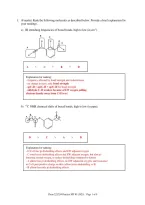
1. (8 marks) Rank the following molecules as described below. Provide a brief explanation for
your rankings.
a) IR stretching frequencies of boxed bonds, high to low (in cm-1).
A > C > B > D
Explanation for ranking:
- frequency affected by bond strength and reduced mass
- no change in mass, only bond strength
- spC-H > sp2C-H > sp3C-H for bond strength
- aldehyde C-H weakest because of EW oxygen pulling
electron density away from C-H bond
13
b) C NMR chemical shifts of boxed bonds, high to low (in ppm).
D > C > A > B
Explanation for ranking:
- D C=O has pi deshielding effects and EW adjacent oxygen
- C ester has pi deshielding effects and EW adjacent oxygen, but also pi-
donating second oxygen, to reduce deshielding compared to ketone
- A alkene has pi deshielding effects, no EW adjancent oxygen, and resonance
to C=O puts positive charge on this carbon (extra deshielding vs B)
- B alkene has only pi deshielding effects
Chem 222/234 Practice MT #3 (2023) Page 1 of 9
, 2. (15 marks) Describe the applicable distinguishing feature in each of the following pairs of
molecules.
1
a) H NMR aromatic signal splitting
Distinguishing feature:
- 2 doublets in A1
- 1 singlet, 2 doublets and 1 triplet in A2
(could discuss 4J patterns but not needed – A1
would have 2 dd and A2 would have t, dd, t)
1
b) H NMR total number of signals
Distinguishing feature:
- B1 has 5 signals
- B2 has 4 signals
c) MS molecule ion region pattern
Distinguishing feature:
- C1 has Br, so has 1:1 M:M+2 signals
- C2 has Cl, so has 3:1 M:M+2 signals
13
d) C NMR aliphatic chemical shift
Distinguishing feature:
- each have 3 signals in the aliphatic region (sp3C)
- D1 has two that are higher chemical shift, because
adjacent to oxygen
- in D2, they are adjacent to C=O which is less
deshielding (further from oxygen)
e) IR OH stretching frequencies
Distinguishing feature:
- E1 has carboxylic acid v. broad OH
- E2 has only OH, less broad than COOH
Chem 222/234 Practice MT #3 (2023) Page 2 of 9
your rankings.
a) IR stretching frequencies of boxed bonds, high to low (in cm-1).
A > C > B > D
Explanation for ranking:
- frequency affected by bond strength and reduced mass
- no change in mass, only bond strength
- spC-H > sp2C-H > sp3C-H for bond strength
- aldehyde C-H weakest because of EW oxygen pulling
electron density away from C-H bond
13
b) C NMR chemical shifts of boxed bonds, high to low (in ppm).
D > C > A > B
Explanation for ranking:
- D C=O has pi deshielding effects and EW adjacent oxygen
- C ester has pi deshielding effects and EW adjacent oxygen, but also pi-
donating second oxygen, to reduce deshielding compared to ketone
- A alkene has pi deshielding effects, no EW adjancent oxygen, and resonance
to C=O puts positive charge on this carbon (extra deshielding vs B)
- B alkene has only pi deshielding effects
Chem 222/234 Practice MT #3 (2023) Page 1 of 9
, 2. (15 marks) Describe the applicable distinguishing feature in each of the following pairs of
molecules.
1
a) H NMR aromatic signal splitting
Distinguishing feature:
- 2 doublets in A1
- 1 singlet, 2 doublets and 1 triplet in A2
(could discuss 4J patterns but not needed – A1
would have 2 dd and A2 would have t, dd, t)
1
b) H NMR total number of signals
Distinguishing feature:
- B1 has 5 signals
- B2 has 4 signals
c) MS molecule ion region pattern
Distinguishing feature:
- C1 has Br, so has 1:1 M:M+2 signals
- C2 has Cl, so has 3:1 M:M+2 signals
13
d) C NMR aliphatic chemical shift
Distinguishing feature:
- each have 3 signals in the aliphatic region (sp3C)
- D1 has two that are higher chemical shift, because
adjacent to oxygen
- in D2, they are adjacent to C=O which is less
deshielding (further from oxygen)
e) IR OH stretching frequencies
Distinguishing feature:
- E1 has carboxylic acid v. broad OH
- E2 has only OH, less broad than COOH
Chem 222/234 Practice MT #3 (2023) Page 2 of 9


