
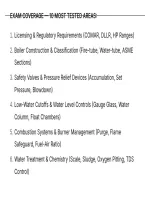
EXAM COVERAGE — 10 MOST TESTED AREAS:
1. Licensing & Regulatory Requirements (COMAR, DLLR, HP Ranges)
2. Boiler Construction & Classification (Fire-tube, Water-tube, ASME
Sections)
3. Safety Valves & Pressure Relief Devices (Accumulation, Set
Pressure, Blowdown)
4. Low-Water Cutoffs & Water Level Controls (Gauge Glass, Water
Column, Float Chambers)
5. Combustion Systems & Burner Management (Purge, Flame
Safeguard, Fuel-Air Ratio)
6. Water Treatment & Chemistry (Scale, Sludge, Oxygen Pitting, TDS
Control)
, 7. Steam Traps, Condensate Return & Hartford Loop (Drainage,
Water Hammer)
8. Draft Systems & Efficiency (Stack Temperature, Excess Air,
Economizers)
9. Pumps, Piping & Auxiliary Equipment (Feedwater, PRVs, Check
Valves)
10. Hydrostatic Testing, Inspection & Emergency Procedures (MAWP,
Test Pressure, Low-Water Response)
Maryland Stationary Engineer Grade 2 Exam
200 MCQs with Answers & Rationales — Only 15+ Word Length
Questions
,1. A Maryland Grade 2 Stationary Engineer license authorizes
operation and supervision of equipment within which specific
horsepower range according to state regulation?
A) Up to 99 horsepower only
B) 100 to 299 horsepower
C) 300 to 499 horsepower
D) 500 horsepower and above unlimited
Correct Answer: C
Rationale: Maryland regulation specifically authorizes the Grade 2
license holder to operate and supervise boilers and equipment in the
300 to 499 horsepower range, which is the defining scope of this
license grade.
2. What is the primary operational authority difference between a
Maryland Grade 2 and Grade 3 stationary engineer license
, regarding horsepower?
A) Grade 2 operates 100-299 HP while Grade 3 operates 300-499
HP
B) Grade 2 operates 300-499 HP while Grade 3 operates 100-299
HP
C) Grade 2 operates unlimited HP while Grade 3 operates 500+ HP
D) Grade 2 and Grade 3 have identical horsepower authority
Correct Answer: B
Rationale: The Grade 2 license covers the 300-499 horsepower
range, while the Grade 3 license is limited to equipment from 100 to
299 horsepower, making Grade 2 the higher supervisory grade.
3. According to Maryland experience requirements, how many
months of documented Grade 3 experience are required to qualify
for the Grade 2 examination?
1. Licensing & Regulatory Requirements (COMAR, DLLR, HP Ranges)
2. Boiler Construction & Classification (Fire-tube, Water-tube, ASME
Sections)
3. Safety Valves & Pressure Relief Devices (Accumulation, Set
Pressure, Blowdown)
4. Low-Water Cutoffs & Water Level Controls (Gauge Glass, Water
Column, Float Chambers)
5. Combustion Systems & Burner Management (Purge, Flame
Safeguard, Fuel-Air Ratio)
6. Water Treatment & Chemistry (Scale, Sludge, Oxygen Pitting, TDS
Control)
, 7. Steam Traps, Condensate Return & Hartford Loop (Drainage,
Water Hammer)
8. Draft Systems & Efficiency (Stack Temperature, Excess Air,
Economizers)
9. Pumps, Piping & Auxiliary Equipment (Feedwater, PRVs, Check
Valves)
10. Hydrostatic Testing, Inspection & Emergency Procedures (MAWP,
Test Pressure, Low-Water Response)
Maryland Stationary Engineer Grade 2 Exam
200 MCQs with Answers & Rationales — Only 15+ Word Length
Questions
,1. A Maryland Grade 2 Stationary Engineer license authorizes
operation and supervision of equipment within which specific
horsepower range according to state regulation?
A) Up to 99 horsepower only
B) 100 to 299 horsepower
C) 300 to 499 horsepower
D) 500 horsepower and above unlimited
Correct Answer: C
Rationale: Maryland regulation specifically authorizes the Grade 2
license holder to operate and supervise boilers and equipment in the
300 to 499 horsepower range, which is the defining scope of this
license grade.
2. What is the primary operational authority difference between a
Maryland Grade 2 and Grade 3 stationary engineer license
, regarding horsepower?
A) Grade 2 operates 100-299 HP while Grade 3 operates 300-499
HP
B) Grade 2 operates 300-499 HP while Grade 3 operates 100-299
HP
C) Grade 2 operates unlimited HP while Grade 3 operates 500+ HP
D) Grade 2 and Grade 3 have identical horsepower authority
Correct Answer: B
Rationale: The Grade 2 license covers the 300-499 horsepower
range, while the Grade 3 license is limited to equipment from 100 to
299 horsepower, making Grade 2 the higher supervisory grade.
3. According to Maryland experience requirements, how many
months of documented Grade 3 experience are required to qualify
for the Grade 2 examination?


