
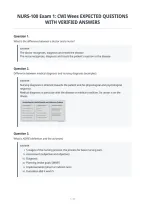
NURS-100 Exam 1: CWI Wees EXPECTED QUESTIONS
WITH VERIFIED ANSWERS
Question 1.
What is the difference between a doctor and a nurse?
ANSWER
The doctor recognizes, diagnosis and treats the disease
The nurse recognizes, diagnosis and treats the patient's reaction to the disease
Question 2.
Difference between medical diagnosis and nursing diagnosis (examples)
ANSWER
Nursing diagnosis is directed towards the patient and his physiological and psychological
response.
Medical diagnosis is particular with the disease or medical condition. Its center is on the
illness.
Question 3.
What is ADPIE (definition and the acronym)
ANSWER
i. 5 stages of the nursing process, the process for basic nursing care.
ii. Assessment (subjective and objective)
iii. Diagnosis
iv. Planning (make goals SMART)
v. Implementation (direct or indirect care)
vi. Evaluation (did it work?)
,Question 4.
What do you look for in a new patient (first glance assessment)
ANSWER
Level of alertness?
Food in front of them?
Facial expression/emotional state (pain obvious?)
Connected to IV, oxygen, suction, dressings, etc?
Question 5.
What elements make up the assessment part of the nursing process?
ANSWER
Data collection methods:
i. Observation
ii. Interview
iii. Examination
iv. Documenting history and physical during assessment
Question 6.
Examples of assessment data
ANSWER
Age, sex, race
Appearance
General status of patient
Anything that stands out (tubes, drains, IVs, dressings)
Mental status/emotional state (alert, oriented to time, person, place)
Vision
Hearing
Physical findings in any body system
(You can see much of it)
Consider cultural and economic status
,Question 7.
What are nursing diagnosis?
ANSWER
"Actual or potential health problems which nurses, by virtue of their education and experience,
are capable and licensed to treat"
Question 8.
Why do we use nursing diagnosis?
ANSWER
i. Unifies our language (North American Nursing Diagnosis Association (NANDA))
ii. Helps set nursing priorities/ interventions
iii. Helps identify how client responds, and identifies resources to prevent or resolve
problems.
iv. Provides a system to evaluate nursing care for effectiveness
v. Nursing diagnoses are an effective teaching tool to help sharpen their problem-solving
and critical thinking skills.
Question 9.
What are the four types of NANDA diagnosis?
ANSWER
i. Actual (Problem-Focused)
ii. Risk
iii. Health promotion
iv. Syndrome
Question 10.
What is a collaborative problem?
ANSWER
Potential problems that nurses manage using both independent and physican-prescribed
interventions. These are problems or conditions that require both medical and nursing
interventions with the nursing aspect focused on monitoring the client's condition and
preventing development of the potential complication.
, Question 11.
What is the format of a nursing diagnosis?
ANSWER
_______________r/t_____________AEB________________
Inconsistent attendance related to (r/t) crummy car as evidenced by (AEB) missing lectures
Question 12.
Actual diagnosis vs potential diagnosis
ANSWER
Actual diagnosis
Constipation r/t decreased fluid intake and decreased activity AEB No BM in 4 days
Potential diagnosis
Risk for Falls r/t RLE weakness
(Risk for dx: NEVER have an AEB)
Question 13.
A nursing diagnosis is NOT
ANSWER
1. Statement of equipment used in medical regimen (e.g. "Large blood pressure cuff needed
for...")
2. Statement of medical regimen (e.g. "Give antibiotic as ordered by doctor")
3. Statement of a diagnostic procedure
4. A statement of a nursing activity.
5. A statement that includes the care required by the patient/client
6. Astatement of an interpersonal problem the nurse has with the patient/client (e.g "Pt uses
call light too much")
7. A statement of a nursing need (e.g. "Give meds after break")
8. The same as a medical diagnosis ("Pneumonia related to respiratory congestion")
9. A statement that no problems exist that require nursing intervention.
10. A statement of a nursing problem ("Difficult to transfer to wheel chair...")
Question 14.
What elements make up the planning part
of the Nursing Process?
ANSWER
Planning is aimed at preventing, reducing, eliminating, the client's health problems.


