
California Private Patrol Operator
Examination with Practice Questions And
Correct Answer
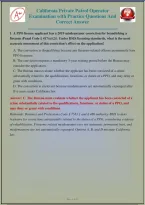
1. A PPO license applicant has a 2019 misdemeanor conviction for brandishing a
firearm (Penal Code § 417(a)(2)). Under BSIS licensing standards, what is the most
accurate assessment of this conviction's effect on the application?
A. The conviction is disqualifying because any firearms-related offense permanently bars
PPO licensure.
B. The conviction requires a mandatory 3-year waiting period before the Bureau may
consider the application.
C. The Bureau must evaluate whether the applicant has been convicted of a crime
substantially related to the qualifications, functions, or duties of a PPO, and may deny or
grant with conditions.
D. The conviction is irrelevant because misdemeanors are automatically expunged after
five years under California law.
Answer: C. The Bureau must evaluate whether the applicant has been convicted of a
crime substantially related to the qualifications, functions, or duties of a PPO, and
may deny or grant with conditions.
Rationale: Business and Professions Code § 7581.1 and § 480 authorize BSIS to deny
licensure for convictions substantially related to the duties of a PPO, considering evidence
of rehabilitation. Firearms-related misdemeanors are not automatic permanent bars, and
misdemeanors are not automatically expunged. Options A, B, and D misstate California
law.
Page 1 of 84
,2. A PPO directs an unarmed security officer to detain a shoplifting suspect. Which
statement correctly describes the officer's legal authority under California law?
A. The officer may detain the suspect indefinitely until police arrive, as citizen's arrest
authority has no time limit.
B. The officer may use reasonable force to detain the suspect, but only if the officer
witnessed the offense and the detention is for a reasonable time and manner.
C. The officer has no authority to detain anyone because only sworn peace officers may
effect arrests in California.
D. The officer may detain the suspect only if the PPO has a written contract with the
local police department.
Answer: B. The officer may use reasonable force to detain the suspect, but only if the
officer witnessed the offense and the detention is for a reasonable time and manner.
Rationale: Penal Code §§ 490.5 and 837 permit a private person who witnesses a
misdemeanor to arrest the offender, using reasonable force and detaining for a reasonable
time. Private security officers possess citizen's arrest authority; no contract with police is
required. Options A, C, and D misstate the law.
Page 2 of 84
,3. A PPO's client contract omits the required notice regarding the licensee's insurance
coverage. Under Business and Professions Code § 7583.9, what is the consequence?
A. The contract is void, and the PPO must return all fees paid by the client.
B. The PPO is subject to a civil penalty of up to $2,500 per violation and possible license
suspension.
C. The omission is a minor infraction with no penalty if corrected within 30 days.
D. The PPO must provide the notice only upon the client's written request.
Answer: B. The PPO is subject to a civil penalty of up to $2,500 per violation and
possible license suspension.
Rationale: B&P Code § 7583.9 requires specific contract disclosures, including insurance
information. Violations may result in civil penalties and license discipline under § 7587.
The contract is not automatically void, and the notice is mandatory, not request-based.
Options A, C, and D are incorrect.
4. A PPO employs a security guard who carries a firearm on duty. Which requirement
must the PPO verify before the guard may carry the weapon?
A. The guard must possess a valid BSIS Firearms Permit and have completed a 40-hour
firearms training course.
B. The guard must have a concealed carry weapon (CCW) permit issued by the county
sheriff.
C. The guard must be a former law enforcement officer with at least five years of service.
D. The guard must have written authorization from the client's property owner.
Answer: A. The guard must possess a valid BSIS Firearms Permit and have completed
a 40-hour firearms training course.
Rationale: B&P Code § 7583.22 and 16 CCR § 635 require security personnel carrying
firearms to hold a valid BSIS Firearms Permit, which mandates a 40-hour training course
and biennial requalification. A CCW permit, law enforcement experience, or client
authorization does not satisfy BSIS requirements. Options B, C, and D are incorrect.
Page 3 of 84
, 5. A PPO operates a patrol vehicle and uses a canine unit. Which additional BSIS
permit is required for the canine handler?
A. A Canine Handler Permit issued by the Bureau of Security and Investigative Services.
B. A K-9 Certification from the California Highway Patrol.
C. A Baton Permit and Firearms Permit, but no separate canine permit exists.
D. A Private Investigator license, since canine units are considered investigative.
Answer: C. A Baton Permit and Firearms Permit, but no separate canine permit
exists.
Rationale: California law does not require a separate BSIS canine handler permit.
However, if the handler uses a baton or firearm, the corresponding BSIS permits are
required under B&P Code § 7583.22 and § 7583.23. Options A, B, and D describe
nonexistent or inapplicable credentials.
6. A PPO's insurance policy lapses for 45 days. Under 16 CCR § 643, what must the
PPO do to maintain licensure?
A. Notify BSIS in writing within 30 days and provide proof of new coverage; failure
may result in license suspension.
B. Nothing, because insurance is only required at the time of initial licensure.
C. Immediately cease all operations permanently and surrender the license.
D. Pay a $500 reinstatement fee to the Bureau within 10 days.
Answer: A. Notify BSIS in writing within 30 days and provide proof of new coverage;
failure may result in license suspension.
Rationale: 16 CCR § 643 requires a PPO to maintain liability insurance and notify BSIS of
any lapse. A lapse may result in suspension or disciplinary action. Insurance is an ongoing
requirement, not a one-time prerequisite. Options B, C, and D misstate the regulation.
Page 4 of 84


