
Bio 235- Midterm 1
Study online at https://quizlet.com/_b15yv8
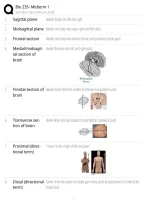
1. Sagittal plane divides body into left and right
2. Midsagittal plane divides the body into equal right and left sides
3. Frontal section divides the body into anterior (front) and posterior (back) parts
4. Medial/midsagit- divide the brain into left and right parts
tal section of
brain
5. Frontal section of divides brain from the middle to anterior and posterior part
brain
6. Transverse sec- divide brain into top (superior) and bottom (posterior) part
tion of brain
7. Proximal (direc- "nearer to the origin of the structure"
tional term)
8. Distal (directional farther from the origin of a body part or the point of attachment of a limb to the
term) body trunk
, Bio 235- Midterm 1
Study online at https://quizlet.com/_b15yv8
9. What are the 6 ba- metabolism, responsiveness, movement, growth, differentiation, reproduction
sic life processes?
10. Catabolism: Breaks down complex substances into simple ones. Digestive processes catab-
olize proteins in food into amino acids.
11. Anabolism: Small simple compounds build up into more complex one. The amino acids that
were broken down from food in catabolism is now used to build new proteins
for muscles and bones.
12. negative feed reverses a change in a controlled condition (ex: when blood pressure rises so the
back loop body decreases it and returns it back to normal)
13. What is the cor- stimulus - controlled condition - receptors - control center - effectors - response
rect order of a
feedback loop:
14. Positive feed back tends to strengthen or reinforce a change in one o the body's controlled condi-
loop tions (ex: in childbirth, the release of oxycotin stimulates muscle contractions to
help push the baby)
15. What are the 4 oxygen, carbon, hydrogen, nitrogen
major elements of
the body?
16. Ionic bond: The force of attraction that holds ions together with opposite charges. Electrons
are gained or lost.
, Bio 235- Midterm 1
Study online at https://quizlet.com/_b15yv8
17. Covalent bond: Two or more atoms share electrons.
18. Nonpolar cova- when two atoms share electrons equally
lent bond:
19. Polar covalent when sharing of electrons is unequal, and one has greater electronegativity. H20
bond: molecule is an example of a polar covalent bond.
20. Hydrogen bond: Attraction between a slightly positive hydrogen atom and a slightly negative
atom.
21. Water molecules: have a high surface tension
22. A catalyst: speeds up a chemical reaction by lowering the activation energy
23. A phospholipid's - contain a glycerol backbone
main functions: - head is polar
- tail is non polar
- part of the cell membrane
24. The function of to convert info in DNA for protein synthesis
RNA:
25. A concentration difference in concentration of a chemical between one side of the plasma
gradient: membrane and the other
26. Electrical gradi- difference in concentration of charges of ions between one side of the plasma
ent: membrane and the other
27. Electrochemical diffusion gradient of an ion, representing a type of potential energy that accounts
gradient: for both the concentration difference of the ion across a membrane and its
tendency to move relative to the membrane potential.
28. Equilibrium:
, Bio 235- Midterm 1
Study online at https://quizlet.com/_b15yv8
when a substances moves down it's concentration gradient where it is less
concentrated (ex: Na+ going into the ecf creates a more concentrated Na+
gradient)
29. Water is the most: important and abundant inorganic compound in all living systems
30. What is the most polarity
important proper-
ty of water?
31. Water as a sol- the universal solvent- many substances dissolve well in water because their polar
vent: molecules bond easily with other polar molecules
32. Hydrophilic: water loving, dissolves in water
33. Hydrophobic: water fearing, not water soluble
34. In a phospholipid, head is polar (hydrophilic),
what is the head tail is non polar (hydrophobic)
and the tail?
35. Water serves as: a medium, and participates as a reactant or product
36. Hydrolysis: break down of large nutrient molecules into smaller molecules by adding water
molecules
37. Dehydration syn- when two smaller molecules join to form a larger molecule and water is removed
thesis:
38. Water has a high can absorb or release a large amount of heat with small change in its own temp
heat capacity:
39. requires large amount of heat to change from liquid to gas
Study online at https://quizlet.com/_b15yv8
1. Sagittal plane divides body into left and right
2. Midsagittal plane divides the body into equal right and left sides
3. Frontal section divides the body into anterior (front) and posterior (back) parts
4. Medial/midsagit- divide the brain into left and right parts
tal section of
brain
5. Frontal section of divides brain from the middle to anterior and posterior part
brain
6. Transverse sec- divide brain into top (superior) and bottom (posterior) part
tion of brain
7. Proximal (direc- "nearer to the origin of the structure"
tional term)
8. Distal (directional farther from the origin of a body part or the point of attachment of a limb to the
term) body trunk
, Bio 235- Midterm 1
Study online at https://quizlet.com/_b15yv8
9. What are the 6 ba- metabolism, responsiveness, movement, growth, differentiation, reproduction
sic life processes?
10. Catabolism: Breaks down complex substances into simple ones. Digestive processes catab-
olize proteins in food into amino acids.
11. Anabolism: Small simple compounds build up into more complex one. The amino acids that
were broken down from food in catabolism is now used to build new proteins
for muscles and bones.
12. negative feed reverses a change in a controlled condition (ex: when blood pressure rises so the
back loop body decreases it and returns it back to normal)
13. What is the cor- stimulus - controlled condition - receptors - control center - effectors - response
rect order of a
feedback loop:
14. Positive feed back tends to strengthen or reinforce a change in one o the body's controlled condi-
loop tions (ex: in childbirth, the release of oxycotin stimulates muscle contractions to
help push the baby)
15. What are the 4 oxygen, carbon, hydrogen, nitrogen
major elements of
the body?
16. Ionic bond: The force of attraction that holds ions together with opposite charges. Electrons
are gained or lost.
, Bio 235- Midterm 1
Study online at https://quizlet.com/_b15yv8
17. Covalent bond: Two or more atoms share electrons.
18. Nonpolar cova- when two atoms share electrons equally
lent bond:
19. Polar covalent when sharing of electrons is unequal, and one has greater electronegativity. H20
bond: molecule is an example of a polar covalent bond.
20. Hydrogen bond: Attraction between a slightly positive hydrogen atom and a slightly negative
atom.
21. Water molecules: have a high surface tension
22. A catalyst: speeds up a chemical reaction by lowering the activation energy
23. A phospholipid's - contain a glycerol backbone
main functions: - head is polar
- tail is non polar
- part of the cell membrane
24. The function of to convert info in DNA for protein synthesis
RNA:
25. A concentration difference in concentration of a chemical between one side of the plasma
gradient: membrane and the other
26. Electrical gradi- difference in concentration of charges of ions between one side of the plasma
ent: membrane and the other
27. Electrochemical diffusion gradient of an ion, representing a type of potential energy that accounts
gradient: for both the concentration difference of the ion across a membrane and its
tendency to move relative to the membrane potential.
28. Equilibrium:
, Bio 235- Midterm 1
Study online at https://quizlet.com/_b15yv8
when a substances moves down it's concentration gradient where it is less
concentrated (ex: Na+ going into the ecf creates a more concentrated Na+
gradient)
29. Water is the most: important and abundant inorganic compound in all living systems
30. What is the most polarity
important proper-
ty of water?
31. Water as a sol- the universal solvent- many substances dissolve well in water because their polar
vent: molecules bond easily with other polar molecules
32. Hydrophilic: water loving, dissolves in water
33. Hydrophobic: water fearing, not water soluble
34. In a phospholipid, head is polar (hydrophilic),
what is the head tail is non polar (hydrophobic)
and the tail?
35. Water serves as: a medium, and participates as a reactant or product
36. Hydrolysis: break down of large nutrient molecules into smaller molecules by adding water
molecules
37. Dehydration syn- when two smaller molecules join to form a larger molecule and water is removed
thesis:
38. Water has a high can absorb or release a large amount of heat with small change in its own temp
heat capacity:
39. requires large amount of heat to change from liquid to gas


