
CHEM 222 | SPECTROSCOPY & STRUCTURE DETERMINATION | 2026–2027
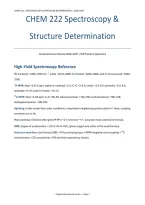
CHEM 222 Spectroscopy &
Structure Determination
Comprehensive Review 2026–2027 | 100 Practice Questions
High-Yield Spectroscopy Reference
IR: Carbonyl ~1650–1800 cm⁻¹; nitrile ~2210–2260; O–H broad ~3200–3600; acid O–H very broad ~2500–
3300.
¹H NMR: Alkyl ~0.8–2 ppm; alpha-to-carbonyl ~2–3; C–O ~3–4.5; vinylic ~4.5–6.5; aromatic ~6.5–8.5;
aldehyde ~9–10; acid O–H often ~10–13.
¹³C NMR: Alkyl ~0–50 ppm; C–O ~50–90; alkene/aromatic ~100–160; acid derivatives ~160–185;
aldehydes/ketones ~190–220.
Splitting: Under simple first-order conditions, n equivalent neighboring protons yield n+1 lines; coupling
constants are in Hz.
Mass spectra: Chlorine often gives M:M+2 ~3:1; bromine ~1:1; accurate mass constrains formula.
DBE: Degree of unsaturation = (2C+2+N−H−X)/2; ignore oxygen and sulfur in the usual formula.
Structure workflow: Use formula/DBE → IR functional groups → NMR integration and coupling → ¹³C
environments → 2D connectivity → MS and final consistency checks.
Original educational review • Page 1
,CHEM 222 | SPECTROSCOPY & STRUCTURE DETERMINATION | 2026–2027
Infrared Spectroscopy (IR)
Question 1. An unknown shows a strong absorption near 1715 cm⁻¹. Which bond is most likely
responsible?
A. C–H bending
B. C=O stretch
C. C≡C stretch
D. O–H stretch
Correct Answer: B. C=O stretch
Detailed Rationale: Carbonyl bonds often absorb strongly around 1650–1800 cm⁻¹.
Why the Other Options Are Incorrect: A — Common C–H bends occur at lower frequencies. C —
Alkyne stretches generally appear around 2100–2260 cm⁻¹. D — O–H stretches generally appear
around 3200–3600 cm⁻¹, or broadly 2500–3300 cm⁻¹ for acids.
Question 2. Which IR feature most strongly supports a carboxylic acid?
A. Absorption at 1600 cm⁻¹ only
B. A peak near 2250 cm⁻¹
C. Broad O–H absorption from about 2500–3300 cm⁻¹ plus C=O
D. Sharp absorption at 3300 cm⁻¹ only
Correct Answer: C. Broad O–H absorption from about 2500–3300 cm⁻¹ plus C=O
Detailed Rationale: Hydrogen-bonded acid O–H is unusually broad and accompanies a carbonyl.
Why the Other Options Are Incorrect: A — This may indicate aromatic C=C and is not diagnostic for
an acid. B — This is typical of nitriles rather than acids. D — A sharp peak can reflect a terminal
alkyne C–H or other groups, without establishing an acid.
Question 3. An unknown has a sharp strong IR band at 2250 cm⁻¹. Which group is plausible?
A. Saturated ketone C=O
B. Alcohol O–H
C. Ether C–O
D. Nitrile C≡N
Correct Answer: D. Nitrile C≡N
Original educational review • Page 2
,CHEM 222 | SPECTROSCOPY & STRUCTURE DETERMINATION | 2026–2027
Detailed Rationale: Nitriles often show a sharp absorption near 2210–2260 cm⁻¹.
Why the Other Options Are Incorrect: A — A typical ketone carbonyl is closer to 1715 cm⁻¹. B —
Alcohol O–H stretching is at higher frequency and often broad. C — Ether C–O absorption is usually
near 1000–1300 cm⁻¹.
Question 4. A terminal alkyne is suspected. Which pair of IR features supports it?
A. Sharp ≡C–H near 3300 and C≡C near 2100–2260 cm⁻¹
B. Broad O–H and C=O
C. Two strong C=O peaks
D. Only a C–O stretch
Correct Answer: A. Sharp ≡C–H near 3300 and C≡C near 2100–2260 cm⁻¹
Detailed Rationale: Terminal alkynes can show both a sharp sp C–H stretch and a triple-bond
stretch.
Why the Other Options Are Incorrect: B — That combination is more typical of carboxylic acids. C
— Two carbonyl features do not establish an alkyne. D — C–O alone suggests an oxygen-containing
functional group.
Question 5. Which IR region is often called the fingerprint region?
A. 2500–2000 cm⁻¹
B. Approximately 1500–500 cm⁻¹
C. 4000–3500 cm⁻¹
D. 3000–2500 cm⁻¹
Correct Answer: B. Approximately 1500–500 cm⁻¹
Detailed Rationale: The complex lower-frequency pattern can aid comparison with references.
Why the Other Options Are Incorrect: A — This region includes triple-bond absorptions. C — This is
the high-frequency X–H stretching region. D — This is not the usual full fingerprint range.
Question 6. What change generally occurs to a carbonyl stretch when conjugated to an alkene?
A. It shifts above 3000 cm⁻¹
B. It becomes an O–H stretch
Original educational review • Page 3
, CHEM 222 | SPECTROSCOPY & STRUCTURE DETERMINATION | 2026–2027
C. Its frequency tends to decrease
D. It always disappears
Correct Answer: C. Its frequency tends to decrease
Detailed Rationale: Conjugation lowers effective C=O bond order and often shifts absorption
lower.
Why the Other Options Are Incorrect: A — That range is not characteristic of carbonyl stretching. B
— Conjugation does not change the bond identity. D — Conjugated carbonyls still absorb IR.
Question 7. An IR spectrum shows a broad 3200–3600 cm⁻¹ band but no strong 1700 cm⁻¹ peak.
Which group is likely?
A. Carboxylic acid
B. Ketone
C. Nitrile
D. Alcohol O–H
Correct Answer: D. Alcohol O–H
Detailed Rationale: An alcohol O–H stretch is broad and does not require a carbonyl.
Why the Other Options Are Incorrect: A — Acids usually show a carbonyl as well as broad O–H. B —
Ketones show C=O but no intrinsic O–H. C — Nitriles typically absorb near 2250 cm⁻¹.
Question 8. Which IR feature distinguishes an aldehyde from a ketone when visible?
A. Weak aldehydic C–H bands near 2720 and 2820 cm⁻¹
B. A sharp nitrile peak
C. An O–H band
D. Absence of a carbonyl
Correct Answer: A. Weak aldehydic C–H bands near 2720 and 2820 cm⁻¹
Detailed Rationale: Aldehydes can display characteristic weak C–H Fermi-doublet bands.
Why the Other Options Are Incorrect: B — Nitrile absorption does not diagnose an aldehyde. C —
Neither aldehydes nor ketones require O–H. D — Both aldehydes and ketones contain C=O.
Original educational review • Page 4
CHEM 222 Spectroscopy &
Structure Determination
Comprehensive Review 2026–2027 | 100 Practice Questions
High-Yield Spectroscopy Reference
IR: Carbonyl ~1650–1800 cm⁻¹; nitrile ~2210–2260; O–H broad ~3200–3600; acid O–H very broad ~2500–
3300.
¹H NMR: Alkyl ~0.8–2 ppm; alpha-to-carbonyl ~2–3; C–O ~3–4.5; vinylic ~4.5–6.5; aromatic ~6.5–8.5;
aldehyde ~9–10; acid O–H often ~10–13.
¹³C NMR: Alkyl ~0–50 ppm; C–O ~50–90; alkene/aromatic ~100–160; acid derivatives ~160–185;
aldehydes/ketones ~190–220.
Splitting: Under simple first-order conditions, n equivalent neighboring protons yield n+1 lines; coupling
constants are in Hz.
Mass spectra: Chlorine often gives M:M+2 ~3:1; bromine ~1:1; accurate mass constrains formula.
DBE: Degree of unsaturation = (2C+2+N−H−X)/2; ignore oxygen and sulfur in the usual formula.
Structure workflow: Use formula/DBE → IR functional groups → NMR integration and coupling → ¹³C
environments → 2D connectivity → MS and final consistency checks.
Original educational review • Page 1
,CHEM 222 | SPECTROSCOPY & STRUCTURE DETERMINATION | 2026–2027
Infrared Spectroscopy (IR)
Question 1. An unknown shows a strong absorption near 1715 cm⁻¹. Which bond is most likely
responsible?
A. C–H bending
B. C=O stretch
C. C≡C stretch
D. O–H stretch
Correct Answer: B. C=O stretch
Detailed Rationale: Carbonyl bonds often absorb strongly around 1650–1800 cm⁻¹.
Why the Other Options Are Incorrect: A — Common C–H bends occur at lower frequencies. C —
Alkyne stretches generally appear around 2100–2260 cm⁻¹. D — O–H stretches generally appear
around 3200–3600 cm⁻¹, or broadly 2500–3300 cm⁻¹ for acids.
Question 2. Which IR feature most strongly supports a carboxylic acid?
A. Absorption at 1600 cm⁻¹ only
B. A peak near 2250 cm⁻¹
C. Broad O–H absorption from about 2500–3300 cm⁻¹ plus C=O
D. Sharp absorption at 3300 cm⁻¹ only
Correct Answer: C. Broad O–H absorption from about 2500–3300 cm⁻¹ plus C=O
Detailed Rationale: Hydrogen-bonded acid O–H is unusually broad and accompanies a carbonyl.
Why the Other Options Are Incorrect: A — This may indicate aromatic C=C and is not diagnostic for
an acid. B — This is typical of nitriles rather than acids. D — A sharp peak can reflect a terminal
alkyne C–H or other groups, without establishing an acid.
Question 3. An unknown has a sharp strong IR band at 2250 cm⁻¹. Which group is plausible?
A. Saturated ketone C=O
B. Alcohol O–H
C. Ether C–O
D. Nitrile C≡N
Correct Answer: D. Nitrile C≡N
Original educational review • Page 2
,CHEM 222 | SPECTROSCOPY & STRUCTURE DETERMINATION | 2026–2027
Detailed Rationale: Nitriles often show a sharp absorption near 2210–2260 cm⁻¹.
Why the Other Options Are Incorrect: A — A typical ketone carbonyl is closer to 1715 cm⁻¹. B —
Alcohol O–H stretching is at higher frequency and often broad. C — Ether C–O absorption is usually
near 1000–1300 cm⁻¹.
Question 4. A terminal alkyne is suspected. Which pair of IR features supports it?
A. Sharp ≡C–H near 3300 and C≡C near 2100–2260 cm⁻¹
B. Broad O–H and C=O
C. Two strong C=O peaks
D. Only a C–O stretch
Correct Answer: A. Sharp ≡C–H near 3300 and C≡C near 2100–2260 cm⁻¹
Detailed Rationale: Terminal alkynes can show both a sharp sp C–H stretch and a triple-bond
stretch.
Why the Other Options Are Incorrect: B — That combination is more typical of carboxylic acids. C
— Two carbonyl features do not establish an alkyne. D — C–O alone suggests an oxygen-containing
functional group.
Question 5. Which IR region is often called the fingerprint region?
A. 2500–2000 cm⁻¹
B. Approximately 1500–500 cm⁻¹
C. 4000–3500 cm⁻¹
D. 3000–2500 cm⁻¹
Correct Answer: B. Approximately 1500–500 cm⁻¹
Detailed Rationale: The complex lower-frequency pattern can aid comparison with references.
Why the Other Options Are Incorrect: A — This region includes triple-bond absorptions. C — This is
the high-frequency X–H stretching region. D — This is not the usual full fingerprint range.
Question 6. What change generally occurs to a carbonyl stretch when conjugated to an alkene?
A. It shifts above 3000 cm⁻¹
B. It becomes an O–H stretch
Original educational review • Page 3
, CHEM 222 | SPECTROSCOPY & STRUCTURE DETERMINATION | 2026–2027
C. Its frequency tends to decrease
D. It always disappears
Correct Answer: C. Its frequency tends to decrease
Detailed Rationale: Conjugation lowers effective C=O bond order and often shifts absorption
lower.
Why the Other Options Are Incorrect: A — That range is not characteristic of carbonyl stretching. B
— Conjugation does not change the bond identity. D — Conjugated carbonyls still absorb IR.
Question 7. An IR spectrum shows a broad 3200–3600 cm⁻¹ band but no strong 1700 cm⁻¹ peak.
Which group is likely?
A. Carboxylic acid
B. Ketone
C. Nitrile
D. Alcohol O–H
Correct Answer: D. Alcohol O–H
Detailed Rationale: An alcohol O–H stretch is broad and does not require a carbonyl.
Why the Other Options Are Incorrect: A — Acids usually show a carbonyl as well as broad O–H. B —
Ketones show C=O but no intrinsic O–H. C — Nitriles typically absorb near 2250 cm⁻¹.
Question 8. Which IR feature distinguishes an aldehyde from a ketone when visible?
A. Weak aldehydic C–H bands near 2720 and 2820 cm⁻¹
B. A sharp nitrile peak
C. An O–H band
D. Absence of a carbonyl
Correct Answer: A. Weak aldehydic C–H bands near 2720 and 2820 cm⁻¹
Detailed Rationale: Aldehydes can display characteristic weak C–H Fermi-doublet bands.
Why the Other Options Are Incorrect: B — Nitrile absorption does not diagnose an aldehyde. C —
Neither aldehydes nor ketones require O–H. D — Both aldehydes and ketones contain C=O.
Original educational review • Page 4


