
PHS 104A | CONVEX LENS & FOCAL LENGTH | 2026–2027
PHS 104A Convex Lens & Focal
Length
Study Guide 2026–2027 | 110 Original Questions
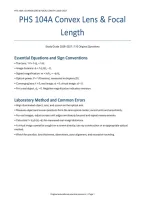
Essential Equations and Sign Conventions
• Thin lens: 1/f = 1/dₒ + 1/dᵢ.
• Image distance: dᵢ = f dₒ/(dₒ − f).
• Signed magnification: m = hᵢ/hₒ = −dᵢ/dₒ.
• Optical power: P = 1/f(meters), measured in diopters (D).
• Converging lens: f > 0; real image: dᵢ > 0; virtual image: dᵢ < 0.
• For a real object, dₒ > 0. Negative magnification indicates inversion.
Laboratory Method and Common Errors
• Align illuminated object, lens, and screen on the optical axis.
• Measure object and screen positions from the lens optical center; record units and uncertainty.
• For real images, adjust screen until edges are sharply focused and repeat measurements.
• Calculate f = dₒdᵢ/(dₒ+dᵢ) for measured real-image distances.
• A virtual image cannot be caught on a screen directly; use ray construction or an appropriate optical
method.
• Watch for parallax, lens thickness, aberrations, poor alignment, and excessive rounding.
Original educational practice resource • Page 1
,PHS 104A | CONVEX LENS & FOCAL LENGTH | 2026–2027
Part I — Real Image Distance (1–40)
Question 1. A thin converging lens has focal length 5 cm. An object is placed 7.5 cm in front of it.
What is the image distance?
A. 2.5 cm
B. 15 cm
C. 7.5 cm
D. 5 cm
Correct Answer: B. 15 cm
Detailed Worked Solution: Using 1/f = 1/dₒ + 1/dᵢ, 1/dᵢ = 1/5 − 1/7.5; dᵢ = (5 × 7.5)/(7.5 − 5) = 15 cm. The
positive value indicates a real image.
Why the Other Options Are Incorrect: A — This value does not satisfy the thin-lens equation for the
stated focal and object distances. C — This value does not satisfy the thin-lens equation for the
stated focal and object distances. D — This value does not satisfy the thin-lens equation for the
stated focal and object distances.
Question 2. A thin converging lens has focal length 5 cm. An object is placed 10 cm in front of it.
What is the image distance?
A. 15 cm
B. 20 cm
C. 10 cm
D. 5 cm
Correct Answer: C. 10 cm
Detailed Worked Solution: Using 1/f = 1/dₒ + 1/dᵢ, 1/dᵢ = 1/5 − 1/10; dᵢ = (5 × 10)/(10 − 5) = 10 cm. The
positive value indicates a real image.
Why the Other Options Are Incorrect: A — This value does not satisfy the thin-lens equation for the
stated focal and object distances. B — This value does not satisfy the thin-lens equation for the
stated focal and object distances. D — This value does not satisfy the thin-lens equation for the
stated focal and object distances.
Question 3. A thin converging lens has focal length 5 cm. An object is placed 12.5 cm in front of it.
What is the image distance?
A. 12.5 cm
B. 5 cm
C. 7.5 cm
D. 8.33 cm
Correct Answer: D. 8.33 cm
Original educational practice resource • Page 2
,PHS 104A | CONVEX LENS & FOCAL LENGTH | 2026–2027
Detailed Worked Solution: Using 1/f = 1/dₒ + 1/dᵢ, 1/dᵢ = 1/5 − 1/12.5; dᵢ = (5 × 12.5)/(12.5 − 5) = 8.33
cm. The positive value indicates a real image.
Why the Other Options Are Incorrect: A — This value does not satisfy the thin-lens equation for the
stated focal and object distances. B — This value does not satisfy the thin-lens equation for the
stated focal and object distances. C — This value does not satisfy the thin-lens equation for the
stated focal and object distances.
Question 4. A thin converging lens has focal length 5 cm. An object is placed 15 cm in front of it.
What is the image distance?
A. 7.5 cm
B. 15 cm
C. 5 cm
D. 10 cm
Correct Answer: A. 7.5 cm
Detailed Worked Solution: Using 1/f = 1/dₒ + 1/dᵢ, 1/dᵢ = 1/5 − 1/15; dᵢ = (5 × 15)/(15 − 5) = 7.5 cm. The
positive value indicates a real image.
Why the Other Options Are Incorrect: B — This value does not satisfy the thin-lens equation for the
stated focal and object distances. C — This value does not satisfy the thin-lens equation for the
stated focal and object distances. D — This value does not satisfy the thin-lens equation for the
stated focal and object distances.
Question 5. A thin converging lens has focal length 5 cm. An object is placed 20 cm in front of it.
What is the image distance?
A. 15 cm
B. 6.67 cm
C. 20 cm
D. 5 cm
Correct Answer: B. 6.67 cm
Detailed Worked Solution: Using 1/f = 1/dₒ + 1/dᵢ, 1/dᵢ = 1/5 − 1/20; dᵢ = (5 × 20)/(20 − 5) = 6.67 cm. The
positive value indicates a real image.
Why the Other Options Are Incorrect: A — This value does not satisfy the thin-lens equation for the
stated focal and object distances. C — This value does not satisfy the thin-lens equation for the
stated focal and object distances. D — This value does not satisfy the thin-lens equation for the
stated focal and object distances.
Question 6. A thin converging lens has focal length 8 cm. An object is placed 12 cm in front of it.
What is the image distance?
A. 8 cm
B. 4 cm
Original educational practice resource • Page 3
, PHS 104A | CONVEX LENS & FOCAL LENGTH | 2026–2027
C. 24 cm
D. 12 cm
Correct Answer: C. 24 cm
Detailed Worked Solution: Using 1/f = 1/dₒ + 1/dᵢ, 1/dᵢ = 1/8 − 1/12; dᵢ = (8 × 12)/(12 − 8) = 24 cm. The
positive value indicates a real image.
Why the Other Options Are Incorrect: A — This value does not satisfy the thin-lens equation for the
stated focal and object distances. B — This value does not satisfy the thin-lens equation for the
stated focal and object distances. D — This value does not satisfy the thin-lens equation for the
stated focal and object distances.
Question 7. A thin converging lens has focal length 8 cm. An object is placed 16 cm in front of it.
What is the image distance?
A. 8 cm
B. 24 cm
C. 32 cm
D. 16 cm
Correct Answer: D. 16 cm
Detailed Worked Solution: Using 1/f = 1/dₒ + 1/dᵢ, 1/dᵢ = 1/8 − 1/16; dᵢ = (8 × 16)/(16 − 8) = 16 cm. The
positive value indicates a real image.
Why the Other Options Are Incorrect: A — This value does not satisfy the thin-lens equation for the
stated focal and object distances. B — This value does not satisfy the thin-lens equation for the
stated focal and object distances. C — This value does not satisfy the thin-lens equation for the
stated focal and object distances.
Question 8. A thin converging lens has focal length 8 cm. An object is placed 20 cm in front of it.
What is the image distance?
A. 13.33 cm
B. 20 cm
C. 8 cm
D. 12 cm
Correct Answer: A. 13.33 cm
Detailed Worked Solution: Using 1/f = 1/dₒ + 1/dᵢ, 1/dᵢ = 1/8 − 1/20; dᵢ = (8 × 20)/(20 − 8) = 13.33 cm.
The positive value indicates a real image.
Why the Other Options Are Incorrect: B — This value does not satisfy the thin-lens equation for the
stated focal and object distances. C — This value does not satisfy the thin-lens equation for the
stated focal and object distances. D — This value does not satisfy the thin-lens equation for the
stated focal and object distances.
Original educational practice resource • Page 4


