
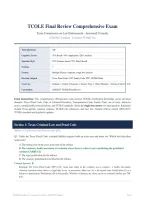
TCOLE Final Review Comprehensive Exam
Texas Commission on Law Enforcement - Answered Correctly
2026/2027 Updated - Complete TCOLE Test
Total Questions 200
Cognitive Levels 35% Recall / 45% Application / 20% Analysis
Question Style 75% Scenario-based / 25% Direct Recall
Sections 7
Format Multiple Choice (4 options, single best answer)
Doctrine Aligned Texas Penal Code, CCP, Family Code, TPC, TCOLE Rules
Case Law Graham v. Connor, Tennessee v. Garner, Terry v. Ohio, Miranda v. Arizona, Carroll v. U.S.
Curriculum 2026/2027 TCOLE Final Review
Exam Instructions: This comprehensive 200-question exam assesses TCOLE certification knowledge across all major
domains: Texas Penal Code, Code of Criminal Procedure, Transportation Code, Family Code, use of force, defensive
tactics, mental health, professionalism, and TCOLE standards. Select the single best answer for each question. Rationales
include Texas-specific statutory citations, TCOLE rule references, and case law. Content reflects current (2026-2027)
TCOLE standards and legislative updates.
Section 1: Texas Criminal Law and Penal Code
Offenses, Classification, and Elements (Q1-Q35)
Q1: Under the Texas Penal Code, criminal liability requires both an actus reus and mens rea. Which best describes
'actus reus'?
A. The mental state of the actor at the time of the offense
B. The voluntary bodily movement (or omission where there is a duty to act) constituting the prohibited
conduct [CORRECT]
C. The legal justification for the offense
D. The statutory punishment prescribed for the offense
Correct Answer: B
Rationale: Per Texas Penal Code (TPC) 6.01, 'actus reus' refers to the voluntary act or conduct - a bodily movement,
voluntary omission where there is a legal duty to act, or possession. Mens rea (A) is the mental state. Justification (C) is a
defense to prosecution. Punishment (D) is the penalty. Without a voluntary act, there can be no criminal liability per TPC
6.01.
TCOLE Final Review Comprehensive Exam - 2026/2027 Updated Page 1
, Q2: Per Texas Penal Code 6.02, which mens rea is the LOWEST level of culpability sufficient to establish criminal
liability when no culpable mental state is specifically prescribed?
A. Intentional
B. Knowing
C. Reckless
D. Criminal negligence [CORRECT]
Correct Answer: D
Rationale: Per TPC 6.02(b), when the definition of an offense does not prescribe a culpable mental state, a culpable mental
state is nonetheless required, and the lowest level sufficient is criminal negligence. The four culpable mental states (TPC
6.03) in descending order of culpability: intentional, knowing, reckless, and criminal negligence. This is a critical TCOLE
exam concept - if no mental state is specified in the statute, criminal negligence is the default minimum.
Q3: A person commits an offense with the conscious objective to cause the result. Which culpable mental state is
described per Texas Penal Code 6.03?
A. Intentional [CORRECT]
B. Knowing
C. Reckless
D. Criminal negligence
Correct Answer: A
Rationale: Per TPC 6.03(a), a person acts intentionally with respect to the nature of conduct or to a result of conduct when it
is his conscious objective or desire to engage in the conduct or cause the result. Intentional is the highest culpable mental
state. Knowing (B) means aware that conduct is reasonably certain to cause the result. Reckless (C) requires conscious risk
creation. Criminal negligence (D) is failure to be aware of a substantial and unjustifiable risk.
Q4: Per TPC 6.03, a person is aware of circumstances or aware that conduct is reasonably certain to cause a result.
Which culpable mental state is described?
A. Intentional
B. Knowing [CORRECT]
C. Reckless
D. Criminal negligence
Correct Answer: B
Rationale: Per TPC 6.03(b), a person acts knowingly with respect to conduct or circumstances when he is aware of the
nature of his conduct or circumstances, or with respect to a result when he is aware that his conduct is reasonably certain to
cause the result. The distinction: intentional = conscious objective; knowing = awareness of reasonable certainty. Reckless
(C) involves conscious risk creation that is unjustifiable. Criminal negligence (D) involves failure to be aware of substantial
and unjustifiable risk.
TCOLE Final Review Comprehensive Exam - 2026/2027 Updated Page 2
, Q5: Per Texas Penal Code 12.04, which offense classification carries the LEAST severe punishment range among
the listed felony categories?
A. State jail felony [CORRECT]
B. Third degree felony
C. Second degree felony
D. First degree felony
Correct Answer: A
Rationale: Per TPC 12.04, felony classifications in ascending order of severity: state jail felony (180 days to 2 years in state
jail), third degree (2-10 years), second degree (2-20 years), first degree (5-99 years or life), and capital felony (life
imprisonment without parole or death). The state jail felony is the least severe felony classification. This is a foundational
TCOLE exam concept tested frequently.
Q6: Per TPC 12.22, the punishment range for a Class A misdemeanor is:
A. Up to 180 days in county jail
B. Up to 1 year in county jail and/or $4,000 fine [CORRECT]
C. Up to 2 years in state jail
D. Up to 6 months in county jail and/or $2,000 fine
Correct Answer: B
Rationale: Per TPC 12.22, a Class A misdemeanor is punishable by up to 1 year confinement in county jail and/or a fine not
to exceed $4,000. Class B misdemeanor (A) is up to 180 days in county jail and/or $2,000. State jail felony (C) is 180 days
to 2 years. Class C misdemeanor (D) is up to $500 fine only, no jail. Memorize TPC 12.21-12.23 punishment ranges for the
TCOLE exam.
Q7: Per TPC 12.23, the punishment for a Class C misdemeanor is:
A. Up to 1 year in county jail
B. Up to 180 days in county jail and/or $2,000 fine
C. A fine not to exceed $500 [CORRECT]
D. 180 days to 2 years in state jail
Correct Answer: C
Rationale: Per TPC 12.23, a Class C misdemeanor is punishable by a fine not to exceed $500. Class C misdemeanors are
filed in justice court or municipal court - no jail time is available. Class A (A) is up to 1 year/$4,000. Class B (B) is up to
180 days/$2,000. State jail felony (D) is 180 days to 2 years. Class C misdemeanor examples include traffic offenses (TPC
12.35(c) for state jail; TPC 49.02 public intoxication is Class C).
Q8: Under TPC 19.02, a person commits criminal homicide if they cause the death of another person. Which is NOT
a criminal homicide offense under Texas law?
A. Murder
B. Capital murder
C. Manslaughter
D. Aggravated assault [CORRECT]
Correct Answer: D
Rationale: Per TPC Chapter 19, criminal homicide includes murder (19.02(b)), capital murder (19.03), manslaughter
(19.04), and criminally negligent homicide (19.05). Aggravated assault (TPC 22.02) is an assaultive offense, not a homicide
offense, even if the victim dies later (which may lead to additional charges of murder). TCOLE frequently tests
classification distinctions between homicide and assaultive offenses.
TCOLE Final Review Comprehensive Exam - 2026/2027 Updated Page 3
, Q9: Per TPC 19.02(b)(1), a person commits murder if they intentionally or knowingly cause the death of an
individual. The punishment for murder is:
A. First degree felony (5-99 years or life) [CORRECT]
B. Second degree felony (2-20 years)
C. Capital felony
D. Third degree felony (2-10 years)
Correct Answer: A
Rationale: Per TPC 12.04(c), murder (TPC 19.02) is a first degree felony punishable by 5-99 years or life imprisonment and
up to a $10,000 fine. Capital murder (TPC 19.03) is a capital felony punishable by life without parole or death.
Manslaughter (TPC 19.04) is a second degree felony (2-20 years). Criminally negligent homicide (TPC 19.05) is a state jail
felony (180 days to 2 years).
Q10: Per TPC 19.03, which of the following circumstances would elevate murder to capital murder?
A. The victim was a peace officer acting in official duty and the actor knew or should have known
[CORRECT]
B. The actor was intoxicated
C. The actor acted under sudden passion
D. The actor committed the offense at night
Correct Answer: A
Rationale: Per TPC 19.03(a)(1), murder becomes capital murder if the victim is a peace officer or fireman acting in official
duty and the actor knew or should have known. Other capital murder circumstances include: murder during commission of
enumerated felonies (robbery, kidnapping, rape, arson, etc.), murder for remuneration, murder of multiple victims, murder
of a child under 10, murder of a judge, and murder during a prison escape. Intoxication (B), sudden passion (C - reduces to
second degree murder), and time of day (D) do not elevate to capital murder.
Q11: Per TPC 20.02, which elements must be proven to establish the offense of unlawful restraint?
A. Intentionally or knowingly restraining another person without their consent and without lawful authority
[CORRECT]
B. Recklessly causing bodily injury to another
C. Intentionally causing the death of another
D. Knowingly causing serious bodily injury
Correct Answer: A
Rationale: Per TPC 20.02, unlawful restraint is committed when a person intentionally or knowingly restrains another
person without their consent and without lawful authority. Restraint means restricting a person's movements without
consent. If the victim is under 17, the offense is elevated (state jail felony). Restraint by moving the victim or concealing the
location increases the severity. Bodily injury (B) is assault. Death (C) is homicide. Serious bodily injury (D) is aggravated
assault.
TCOLE Final Review Comprehensive Exam - 2026/2027 Updated Page 4
Texas Commission on Law Enforcement - Answered Correctly
2026/2027 Updated - Complete TCOLE Test
Total Questions 200
Cognitive Levels 35% Recall / 45% Application / 20% Analysis
Question Style 75% Scenario-based / 25% Direct Recall
Sections 7
Format Multiple Choice (4 options, single best answer)
Doctrine Aligned Texas Penal Code, CCP, Family Code, TPC, TCOLE Rules
Case Law Graham v. Connor, Tennessee v. Garner, Terry v. Ohio, Miranda v. Arizona, Carroll v. U.S.
Curriculum 2026/2027 TCOLE Final Review
Exam Instructions: This comprehensive 200-question exam assesses TCOLE certification knowledge across all major
domains: Texas Penal Code, Code of Criminal Procedure, Transportation Code, Family Code, use of force, defensive
tactics, mental health, professionalism, and TCOLE standards. Select the single best answer for each question. Rationales
include Texas-specific statutory citations, TCOLE rule references, and case law. Content reflects current (2026-2027)
TCOLE standards and legislative updates.
Section 1: Texas Criminal Law and Penal Code
Offenses, Classification, and Elements (Q1-Q35)
Q1: Under the Texas Penal Code, criminal liability requires both an actus reus and mens rea. Which best describes
'actus reus'?
A. The mental state of the actor at the time of the offense
B. The voluntary bodily movement (or omission where there is a duty to act) constituting the prohibited
conduct [CORRECT]
C. The legal justification for the offense
D. The statutory punishment prescribed for the offense
Correct Answer: B
Rationale: Per Texas Penal Code (TPC) 6.01, 'actus reus' refers to the voluntary act or conduct - a bodily movement,
voluntary omission where there is a legal duty to act, or possession. Mens rea (A) is the mental state. Justification (C) is a
defense to prosecution. Punishment (D) is the penalty. Without a voluntary act, there can be no criminal liability per TPC
6.01.
TCOLE Final Review Comprehensive Exam - 2026/2027 Updated Page 1
, Q2: Per Texas Penal Code 6.02, which mens rea is the LOWEST level of culpability sufficient to establish criminal
liability when no culpable mental state is specifically prescribed?
A. Intentional
B. Knowing
C. Reckless
D. Criminal negligence [CORRECT]
Correct Answer: D
Rationale: Per TPC 6.02(b), when the definition of an offense does not prescribe a culpable mental state, a culpable mental
state is nonetheless required, and the lowest level sufficient is criminal negligence. The four culpable mental states (TPC
6.03) in descending order of culpability: intentional, knowing, reckless, and criminal negligence. This is a critical TCOLE
exam concept - if no mental state is specified in the statute, criminal negligence is the default minimum.
Q3: A person commits an offense with the conscious objective to cause the result. Which culpable mental state is
described per Texas Penal Code 6.03?
A. Intentional [CORRECT]
B. Knowing
C. Reckless
D. Criminal negligence
Correct Answer: A
Rationale: Per TPC 6.03(a), a person acts intentionally with respect to the nature of conduct or to a result of conduct when it
is his conscious objective or desire to engage in the conduct or cause the result. Intentional is the highest culpable mental
state. Knowing (B) means aware that conduct is reasonably certain to cause the result. Reckless (C) requires conscious risk
creation. Criminal negligence (D) is failure to be aware of a substantial and unjustifiable risk.
Q4: Per TPC 6.03, a person is aware of circumstances or aware that conduct is reasonably certain to cause a result.
Which culpable mental state is described?
A. Intentional
B. Knowing [CORRECT]
C. Reckless
D. Criminal negligence
Correct Answer: B
Rationale: Per TPC 6.03(b), a person acts knowingly with respect to conduct or circumstances when he is aware of the
nature of his conduct or circumstances, or with respect to a result when he is aware that his conduct is reasonably certain to
cause the result. The distinction: intentional = conscious objective; knowing = awareness of reasonable certainty. Reckless
(C) involves conscious risk creation that is unjustifiable. Criminal negligence (D) involves failure to be aware of substantial
and unjustifiable risk.
TCOLE Final Review Comprehensive Exam - 2026/2027 Updated Page 2
, Q5: Per Texas Penal Code 12.04, which offense classification carries the LEAST severe punishment range among
the listed felony categories?
A. State jail felony [CORRECT]
B. Third degree felony
C. Second degree felony
D. First degree felony
Correct Answer: A
Rationale: Per TPC 12.04, felony classifications in ascending order of severity: state jail felony (180 days to 2 years in state
jail), third degree (2-10 years), second degree (2-20 years), first degree (5-99 years or life), and capital felony (life
imprisonment without parole or death). The state jail felony is the least severe felony classification. This is a foundational
TCOLE exam concept tested frequently.
Q6: Per TPC 12.22, the punishment range for a Class A misdemeanor is:
A. Up to 180 days in county jail
B. Up to 1 year in county jail and/or $4,000 fine [CORRECT]
C. Up to 2 years in state jail
D. Up to 6 months in county jail and/or $2,000 fine
Correct Answer: B
Rationale: Per TPC 12.22, a Class A misdemeanor is punishable by up to 1 year confinement in county jail and/or a fine not
to exceed $4,000. Class B misdemeanor (A) is up to 180 days in county jail and/or $2,000. State jail felony (C) is 180 days
to 2 years. Class C misdemeanor (D) is up to $500 fine only, no jail. Memorize TPC 12.21-12.23 punishment ranges for the
TCOLE exam.
Q7: Per TPC 12.23, the punishment for a Class C misdemeanor is:
A. Up to 1 year in county jail
B. Up to 180 days in county jail and/or $2,000 fine
C. A fine not to exceed $500 [CORRECT]
D. 180 days to 2 years in state jail
Correct Answer: C
Rationale: Per TPC 12.23, a Class C misdemeanor is punishable by a fine not to exceed $500. Class C misdemeanors are
filed in justice court or municipal court - no jail time is available. Class A (A) is up to 1 year/$4,000. Class B (B) is up to
180 days/$2,000. State jail felony (D) is 180 days to 2 years. Class C misdemeanor examples include traffic offenses (TPC
12.35(c) for state jail; TPC 49.02 public intoxication is Class C).
Q8: Under TPC 19.02, a person commits criminal homicide if they cause the death of another person. Which is NOT
a criminal homicide offense under Texas law?
A. Murder
B. Capital murder
C. Manslaughter
D. Aggravated assault [CORRECT]
Correct Answer: D
Rationale: Per TPC Chapter 19, criminal homicide includes murder (19.02(b)), capital murder (19.03), manslaughter
(19.04), and criminally negligent homicide (19.05). Aggravated assault (TPC 22.02) is an assaultive offense, not a homicide
offense, even if the victim dies later (which may lead to additional charges of murder). TCOLE frequently tests
classification distinctions between homicide and assaultive offenses.
TCOLE Final Review Comprehensive Exam - 2026/2027 Updated Page 3
, Q9: Per TPC 19.02(b)(1), a person commits murder if they intentionally or knowingly cause the death of an
individual. The punishment for murder is:
A. First degree felony (5-99 years or life) [CORRECT]
B. Second degree felony (2-20 years)
C. Capital felony
D. Third degree felony (2-10 years)
Correct Answer: A
Rationale: Per TPC 12.04(c), murder (TPC 19.02) is a first degree felony punishable by 5-99 years or life imprisonment and
up to a $10,000 fine. Capital murder (TPC 19.03) is a capital felony punishable by life without parole or death.
Manslaughter (TPC 19.04) is a second degree felony (2-20 years). Criminally negligent homicide (TPC 19.05) is a state jail
felony (180 days to 2 years).
Q10: Per TPC 19.03, which of the following circumstances would elevate murder to capital murder?
A. The victim was a peace officer acting in official duty and the actor knew or should have known
[CORRECT]
B. The actor was intoxicated
C. The actor acted under sudden passion
D. The actor committed the offense at night
Correct Answer: A
Rationale: Per TPC 19.03(a)(1), murder becomes capital murder if the victim is a peace officer or fireman acting in official
duty and the actor knew or should have known. Other capital murder circumstances include: murder during commission of
enumerated felonies (robbery, kidnapping, rape, arson, etc.), murder for remuneration, murder of multiple victims, murder
of a child under 10, murder of a judge, and murder during a prison escape. Intoxication (B), sudden passion (C - reduces to
second degree murder), and time of day (D) do not elevate to capital murder.
Q11: Per TPC 20.02, which elements must be proven to establish the offense of unlawful restraint?
A. Intentionally or knowingly restraining another person without their consent and without lawful authority
[CORRECT]
B. Recklessly causing bodily injury to another
C. Intentionally causing the death of another
D. Knowingly causing serious bodily injury
Correct Answer: A
Rationale: Per TPC 20.02, unlawful restraint is committed when a person intentionally or knowingly restrains another
person without their consent and without lawful authority. Restraint means restricting a person's movements without
consent. If the victim is under 17, the offense is elevated (state jail felony). Restraint by moving the victim or concealing the
location increases the severity. Bodily injury (B) is assault. Death (C) is homicide. Serious bodily injury (D) is aggravated
assault.
TCOLE Final Review Comprehensive Exam - 2026/2027 Updated Page 4


