
NPTE-PT Study Guide
NPTE-PT Study Guide
Oct 13, 2026 · @tony
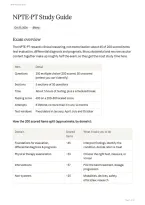
Exam overview
The NPTE-PT rewards clinical reasoning, not memorization: about 65 of 200 scored items
test evaluation, differential diagnosis and prognosis. Musculoskeletal and neuromuscular
content together make up roughly half the exam, so they get the most study time here.
Item Detail
Questions 250 multiple choice (200 scored, 50 unscored
pretest you can't identify)
Sections 5 sections of 50 questions
Time About 5 hours of testing, plus a scheduled break
Passing score 600 on a 200–800 scaled score
Attempts 6 lifetime; no more than 3 in any 12 months
Test windows Fixed dates in January, April, July and October
How the 200 scored items split (approximate, by domain):
Domain Scored What it asks you to do
items
Foundations for evaluation, ~65 Interpret findings, identify the
differential diagnosis & prognosis condition, decide refer vs treat
Physical therapy examination ~53 Choose the right test, measure, or
screen
Interventions ~57 Pick the best treatment, dosage,
progression
Non-systems ~25 Modalities, devices, safety,
ethics/law, research
Page 1 of 33
,NPTE-PT Study Guide
By body system, expect roughly: musculoskeletal ~25%, neuromuscular ~22%,
cardiopulmonary/lymphatic ~17%, other systems ~13%, non-systems ~13%.
How to use this guide: read a system section, then do 50+ practice questions on that
system the same day. Read the cheat sheet (Must-know numbers) every morning for all 14
days. FSBPT periodically revises the outline and fees, so confirm current details at
fsbpt.org before you register.
14-day plan
With two weeks left, practice questions drive everything: aim for 75–100 questions a day,
about 1,200 total, and review every miss. Content review is targeted at what you miss, not
a cover-to-cover reread.
Day Focus Questions
1 Full-length timed practice exam (PEAT if you have 250
it) as a baseline; tally misses by system
2 MSK: special tests, spine, shoulder, nerve injuries 100 MSK
3 Neuro: stroke syndromes, spinal cord injury, cranial 100 neuro
nerves
4 Cardiopulmonary: exercise responses, cardiac 100 cardio-pulm
conditions, ECG, lab values
5 MSK: hip, knee, ankle, post-op protocols, fractures, 100 MSK
peds ortho
6 Neuro: progressive diseases, TBI, vestibular, peds 100 neuro
neuro
7 Pulmonary and lymphatic; half-day rest; review 75 cardio-pulm
error log
8 Second full-length timed practice exam 250
9 Big three "commonly confused" tables; redo every 100 mixed big three
missed big-three question
10 Other systems + non-systems in one day (cheat 75 mixed
sheet, modalities, gait, ethics, stats)
Page 2 of 33
,NPTE-PT Study Guide
Day Focus Questions
11 Your lowest of the big three from exam 2 100 targeted
12 Your second-lowest of the big three 100 targeted
13 Light mixed review, cheat sheet, error log only 50 mixed
14 Day before: no new content, cheat sheet once, 0
logistics, sleep
Daily rhythm (about 6–8 hours): questions in timed 50-question blocks in the morning,
then review every question, including ones you got right by guessing. Write each miss in
one line: the concept, why the right answer wins, and the trap you fell for.
If you score under 600 on a practice exam: don't panic. Most candidates gain points in
the final two weeks from question volume and error review. Spend extra days on your two
lowest systems and keep doing questions.
Good question sources: FSBPT's PEAT (closest to the real exam), Scorebuilders,
TherapyEd (O'Sullivan), PT Final Exam, TrueLearn. Pick one or two; don't spread across
five.
Musculoskeletal
MSK is the largest system (~25% of the exam). Most questions give a case and ask you to
pick the diagnosis, the confirming test, or the next intervention, so learn tests and
conditions as pairs.
Special tests by region
Region Condition Key test(s) Positive finding
Cervical Radiculopathy Spurling, distraction, Spurling reproduces arm
ULTT (Wainner cluster) pain; distraction relieves it
Cervical Upper cervical Sharp-Purser, alar Symptoms reduce with
instability ligament test posterior glide of head
Shoulder Impingement Hawkins-Kennedy, Neer, Pain
painful arc 60–120°
Page 3 of 33
, NPTE-PT Study Guide
Region Condition Key test(s) Positive finding
Shoulder Rotator cuff tear Drop arm, ER lag sign, Can't hold/lower arm; lag
empty can
Shoulder Labrum (SLAP) O'Brien (active Pain/click with thumb
compression), crank, down, relieved thumb up
biceps load II
Shoulder Anterior Apprehension, relocation Apprehension relieved by
instability posterior force
Shoulder Biceps tendon Speed's, Yergason's Pain in bicipital groove
Elbow/wrist Lateral Cozen's, Mill's Lateral elbow pain
epicondylalgia
Wrist De Quervain's Finkelstein (Eichhoff) Pain over 1st dorsal
compartment (APL, EPB)
Wrist Carpal tunnel Phalen, Tinel at wrist, Median nerve paresthesia
carpal compression
Hand Ulnar nerve Froment's IP flexion of thumb (FPL
substitutes for adductor
pollicis)
Thoracic TOS Adson, Roos (EAST), Pulse change / symptoms
outlet Wright
Lumbar Radiculopathy SLR (30–70° is the nerve- Reproduces leg symptoms
tension range), slump,
crossed SLR
SI joint SIJ dysfunction Laslett cluster: 3 of 5 positive
distraction, compression,
thigh thrust, sacral
thrust, Gaenslen
Hip Intra-articular / FADIR, FABER, scour Groin pain
FAI
Hip Tight structures Thomas (hip flexors), Can't reach neutral
Ober (ITB), Ely (rectus
femoris)
Page 4 of 33
NPTE-PT Study Guide
Oct 13, 2026 · @tony
Exam overview
The NPTE-PT rewards clinical reasoning, not memorization: about 65 of 200 scored items
test evaluation, differential diagnosis and prognosis. Musculoskeletal and neuromuscular
content together make up roughly half the exam, so they get the most study time here.
Item Detail
Questions 250 multiple choice (200 scored, 50 unscored
pretest you can't identify)
Sections 5 sections of 50 questions
Time About 5 hours of testing, plus a scheduled break
Passing score 600 on a 200–800 scaled score
Attempts 6 lifetime; no more than 3 in any 12 months
Test windows Fixed dates in January, April, July and October
How the 200 scored items split (approximate, by domain):
Domain Scored What it asks you to do
items
Foundations for evaluation, ~65 Interpret findings, identify the
differential diagnosis & prognosis condition, decide refer vs treat
Physical therapy examination ~53 Choose the right test, measure, or
screen
Interventions ~57 Pick the best treatment, dosage,
progression
Non-systems ~25 Modalities, devices, safety,
ethics/law, research
Page 1 of 33
,NPTE-PT Study Guide
By body system, expect roughly: musculoskeletal ~25%, neuromuscular ~22%,
cardiopulmonary/lymphatic ~17%, other systems ~13%, non-systems ~13%.
How to use this guide: read a system section, then do 50+ practice questions on that
system the same day. Read the cheat sheet (Must-know numbers) every morning for all 14
days. FSBPT periodically revises the outline and fees, so confirm current details at
fsbpt.org before you register.
14-day plan
With two weeks left, practice questions drive everything: aim for 75–100 questions a day,
about 1,200 total, and review every miss. Content review is targeted at what you miss, not
a cover-to-cover reread.
Day Focus Questions
1 Full-length timed practice exam (PEAT if you have 250
it) as a baseline; tally misses by system
2 MSK: special tests, spine, shoulder, nerve injuries 100 MSK
3 Neuro: stroke syndromes, spinal cord injury, cranial 100 neuro
nerves
4 Cardiopulmonary: exercise responses, cardiac 100 cardio-pulm
conditions, ECG, lab values
5 MSK: hip, knee, ankle, post-op protocols, fractures, 100 MSK
peds ortho
6 Neuro: progressive diseases, TBI, vestibular, peds 100 neuro
neuro
7 Pulmonary and lymphatic; half-day rest; review 75 cardio-pulm
error log
8 Second full-length timed practice exam 250
9 Big three "commonly confused" tables; redo every 100 mixed big three
missed big-three question
10 Other systems + non-systems in one day (cheat 75 mixed
sheet, modalities, gait, ethics, stats)
Page 2 of 33
,NPTE-PT Study Guide
Day Focus Questions
11 Your lowest of the big three from exam 2 100 targeted
12 Your second-lowest of the big three 100 targeted
13 Light mixed review, cheat sheet, error log only 50 mixed
14 Day before: no new content, cheat sheet once, 0
logistics, sleep
Daily rhythm (about 6–8 hours): questions in timed 50-question blocks in the morning,
then review every question, including ones you got right by guessing. Write each miss in
one line: the concept, why the right answer wins, and the trap you fell for.
If you score under 600 on a practice exam: don't panic. Most candidates gain points in
the final two weeks from question volume and error review. Spend extra days on your two
lowest systems and keep doing questions.
Good question sources: FSBPT's PEAT (closest to the real exam), Scorebuilders,
TherapyEd (O'Sullivan), PT Final Exam, TrueLearn. Pick one or two; don't spread across
five.
Musculoskeletal
MSK is the largest system (~25% of the exam). Most questions give a case and ask you to
pick the diagnosis, the confirming test, or the next intervention, so learn tests and
conditions as pairs.
Special tests by region
Region Condition Key test(s) Positive finding
Cervical Radiculopathy Spurling, distraction, Spurling reproduces arm
ULTT (Wainner cluster) pain; distraction relieves it
Cervical Upper cervical Sharp-Purser, alar Symptoms reduce with
instability ligament test posterior glide of head
Shoulder Impingement Hawkins-Kennedy, Neer, Pain
painful arc 60–120°
Page 3 of 33
, NPTE-PT Study Guide
Region Condition Key test(s) Positive finding
Shoulder Rotator cuff tear Drop arm, ER lag sign, Can't hold/lower arm; lag
empty can
Shoulder Labrum (SLAP) O'Brien (active Pain/click with thumb
compression), crank, down, relieved thumb up
biceps load II
Shoulder Anterior Apprehension, relocation Apprehension relieved by
instability posterior force
Shoulder Biceps tendon Speed's, Yergason's Pain in bicipital groove
Elbow/wrist Lateral Cozen's, Mill's Lateral elbow pain
epicondylalgia
Wrist De Quervain's Finkelstein (Eichhoff) Pain over 1st dorsal
compartment (APL, EPB)
Wrist Carpal tunnel Phalen, Tinel at wrist, Median nerve paresthesia
carpal compression
Hand Ulnar nerve Froment's IP flexion of thumb (FPL
substitutes for adductor
pollicis)
Thoracic TOS Adson, Roos (EAST), Pulse change / symptoms
outlet Wright
Lumbar Radiculopathy SLR (30–70° is the nerve- Reproduces leg symptoms
tension range), slump,
crossed SLR
SI joint SIJ dysfunction Laslett cluster: 3 of 5 positive
distraction, compression,
thigh thrust, sacral
thrust, Gaenslen
Hip Intra-articular / FADIR, FABER, scour Groin pain
FAI
Hip Tight structures Thomas (hip flexors), Can't reach neutral
Ober (ITB), Ely (rectus
femoris)
Page 4 of 33


