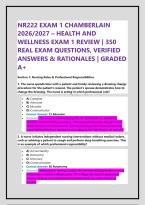
NR222 EXAM 1 CHAMBERLAIN
2026/2027 – HEALTH AND
WELLNESS EXAM 1 REVIEW | 350
REAL EXAM QUESTIONS, VERIFIED
ANSWERS & RATIONALES | GRADED
A+
Section 1: Nursing Roles & Professional Responsibilities
1. The nurse spends time with a patient and family reviewing a dressing change
procedure for the patient's wound. The patient's spouse demonstrates how to
change the dressing. The nurse is acting in which professional role?
• A) Caregiver
• B) Advocate
• C) Educator
• D) Communicator
• Correct Answer: C) Educator
• Rationale: The nurse is demonstrating the role of educator by explaining
concepts, demonstrating procedures, and evaluating learning through return
demonstration. The educator role involves providing information, facilitating
health-related behavior changes, and evaluating the effectiveness of teaching.
2. A nurse initiates independent nursing interventions without medical orders,
such as advising a patient to cough and perform deep breathing exercises. This
is an example of which professional responsibility?
• A) Accountability
• B) Autonomy
• C) Advocacy
• D) Communication
• Correct Answer: B) Autonomy
• Rationale: Autonomy in nursing involves the initiation of independent nursing
interventions without medical orders. This reflects the nurse's independent
decision-making and professional judgment within the scope of nursing
practice.
,3. The nurse is responsible professionally and legally for the type and quality of
nursing care provided. This describes which professional responsibility?
• A) Autonomy
• B) Advocacy
• C) Accountability
• D) Communication
• Correct Answer: C) Accountability
• Rationale: Accountability means being responsible professionally and legally for
the type and quality of nursing care provided. This is a core professional value
that underpins all nursing practice.
4. Which organization founded the first organized program for training nurses
and was the first practicing nurse epidemiologist?
• A) Clara Barton
• B) Dorothea Dix
• C) Florence Nightingale
• D) Lillian Wald
• Correct Answer: C) Florence Nightingale
• Rationale: Florence Nightingale founded the first organized program for training
nurses and is considered the first practicing nurse epidemiologist.
Section 2: Health Models & Theories
5. The Transtheoretical Model is and includes?
• Correct Answer: Stages of change: 1. Precontemplation, 2. Contemplation, 3.
Preparation, 4. Action, 5. Maintenance, 6. Termination or Relapse.
6. The Health Belief Model is?
• Correct Answer: Addresses the relationship between a person's beliefs and
behaviors.
7. The Ecological Model of Health is and includes?
• Correct Answer: Promotes health based on levels of influence: 1. Individual, 2.
Interpersonal, 3. Organizational, 4. Community, 5. Policy.
8. Pender's Health Promotion Model has three focus areas. What are they?
• Correct Answer: 1. Individual experiences, 2. Behavioral-specific knowledge
and affect, 3. Behavioral outcomes.
9. The Clinical Model of Health is?
, • Correct Answer: Absence of disease; prevention not emphasized.
10. The Role Performance Model is?
• Correct Answer: Health is indicated by the ability to perform social roles. Role
performance includes work, family and social roles, with performance based
on societal expectations. Illness would be the failure to perform a person's
roles at the level of others in society.
11. The Adaptive Model of Health is?
• Correct Answer: Ability to adjust to social, mental, and physiological changes.
12. The Eudaimonistic Model of Health is?
• Correct Answer: This model emphasizes the interactions between physical,
social, psychological, and spiritual aspects of life and the environment.
Section 3: Health Promotion & Disease Prevention
13. Which definition best reflects health?
• A) Absence of disease
• B) Complete physical, mental, and social well-being
• C) Ability to perform ADLs
• D) Genetic fitness
• Correct Answer: B) Complete physical, mental, and social well-being
• Rationale: The WHO defines health as a state of complete physical, mental, and
social well-being, not merely the absence of disease.
14. Wellness is best described as:
• A) A fixed state
• B) The same as illness
• C) An active process of making choices toward a healthy and fulfilling life
• D) Only physical fitness
• Correct Answer: C) An active process of making choices toward a healthy
and fulfilling life
• Rationale: Wellness is an active, ongoing process involving multiple dimensions
of health.
15. Which is a social determinant of health?
• A) Food insecurity
• B) Blood pressure
• C) Height
, • D) Age
• Correct Answer: A) Food insecurity
• Rationale: Social determinants include income, education, housing, food
security, and neighborhood conditions.
16. Health disparities are:
• A) Random differences in health
• B) Preventable differences in health among groups
• C) Only genetic differences
• D) Differences in hospital size
• Correct Answer: B) Preventable differences in health among groups
• Rationale: Health disparities are unfair, preventable differences closely linked to
social, economic, and environmental disadvantage.
17. A major goal of Healthy People 2030 is to:
• A) Eliminate all diseases
• B) Increase health disparities
• C) Attain healthy lives free of preventable disease, injury, and premature death
• D) Focus only on hospital care
• Correct Answer: C) Attain healthy lives free of preventable disease, injury,
and premature death
• Rationale: Healthy People 2030 promotes health equity and disease prevention
across the lifespan.
18. Which is an example of primary prevention?
• A) Mammogram
• B) Immunization
• C) Cardiac rehabilitation
• D) Physical therapy after stroke
• Correct Answer: B) Immunization
• Rationale: Primary prevention prevents disease before it occurs, such as through
immunization.
19. Which is an example of secondary prevention?
• A) Seat belt education
• B) Smoking prevention program
• C) Blood pressure screening
• D) Cardiac rehab
• Correct Answer: C) Blood pressure screening
• Rationale: Secondary prevention focuses on early detection and treatment of
disease.