
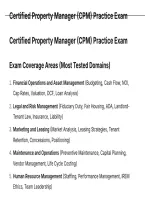
Certified Property Manager (CPM) Practice Exam
Certified Property Manager (CPM) Practice Exam
Exam Coverage Areas (Most Tested Domains)
1. Financial Operations and Asset Management (Budgeting, Cash Flow, NOI,
Cap Rates, Valuation, DCF, Loan Analysis)
2. Legal and Risk Management (Fiduciary Duty, Fair Housing, ADA, Landlord-
Tenant Law, Insurance, Liability)
3. Marketing and Leasing (Market Analysis, Leasing Strategies, Tenant
Retention, Concessions, Positioning)
4. Maintenance and Operations (Preventive Maintenance, Capital Planning,
Vendor Management, Life Cycle Costing)
5. Human Resource Management (Staffing, Performance Management, IREM
Ethics, Team Leadership)
, 6. IREM Code of Professional Ethics (Professional Conduct, Conflict of Interest,
Confidentiality)
7. Property Management Plan Framework (Owner Objectives, Asset Strategy,
Reporting)
8. Investment Analysis (IRR, NPV, Leverage, Sensitivity Analysis, Portfolio
Strategy)
9. Emergency Preparedness and Environmental Compliance (Life Safety, Lead
Paint, Asbestos, Disaster Planning)
10. Reporting and Owner Communication (Financial Reporting, Variance Analysis,
Owner Relations)
Certified Property Manager (CPM) Practice Exam
,1. A property manager is preparing an annual operating budget for a 200-unit
residential community. The owner has instructed that the budget must maintain
a debt service coverage ratio (DSCR) of at least 1.25. If net operating income is
projected at $1,200,000, what is the maximum annual debt service that
satisfies this requirement?
A. $960,000
B. $1,000,000
C. $1,500,000
D. $1,250,000
Correct Answer: A
Explained Point Form Notes:
DSCR = NOI ÷ Annual Debt Service. To find maximum debt service, rearrange:
Debt Service = NOI ÷ DSCR.
$1,200,000 ÷ 1.25 = $960,000.
, Choice B is incorrect: $1,000,000 would produce a DSCR of 1.20, below the
required threshold.
Choice C is incorrect: $1,500,000 would produce a DSCR of 0.80, meaning the
property cannot cover its debt obligations.
Choice D is incorrect: $1,250,000 would produce a DSCR of 0.96, also below
1.25.
The DSCR is a critical metric lenders use to assess a property's ability to
service debt from operating income 16 .
2. Which of the following best describes the primary purpose of a property
management plan when presented to an owner?
A. To document all tenant complaints received during the year
B. To align property operations with the owner's investment objectives and
provide a roadmap for achieving financial and operational goals
Certified Property Manager (CPM) Practice Exam
Exam Coverage Areas (Most Tested Domains)
1. Financial Operations and Asset Management (Budgeting, Cash Flow, NOI,
Cap Rates, Valuation, DCF, Loan Analysis)
2. Legal and Risk Management (Fiduciary Duty, Fair Housing, ADA, Landlord-
Tenant Law, Insurance, Liability)
3. Marketing and Leasing (Market Analysis, Leasing Strategies, Tenant
Retention, Concessions, Positioning)
4. Maintenance and Operations (Preventive Maintenance, Capital Planning,
Vendor Management, Life Cycle Costing)
5. Human Resource Management (Staffing, Performance Management, IREM
Ethics, Team Leadership)
, 6. IREM Code of Professional Ethics (Professional Conduct, Conflict of Interest,
Confidentiality)
7. Property Management Plan Framework (Owner Objectives, Asset Strategy,
Reporting)
8. Investment Analysis (IRR, NPV, Leverage, Sensitivity Analysis, Portfolio
Strategy)
9. Emergency Preparedness and Environmental Compliance (Life Safety, Lead
Paint, Asbestos, Disaster Planning)
10. Reporting and Owner Communication (Financial Reporting, Variance Analysis,
Owner Relations)
Certified Property Manager (CPM) Practice Exam
,1. A property manager is preparing an annual operating budget for a 200-unit
residential community. The owner has instructed that the budget must maintain
a debt service coverage ratio (DSCR) of at least 1.25. If net operating income is
projected at $1,200,000, what is the maximum annual debt service that
satisfies this requirement?
A. $960,000
B. $1,000,000
C. $1,500,000
D. $1,250,000
Correct Answer: A
Explained Point Form Notes:
DSCR = NOI ÷ Annual Debt Service. To find maximum debt service, rearrange:
Debt Service = NOI ÷ DSCR.
$1,200,000 ÷ 1.25 = $960,000.
, Choice B is incorrect: $1,000,000 would produce a DSCR of 1.20, below the
required threshold.
Choice C is incorrect: $1,500,000 would produce a DSCR of 0.80, meaning the
property cannot cover its debt obligations.
Choice D is incorrect: $1,250,000 would produce a DSCR of 0.96, also below
1.25.
The DSCR is a critical metric lenders use to assess a property's ability to
service debt from operating income 16 .
2. Which of the following best describes the primary purpose of a property
management plan when presented to an owner?
A. To document all tenant complaints received during the year
B. To align property operations with the owner's investment objectives and
provide a roadmap for achieving financial and operational goals


