
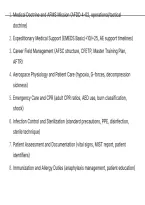
1. Medical Doctrine and AFMS Mission (AFDD 4-02, operational/tactical
doctrine)
2. Expeditionary Medical Support (EMEDS Basic/+10/+25, AE support timelines)
3. Career Field Management (AFSC structure, CFETP, Master Training Plan,
AFTR)
4. Aerospace Physiology and Patient Care (hypoxia, G-forces, decompression
sickness)
5. Emergency Care and CPR (adult CPR ratios, AED use, burn classification,
shock)
6. Infection Control and Sterilization (standard precautions, PPE, disinfection,
sterile technique)
7. Patient Assessment and Documentation (vital signs, MIST report, patient
identifiers)
8. Immunization and Allergy Duties (anaphylaxis management, patient education)
, 9. Nursing Procedures and Fluid Balance (catheterization, intake/output,
medication calculations)
10. Triage and Mass Casualty Care (triage categories, TCCC principles,
aeromedical evacuation)
4N0X1 End-of-Course Comprehensive Exam CDC Volume 1–12 Final Test
1. Which Air Force Doctrine Document serves as the primary guide used by Air
Force Medical Service commanders to accomplish their assigned missions?
A. AFDD 1, Basic Doctrine
B. AFDD 2-8, Command and Control
C. AFDD 4-02, Medical Operations
D. AFDD 1-1, Leadership and Force Development
Correct Answer: C
Explained Notes:
, AFDD 4-02, Medical Operations: This document provides the foundational
doctrine for the Air Force Medical Service, guiding commanders on how to
organize, train, and equip medical forces to support the full spectrum of
military operations 3 4 12 .
AFDD 1, Basic Doctrine: Serves as the capstone doctrine for the entire Air
Force, not specifically for medical operations or AFMS commanders.
AFDD 2-8, Command and Control: Addresses C2 principles and organization
across the Air Force, not medical-specific guidance for AFMS commanders.
AFDD 1-1, Leadership and Force Development: Focuses on leadership
philosophy and developing Airmen, not the primary guide for medical mission
accomplishment.
2. Why is Medical Doctrine considered necessary for Air Force Medical Service
operations?
A. It recommends step-by-step actions for every medical procedure
B. It directs the specific actions of individual commanders without flexibility
, C. It guides commanders in effectively using available medical assets
D. It changes faster than standard Air Force guidance documents
Correct Answer: C
Explained Notes:
Guides commanders in using assets: Medical doctrine provides a framework
for commanders to make informed decisions about employing medical
resources effectively in support of operational requirements 3 4 .
Recommends step-by-step actions: Doctrine is fundamentally authoritative
but not directive; it does not prescribe step-by-step procedures for every
medical task 14 .
Directs the specific actions of individual commanders: Doctrine is
authoritative but not directive, meaning it guides judgment rather than
dictating specific actions.
Changes faster than Air Force guidance: Doctrine is relatively stable and
enduring, not characterized by rapid changes compared to other guidance


