
Chapter 1
Supervisory Management Roles and Challenges
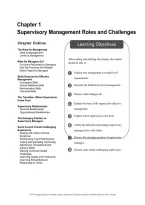
Chapter Outline Learning Objectives
The Need for Management
What Is Management?
Levels of Management
After reading and studying this chapter, the student
What Do Managers Do? should be able to:
Functions Performed by Managers
How the Functions Are Related
Roles Played by Managers
Skills Required for Effective
Explain why management is needed in all
organizations.
Management
Conceptual Skills
Human Relations Skills
Administrative Skills
Describe the different levels of management.
Technical Skills
The Transition: Where Supervisors
Discuss what managers do.
Come From
Supervisory Relationships Explain the basic skills required for effective
Personal Relationships management.
Organizational Relationships
The Emerging Position of Explain where supervisors come from.
Supervisory Managers
Some Current Trends Challenging Clarify the different relationships supervisory
Supervisors managers have with others.
Dealing with a More Diverse
Workforce
Emphasizing Team Performance Discuss the emerging position of supervisory
Coping with Exploding Technology managers.
Adjusting to Occupational and
Industry Shifts
Meeting Continued Global Discuss some trends challenging supervisors.
Challenges
Improving Quality and Productivity
Improving Ethical Behavior
Responding to Crises
© 2019 Cengage. May not be scanned, copied or duplicated, or posted to a publicly accessible website, in whole or in part.
,SUPERVISORY MANAGEMENT Instructor’s Manual
© 2019 Cengage. All Rights Reserved. May not be scanned, copied or duplicated, or posted to a publicly accessible website, in whole or in part.
, CHAPTER NOTES Chapter 1
Preview
Jackie Schultz, Supervisor
This chapter begins with a profile of Jackie Schultz, supervisor for Panera Bread. The profile highlights
several concepts that will be discussed throughout the text. Schultz joined Panera Bread while she was a
high school senior. She cross-trained for multiple associate jobs and, within six months, was named an
associate trainer. A year later, she was promoted to shift supervisor and training specialist. The associates
in Jackie’s store are representative of a diverse group of employees. The profile demonstrates the
importance of working through associates to achieve goals. As a supervisor, the core of Jackie’s daily job
is making sure Panera’s commitment to quality is reflected in her associates’ job performance. The profile
also lists the activities that Schultz performs and the skills she uses.
Lecture Outline
I. The Need for Management
Whenever a group of people works together in a structured situation to achieve a common
objective, they form an organization.
The main objective of an organization is to produce a product or provide a service.
To reach the objectives, management must perform three basic organizational activities:
o Operations, or producing the product or service
o Marketing, or selling and distributing the product
o Financing, or providing and using funds
A. What is Management?
Management can be defined as the process of working with and through people to achieve
objectives by means of effective decision making and coordination of available resources.
The basic resources of any organization are human resources, which are the people involved;
physical resources, which include buildings, furnishings, machinery, computers, equipment,
materials, and supplies; and financial resources, such as money, capital, and credit.
B. Levels of Management
Except in very small organizations, the different levels of management are usually based on the
amount of responsibility and authority required to perform the job.
Authority is the right to tell others to act or not act in order to reach objectives.
Responsibility is the obligation that is created when an employee accepts a manager’s
delegated authority.
Large organizations usually have at least three levels of management, plus a level of operative
© 2019 Cengage. All Rights Reserved. May not be scanned, copied or duplicated, or posted to a publicly accessible website, in whole or in part.
, SUPERVISORY MANAGEMENT Instructor’s Manual
employees. These levels are generally referred to as:
o Top management is responsible for the overall operations of the entire organization or
oversees a major segment of the organization or a basic organizational activity.
o Middle management is responsible for a substantial part of the organization.
o Supervisory management has control over the operations of a smaller organizational
unit.
Supervisory managers or supervisors are the organization’s primary link with most of its
employees.
II. What Do Managers Do?
A. Functions Performed by Managers
Managerial functions are the broad classifications of activities that all managers perform.
The functions are planning, organizing, staffing, leading, and controlling.
1. Planning
Planning involves selecting goals and future courses of action and deciding how to achieve
the desired results.
All other basic managerial functions depend on planning because it is unlikely that they will
be successfully carried out without sound and continuous planning.
2. Organizing
Deciding what activities are needed to reach goals and objectives, deciding who is to
perform what task, dividing human resources into work groups, and assigning each group to
a manager are tasks that make up the organizing function.
Another aspect of organizing is bringing together the physical, financial, and human
resources needed to achieve the organization’s objectives.
3. Staffing
The process of recruiting, selecting, training, developing, promoting, and paying and
rewarding people to do the organization’s work is called staffing.
4. Leading
The leading function involves guiding, influencing, and motivating employees in the
performance of their duties and responsibilities.
It consists of coaching and empowering employees, facilitating their activities,
communicating ideas and instructions, and motivating employees to perform their work
efficiently.
© 2019 Cengage. All Rights Reserved. May not be scanned, copied or duplicated, or posted to a publicly accessible website, in whole or in part.


