
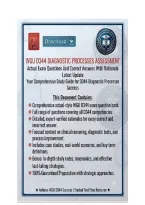
,WGU D344 DIAGNOSTIC PROCESSES ASSESSMENT Actual Exam
Questions And Correct Answers With Rationale Latest Update
1. During an initial psychiatric interview, a patient expresses
intense anger toward the PMHNP, accusing the clinician of
being cold and unsupportive, mirroring feelings the patient
holds toward their critical parent. What phenomenon is the
patient exhibiting?
• A) Countertransference
• B) Transference
• C) Projection
• D) Displacement
• Answer: B) Transference
• Rationale: Transference occurs when a patient
unconsciously redirects feelings, expectations, or desires
from significant figures in their past (such as parents) onto
the therapist or clinician.
2. A PMHNP finds themselves feeling unusually irritated and
impatient with a patient who frequently misses appointments,
noticing that the patient reminds them of an irresponsible
former business partner. This dynamic is an example of:
• A) Positive transference
• B) Negative transference
, • C) Countertransference
• D) Resistance
• Answer: C) Countertransference
• Rationale: Countertransference happens when the
clinician projects their own unresolved personal feelings,
attitudes, or past experiences onto the patient.
3. Which questioning strategy is most appropriate for a
PMHNP to use at the beginning of an interview to encourage a
patient's open narrative?
• A) Closed-ended questions
• B) Leading questions
• C) Open-ended questions
• D) Multiple-choice questions
• Answer: C) Open-ended questions
• Rationale: Open-ended questions invite patients to
describe their experiences in their own words, yielding rich
qualitative data and encouraging a collaborative
therapeutic alliance.
4. How should the chief complaint (CC) ideally be documented
in a psychiatric evaluation?
• A) Using the clinician's diagnostic terminology
, • B) In the patient's own words whenever possible
• C) As a summarized DSM-5-TR code
• D) Only after the full mental status exam is complete
• Answer: B) In the patient's own words whenever possible
• Rationale: Documenting the chief complaint verbatim
preserves the authentic reason for the patient's visit and
avoids premature diagnostic labeling.
5. Which nonverbal communication strategy enhances
empathy and active listening during a clinical interview?
• A) Maintaining rigid posture and avoiding eye contact to
remain neutral
• B) Checking a wristwatch frequently to manage time
efficiently
• C) Assuming a relaxed, open posture and mirroring
appropriate body language
• D) Writing continuous notes without looking up at the
patient
• Answer: C) Assuming a relaxed, open posture and
mirroring appropriate body language
• Rationale: Open posture, appropriate eye contact, and
empathetic nonverbal cues foster trust, safety, and
engagement.
Questions And Correct Answers With Rationale Latest Update
1. During an initial psychiatric interview, a patient expresses
intense anger toward the PMHNP, accusing the clinician of
being cold and unsupportive, mirroring feelings the patient
holds toward their critical parent. What phenomenon is the
patient exhibiting?
• A) Countertransference
• B) Transference
• C) Projection
• D) Displacement
• Answer: B) Transference
• Rationale: Transference occurs when a patient
unconsciously redirects feelings, expectations, or desires
from significant figures in their past (such as parents) onto
the therapist or clinician.
2. A PMHNP finds themselves feeling unusually irritated and
impatient with a patient who frequently misses appointments,
noticing that the patient reminds them of an irresponsible
former business partner. This dynamic is an example of:
• A) Positive transference
• B) Negative transference
, • C) Countertransference
• D) Resistance
• Answer: C) Countertransference
• Rationale: Countertransference happens when the
clinician projects their own unresolved personal feelings,
attitudes, or past experiences onto the patient.
3. Which questioning strategy is most appropriate for a
PMHNP to use at the beginning of an interview to encourage a
patient's open narrative?
• A) Closed-ended questions
• B) Leading questions
• C) Open-ended questions
• D) Multiple-choice questions
• Answer: C) Open-ended questions
• Rationale: Open-ended questions invite patients to
describe their experiences in their own words, yielding rich
qualitative data and encouraging a collaborative
therapeutic alliance.
4. How should the chief complaint (CC) ideally be documented
in a psychiatric evaluation?
• A) Using the clinician's diagnostic terminology
, • B) In the patient's own words whenever possible
• C) As a summarized DSM-5-TR code
• D) Only after the full mental status exam is complete
• Answer: B) In the patient's own words whenever possible
• Rationale: Documenting the chief complaint verbatim
preserves the authentic reason for the patient's visit and
avoids premature diagnostic labeling.
5. Which nonverbal communication strategy enhances
empathy and active listening during a clinical interview?
• A) Maintaining rigid posture and avoiding eye contact to
remain neutral
• B) Checking a wristwatch frequently to manage time
efficiently
• C) Assuming a relaxed, open posture and mirroring
appropriate body language
• D) Writing continuous notes without looking up at the
patient
• Answer: C) Assuming a relaxed, open posture and
mirroring appropriate body language
• Rationale: Open posture, appropriate eye contact, and
empathetic nonverbal cues foster trust, safety, and
engagement.


