
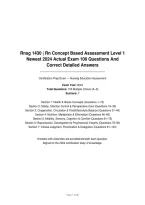
Rnsg 1430 | Rn Concept Based Assessment Level 1
Newest 2024 Actual Exam 100 Questions And
Correct Detailed Answers
Certification Prep Exam — Nursing Education Assessment
Exam Year: 2024
Total Questions: 100 Multiple-Choice (A–D)
Sections: 7
Section 1: Health & Illness Concepts (Questions 1–15)
Section 2: Safety, Infection Control & Perioperative Care (Questions 16–30)
Section 3: Oxygenation, Circulation & Fluid/Electrolyte Balance (Questions 31–45)
Section 4: Nutrition, Metabolism & Elimination (Questions 46–60)
Section 5: Mobility, Sensory, Cognition & Comfort (Questions 61–75)
Section 6: Reproduction, Development & Psychosocial Integrity (Questions 76–90)
Section 7: Clinical Judgment, Prioritization & Delegation (Questions 91–100)
Answers with rationales are provided beneath each question.
Aligned to the 2024 certification body of knowledge.
Page 1 of 36
,Table of Contents
Section 1: Health & Illness Concepts (Questions 1–15)3
Section 2: Safety, Infection Control & Perioperative Care (Questions 16–30)8
Section 3: Oxygenation, Circulation & Fluid/Electrolyte Balance (Questions 31–45)13
Section 4: Nutrition, Metabolism & Elimination (Questions 46–60)18
Section 5: Mobility, Sensory, Cognition & Comfort (Questions 61–75)23
Section 6: Reproduction, Development & Psychosocial Integrity (Questions 76–90)28
Section 7: Clinical Judgment, Prioritization & Delegation (Questions 91–100)33
Page 2 of 36
,Section 1: Health & Illness Concepts (Questions 1–15)
Q1: A community health nurse plans programs for a neighborhood. Which activity is an
example of primary prevention?
A. Annual mammography for clients older than 50 years
B. Blood glucose monitoring for a client with type 2 diabetes
C. Cardiac rehabilitation after myocardial infarction
D. Influenza immunization for a 68-year-old client **[CORRECT]**
Correct Answer: D
Rationale: Primary prevention prevents disease before it occurs through measures such
as immunization. Mammography and glucose monitoring are secondary prevention (early
detection), and cardiac rehabilitation is tertiary prevention (limiting disability).
Q2: A client newly diagnosed with type 2 diabetes states, "I feel fine, so I don't need to change
anything." Which action should the nurse take first?
A. Provide a detailed list of diabetes complications
B. Explore the client's beliefs about personal risk and the seriousness of diabetes
**[CORRECT]**
C. Refer the client immediately to an endocrinologist
D. Document that the client is noncompliant with the plan of care
Correct Answer: B
Rationale: The health belief model holds that perceived susceptibility and severity drive
health behavior, so assessment of the client's beliefs comes before teaching. Listing
complications or labeling noncompliance skips assessment, and referral is not the first
step.
Q3: The nurse is preparing discharge instructions for a client with limited health literacy.
Which strategy best promotes understanding?
A. Provide a 15-page printed teaching packet
B. Review all instructions quickly at the moment of discharge
C. Use teach-back with plain language and include the family in teaching **[CORRECT]**
D. Mail the written instructions to the client after discharge
Correct Answer: C
Rationale: Teach-back verifies comprehension and allows correction in the moment, which
is the recommended strategy for limited health literacy. Long handouts, rushed teaching,
and post-discharge materials do not confirm understanding.
Page 3 of 36
, Q4: According to the health-illness continuum, which statement is most accurate?
A. A person moves along the continuum, from high-level wellness to illness, and may
move in either direction at any time **[CORRECT]**
B. Health is a fixed state that changes only with illness
C. Only physical factors determine a person's position on the continuum
D. A client with a chronic illness remains permanently at the illness end
Correct Answer: A
Rationale: The continuum describes a dynamic range of wellness and illness that
individuals move along in either direction. It is not static, is influenced by physical and
psychosocial factors, and does not permanently fix clients with chronic illness.
Q5: A client with COPD reports that fatigue limits daily activities but states, "I have adjusted
my routine and I'm doing the best I can." Which concept is the client demonstrating?
A. Denial
B. Exacerbation of the disease
C. Adaptation to a chronic illness **[CORRECT]**
D. Noncompliance with the treatment plan
Correct Answer: C
Rationale: Adjusting routines and functioning within limitations demonstrates adaptation to
a chronic condition. Denial and noncompliance imply avoidance or refusal, and
exacerbation refers to worsening of the disease itself.
Q6: Which nursing action reflects health promotion rather than disease prevention in an older
adult?
A. Administering scheduled immunizations
B. Teaching the client to recognize signs of infection
C. Screening for depression at every visit
D. Assisting the client to set a goal of walking 20 minutes daily **[CORRECT]**
Correct Answer: D
Rationale: Health promotion aims to expand positive health potential through behaviors
such as activity goal setting. Immunizations, early-detection teaching, and screening are
disease prevention activities.
Page 4 of 36


