
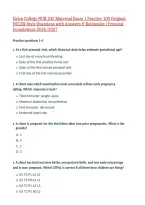
Galen College NUR 243 Maternal Exam 1 Practice 100 Original
NCLEX-Style Questions with Answers & Rationales | Prenatal
Foundations 2026/2027
Practice questions 1-4
1. At a first prenatal visit, which historical date helps estimate gestational age?
A. Last day of menstrual bleeding
B. Date of the first positive home test
C. Date of the first missed prenatal visit
D. First day of the last menstrual period
2.A client asks which examination most accurately refines early pregnancy
dating. Which response is best?
A. Third-trimester weight alone
B. Maternal abdominal circumference
C. First-trimester ultrasound
D. Maternal heart rate
3. A client is pregnant for the third time after two prior pregnancies. What is the
gravida?
A. 1
B. 4
C. 2
D. 3
4.A client has had two term births, one preterm birth, and one early miscarriage
and is now pregnant. Which GTPAL is correct if all three born children are living?
A. G5 T2 P1 A1 L3
B. G5 T3 P0 A1 L3
C. G4 T2 P1 A1 L3
D. G5 T2 P1 A0 L3
,Practice questions 5-8
5.A client delivered twins at 36 weeks and is now pregnant again. Which GTPAL is
correct if both twins are living?
A. G3 T0 P1 A0 L2
B. G2 T1 P0 A0 L2
C. G2 T0 P1 A0 L2
D. G2 T0 P2 A0 L2
6. Which finding is a presumptive sign of pregnancy?
A. Fetus visualized on ultrasound
B. Amenorrhea
C. Fetal movement palpated by the examiner
D. Fetal cardiac activity on ultrasound
7. Which finding is a positive sign of pregnancy?
A. Nausea
B. Fetal cardiac activity detected by ultrasound
C. Urinary frequency
D. Breast tenderness
8. Why may hemoglobin decrease somewhat during normal pregnancy?
A. All iron is lost through the placenta
B. Blood volume decreases sharply
C. Plasma volume increases more than red-cell mass
D. Red-cell production stops
,Practice questions 9-12
9. A pregnant client feels dizzy while supine. Which position should the nurse assist
with?
A. Side-lying, preferably left lateral
B. Flat with legs straight
C. Prone with abdominal pressure
D. Head-down with no turn
10. Which cardiovascular change is expected in uncomplicated pregnancy?
A. Increased cardiac output
B. Persistent severe hypertension
C. Absent peripheral pulses
D. Markedly reduced blood volume
11.A client reports mild shortness of breath with exertion but no distress. Which
response is appropriate?
A. Tell the client to stop all activity
B. Assume every breathing change is normal
C. Assess symptoms and distinguish expected adaptation from warning signs
D. Diagnose pulmonary embolism without assessment
12. Which pregnancy symptom requires urgent assessment?
A. Mild constipation
B. Occasional morning nausea with normal intake
C. Chest pain with difficulty breathing
D. Mild breast fullness
, Practice questions 13-16
13. Which early-pregnancy urinary complaint needs evaluation for infection?
A. Occasional nocturia without other symptoms
B. Frequency without pain
C. Burning with urination
D. Increased urine volume after drinking water
14. Why is asymptomatic bacteriuria screening important in pregnancy?
A. It measures placental function directly
B. It replaces all blood tests
C. It confirms fetal sex
D. Untreated bacteriuria can progress to pyelonephritis
15. Which response best addresses mild morning nausea?
A. Use any herbal remedy without review
B. Try small frequent meals and avoid personal triggers
C. Fast for the entire day
D. Drink large volumes only with meals
16. A pregnant client cannot retain fluids and has dizziness. What should the nurse
recommend?
A. Prompt clinical assessment
B. Treat with exercise alone
C. Wait until the next routine visit
D. Stop drinking until vomiting ends


