
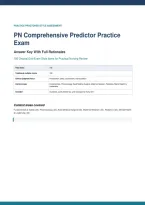
PRACTICE PROCTORED-STYLE ASSESSMENT
PN Comprehensive Predictor Practice
Exam
Answer Key With Full Rationales
180 Original Exit-Exam-Style Items for Practical Nursing Review
Total items 180
Traditional multiple choice 180
Clinical judgment focus Prioritization, safety, assessment, and escalation
Content areas Fundamentals, Pharmacology, Adult Medical-Surgical, Maternal-Newborn, Pediatrics, Mental Health &
Leadership
Included Questions, quick answer key, and rationales for every item
Content areas covered
Fundamentals & Safety (30), Pharmacology (30), Adult Medical-Surgical (30), Maternal-Newborn (30), Pediatrics (30), Mental Health
& Leadership (30)
,PN Comprehensive Predictor Practice Exam Answer Key and Rationales
How to Use This Answer Key
• Take the questions first under timed conditions, then score your responses with the Quick Answer Key.
• For each question, choose the single best answer. These items are original review questions and are not reproduced from ATI's
secure exam.
• Read every rationale, including for items you answered correctly. Focus on safety, changes in condition, scope of practice, and
timely escalation.
• Use missed items to identify topics for remediation. Confirm clinical decisions against current course materials, facility policy, and
guidance from your instructor.
• The official ATI Comprehensive Predictor is a secure 180-question assessment. This packet is an independent practice resource,
not an official ATI publication.
Suggested Review Blueprint
Content area Items Focus
Fundamentals & Safety 30 Infection prevention, mobility, communication, documentation, client rights
Pharmacology 30 Medication safety, adverse effects, monitoring, client teaching
Adult Medical-Surgical 30 Acute changes, chronic illness, assessment, escalation
Maternal-Newborn 30 Pregnancy warning signs, labor, postpartum, newborn safety
Pediatrics 30 Developmentally appropriate care, respiratory distress, hydration, safety
Mental Health & Leadership 30 Therapeutic communication, safety, delegation, handoff, legal/ethical care
Original educational practice items; not affiliated with or endorsed by ATI or NCSBN. Page 2
,PN Comprehensive Predictor Practice Exam Answer Key and Rationales
Quick Answer Key
# Format Correct answer Topic
1 Multiple Choice A Fundamentals & Safety — A client has a new prescription for a medication, but the name on the
pa…
2 Multiple Choice A Fundamentals & Safety — A client is at risk for falls after receiving an opioid. Which action be…
3 Multiple Choice C Fundamentals & Safety — Which action is appropriate when removing contaminated gloves?
4 Multiple Choice A Fundamentals & Safety — A client begins choking and cannot speak or cough effectively. What
is t…
5 Multiple Choice D Fundamentals & Safety — Which practice helps prevent catheter-associated urinary tract
infection…
6 Multiple Choice D Fundamentals & Safety — A client with suspected tuberculosis is admitted. Which precautions
are …
7 Multiple Choice D Fundamentals & Safety — A sterile field becomes wet from fluid soaking through the drape.
What s…
8 Multiple Choice B Fundamentals & Safety — Which action is safest before transferring a client from bed to
wheelcha…
9 Multiple Choice D Fundamentals & Safety — A client has a pressure injury risk and limited mobility. Which
interven…
10 Multiple Choice D Fundamentals & Safety — Which finding should be reported promptly after a fall?
11 Multiple Choice D Fundamentals & Safety — A client refuses a prescribed treatment. What is the nurse's best
respon…
12 Multiple Choice B Fundamentals & Safety — Which documentation entry is most appropriate?
13 Multiple Choice A Fundamentals & Safety — A fire starts in a client's room. Which sequence is commonly taught
by R…
14 Multiple Choice D Fundamentals & Safety — A nurse needs to use a fire extinguisher. Which PASS sequence is
correct…
15 Multiple Choice C Fundamentals & Safety — Which action best protects client confidentiality?
16 Multiple Choice B Fundamentals & Safety — A client is prescribed oxygen. Which safety instruction is essential?
17 Multiple Choice A Fundamentals & Safety — Which action should be taken before applying restraints when a
client is…
18 Multiple Choice D Fundamentals & Safety — A client reports dizziness when standing. Which nursing action is
approp…
19 Multiple Choice C Fundamentals & Safety — Which action is appropriate when collecting a clean-catch urine
specimen…
20 Multiple Choice A Fundamentals & Safety — A client with diarrhea is suspected of having C. difficile. Which hand
h…
21 Multiple Choice B Fundamentals & Safety — Which task is generally appropriate to delegate to trained assistive
per…
22 Multiple Choice B Fundamentals & Safety — A client has difficulty swallowing. Which action should the nurse take
d…
23 Multiple Choice B Fundamentals & Safety — Which action is appropriate when using a gait belt?
24 Multiple Choice B Fundamentals & Safety — A client with limited mobility needs prevention of venous stasis.
Which …
25 Multiple Choice B Fundamentals & Safety — Which vital-sign change is most concerning and needs immediate
reassessm…
26 Multiple Choice D Fundamentals & Safety — A client has a hearing impairment. Which communication technique
is best…
27 Multiple Choice A Fundamentals & Safety — Which action is appropriate before a procedure requiring informed
consen…
28 Multiple Choice C Fundamentals & Safety — A client is on aspiration precautions. Which item should be checked
befo…
29 Multiple Choice B Fundamentals & Safety — Which action best supports safe medication administration?
Original educational practice items; not affiliated with or endorsed by ATI or NCSBN. Page 3
, PN Comprehensive Predictor Practice Exam Answer Key and Rationales
# Format Correct answer Topic
30 Multiple Choice C Fundamentals & Safety — A client develops sudden shortness of breath. What should the
nurse do f…
31 Multiple Choice B Pharmacology — A client taking digoxin reports nausea and yellow-green visual changes. …
32 Multiple Choice D Pharmacology — Before administering a beta blocker, which assessment is especially impo…
33 Multiple Choice B Pharmacology — A client taking warfarin reports black, tarry stools. What is the priori…
34 Multiple Choice C Pharmacology — Which instruction is appropriate for a client prescribed an oral antibio…
35 Multiple Choice B Pharmacology — A client receiving insulin becomes sweaty, shaky, and confused. What sho…
36 Multiple Choice D Pharmacology — Which site is commonly used for subcutaneous enoxaparin administration?
37 Multiple Choice C Pharmacology — Which instruction is important for a client taking a loop diuretic?
38 Multiple Choice D Pharmacology — A client prescribed an ACE inhibitor develops swelling of the lips and t…
39 Multiple Choice A Pharmacology — Which statement about acetaminophen is correct?
40 Multiple Choice B Pharmacology — A client taking lithium develops coarse tremor, vomiting, and unsteady g…
41 Multiple Choice A Pharmacology — Which instruction is appropriate for a client taking oral iron?
42 Multiple Choice C Pharmacology — A client is prescribed a medication that may cause orthostatic hypotensi…
43 Multiple Choice B Pharmacology — Which action is appropriate when administering a transdermal medication …
44 Multiple Choice C Pharmacology — A client using an inhaled corticosteroid should be taught to:
45 Multiple Choice D Pharmacology — Which finding is most concerning in a client receiving an opioid?
46 Multiple Choice B Pharmacology — A client taking a statin reports unexplained muscle pain and weakness. W…
47 Multiple Choice C Pharmacology — Which instruction is appropriate for a client prescribed levothyroxine?
48 Multiple Choice A Pharmacology — A client receiving a potassium-sparing diuretic should be monitored for:
49 Multiple Choice A Pharmacology — Which action is correct when giving eye drops?
50 Multiple Choice B Pharmacology — A client is prescribed a medication by a route that seems unusual for th…
51 Multiple Choice A Pharmacology — Which finding may indicate anaphylaxis after a medication?
52 Multiple Choice A Pharmacology — A client taking metformin is scheduled for a contrast imaging study. Wha…
53 Multiple Choice B Pharmacology — Which teaching is important for a client using a rescue bronchodilator i…
54 Multiple Choice B Pharmacology — Which lab result is especially important to review before administering …
55 Multiple Choice A Pharmacology — A client is prescribed an anticoagulant. Which teaching is appropriate?
56 Multiple Choice A Pharmacology — Which instruction is appropriate for a client using nitroglycerin for an…
57 Multiple Choice C Pharmacology — Which medication safety action is appropriate for a high-alert medicatio…
58 Multiple Choice B Pharmacology — A client is taking a benzodiazepine. Which safety teaching is appropriat…
59 Multiple Choice B Pharmacology — A client prescribed a proton pump inhibitor asks how to take it. What is…
60 Multiple Choice B Pharmacology — Which action is appropriate when a client experiences a suspected advers…
61 Multiple Choice D Adult Medical-Surgical — A client with heart failure has worsening dyspnea and crackles. What
is …
62 Multiple Choice C Adult Medical-Surgical — A client with diabetes is alert and has a blood glucose of 58 mg/dL.
Wha…
63 Multiple Choice C Adult Medical-Surgical — Which finding is typical of left-sided heart failure?
64 Multiple Choice B Adult Medical-Surgical — A client reports crushing chest pressure with sweating. What should
the …
65 Multiple Choice C Adult Medical-Surgical — Which instruction is appropriate for a client with COPD who becomes
shor…
66 Multiple Choice C Adult Medical-Surgical — A client with suspected stroke develops facial droop and arm
weakness. W…
67 Multiple Choice D Adult Medical-Surgical — Which finding in a client with pneumonia requires prompt attention?
68 Multiple Choice A Adult Medical-Surgical — A client with chronic kidney disease should be taught to:
69 Multiple Choice B Adult Medical-Surgical — Which finding may indicate an upper gastrointestinal bleed?
Original educational practice items; not affiliated with or endorsed by ATI or NCSBN. Page 4
PN Comprehensive Predictor Practice
Exam
Answer Key With Full Rationales
180 Original Exit-Exam-Style Items for Practical Nursing Review
Total items 180
Traditional multiple choice 180
Clinical judgment focus Prioritization, safety, assessment, and escalation
Content areas Fundamentals, Pharmacology, Adult Medical-Surgical, Maternal-Newborn, Pediatrics, Mental Health &
Leadership
Included Questions, quick answer key, and rationales for every item
Content areas covered
Fundamentals & Safety (30), Pharmacology (30), Adult Medical-Surgical (30), Maternal-Newborn (30), Pediatrics (30), Mental Health
& Leadership (30)
,PN Comprehensive Predictor Practice Exam Answer Key and Rationales
How to Use This Answer Key
• Take the questions first under timed conditions, then score your responses with the Quick Answer Key.
• For each question, choose the single best answer. These items are original review questions and are not reproduced from ATI's
secure exam.
• Read every rationale, including for items you answered correctly. Focus on safety, changes in condition, scope of practice, and
timely escalation.
• Use missed items to identify topics for remediation. Confirm clinical decisions against current course materials, facility policy, and
guidance from your instructor.
• The official ATI Comprehensive Predictor is a secure 180-question assessment. This packet is an independent practice resource,
not an official ATI publication.
Suggested Review Blueprint
Content area Items Focus
Fundamentals & Safety 30 Infection prevention, mobility, communication, documentation, client rights
Pharmacology 30 Medication safety, adverse effects, monitoring, client teaching
Adult Medical-Surgical 30 Acute changes, chronic illness, assessment, escalation
Maternal-Newborn 30 Pregnancy warning signs, labor, postpartum, newborn safety
Pediatrics 30 Developmentally appropriate care, respiratory distress, hydration, safety
Mental Health & Leadership 30 Therapeutic communication, safety, delegation, handoff, legal/ethical care
Original educational practice items; not affiliated with or endorsed by ATI or NCSBN. Page 2
,PN Comprehensive Predictor Practice Exam Answer Key and Rationales
Quick Answer Key
# Format Correct answer Topic
1 Multiple Choice A Fundamentals & Safety — A client has a new prescription for a medication, but the name on the
pa…
2 Multiple Choice A Fundamentals & Safety — A client is at risk for falls after receiving an opioid. Which action be…
3 Multiple Choice C Fundamentals & Safety — Which action is appropriate when removing contaminated gloves?
4 Multiple Choice A Fundamentals & Safety — A client begins choking and cannot speak or cough effectively. What
is t…
5 Multiple Choice D Fundamentals & Safety — Which practice helps prevent catheter-associated urinary tract
infection…
6 Multiple Choice D Fundamentals & Safety — A client with suspected tuberculosis is admitted. Which precautions
are …
7 Multiple Choice D Fundamentals & Safety — A sterile field becomes wet from fluid soaking through the drape.
What s…
8 Multiple Choice B Fundamentals & Safety — Which action is safest before transferring a client from bed to
wheelcha…
9 Multiple Choice D Fundamentals & Safety — A client has a pressure injury risk and limited mobility. Which
interven…
10 Multiple Choice D Fundamentals & Safety — Which finding should be reported promptly after a fall?
11 Multiple Choice D Fundamentals & Safety — A client refuses a prescribed treatment. What is the nurse's best
respon…
12 Multiple Choice B Fundamentals & Safety — Which documentation entry is most appropriate?
13 Multiple Choice A Fundamentals & Safety — A fire starts in a client's room. Which sequence is commonly taught
by R…
14 Multiple Choice D Fundamentals & Safety — A nurse needs to use a fire extinguisher. Which PASS sequence is
correct…
15 Multiple Choice C Fundamentals & Safety — Which action best protects client confidentiality?
16 Multiple Choice B Fundamentals & Safety — A client is prescribed oxygen. Which safety instruction is essential?
17 Multiple Choice A Fundamentals & Safety — Which action should be taken before applying restraints when a
client is…
18 Multiple Choice D Fundamentals & Safety — A client reports dizziness when standing. Which nursing action is
approp…
19 Multiple Choice C Fundamentals & Safety — Which action is appropriate when collecting a clean-catch urine
specimen…
20 Multiple Choice A Fundamentals & Safety — A client with diarrhea is suspected of having C. difficile. Which hand
h…
21 Multiple Choice B Fundamentals & Safety — Which task is generally appropriate to delegate to trained assistive
per…
22 Multiple Choice B Fundamentals & Safety — A client has difficulty swallowing. Which action should the nurse take
d…
23 Multiple Choice B Fundamentals & Safety — Which action is appropriate when using a gait belt?
24 Multiple Choice B Fundamentals & Safety — A client with limited mobility needs prevention of venous stasis.
Which …
25 Multiple Choice B Fundamentals & Safety — Which vital-sign change is most concerning and needs immediate
reassessm…
26 Multiple Choice D Fundamentals & Safety — A client has a hearing impairment. Which communication technique
is best…
27 Multiple Choice A Fundamentals & Safety — Which action is appropriate before a procedure requiring informed
consen…
28 Multiple Choice C Fundamentals & Safety — A client is on aspiration precautions. Which item should be checked
befo…
29 Multiple Choice B Fundamentals & Safety — Which action best supports safe medication administration?
Original educational practice items; not affiliated with or endorsed by ATI or NCSBN. Page 3
, PN Comprehensive Predictor Practice Exam Answer Key and Rationales
# Format Correct answer Topic
30 Multiple Choice C Fundamentals & Safety — A client develops sudden shortness of breath. What should the
nurse do f…
31 Multiple Choice B Pharmacology — A client taking digoxin reports nausea and yellow-green visual changes. …
32 Multiple Choice D Pharmacology — Before administering a beta blocker, which assessment is especially impo…
33 Multiple Choice B Pharmacology — A client taking warfarin reports black, tarry stools. What is the priori…
34 Multiple Choice C Pharmacology — Which instruction is appropriate for a client prescribed an oral antibio…
35 Multiple Choice B Pharmacology — A client receiving insulin becomes sweaty, shaky, and confused. What sho…
36 Multiple Choice D Pharmacology — Which site is commonly used for subcutaneous enoxaparin administration?
37 Multiple Choice C Pharmacology — Which instruction is important for a client taking a loop diuretic?
38 Multiple Choice D Pharmacology — A client prescribed an ACE inhibitor develops swelling of the lips and t…
39 Multiple Choice A Pharmacology — Which statement about acetaminophen is correct?
40 Multiple Choice B Pharmacology — A client taking lithium develops coarse tremor, vomiting, and unsteady g…
41 Multiple Choice A Pharmacology — Which instruction is appropriate for a client taking oral iron?
42 Multiple Choice C Pharmacology — A client is prescribed a medication that may cause orthostatic hypotensi…
43 Multiple Choice B Pharmacology — Which action is appropriate when administering a transdermal medication …
44 Multiple Choice C Pharmacology — A client using an inhaled corticosteroid should be taught to:
45 Multiple Choice D Pharmacology — Which finding is most concerning in a client receiving an opioid?
46 Multiple Choice B Pharmacology — A client taking a statin reports unexplained muscle pain and weakness. W…
47 Multiple Choice C Pharmacology — Which instruction is appropriate for a client prescribed levothyroxine?
48 Multiple Choice A Pharmacology — A client receiving a potassium-sparing diuretic should be monitored for:
49 Multiple Choice A Pharmacology — Which action is correct when giving eye drops?
50 Multiple Choice B Pharmacology — A client is prescribed a medication by a route that seems unusual for th…
51 Multiple Choice A Pharmacology — Which finding may indicate anaphylaxis after a medication?
52 Multiple Choice A Pharmacology — A client taking metformin is scheduled for a contrast imaging study. Wha…
53 Multiple Choice B Pharmacology — Which teaching is important for a client using a rescue bronchodilator i…
54 Multiple Choice B Pharmacology — Which lab result is especially important to review before administering …
55 Multiple Choice A Pharmacology — A client is prescribed an anticoagulant. Which teaching is appropriate?
56 Multiple Choice A Pharmacology — Which instruction is appropriate for a client using nitroglycerin for an…
57 Multiple Choice C Pharmacology — Which medication safety action is appropriate for a high-alert medicatio…
58 Multiple Choice B Pharmacology — A client is taking a benzodiazepine. Which safety teaching is appropriat…
59 Multiple Choice B Pharmacology — A client prescribed a proton pump inhibitor asks how to take it. What is…
60 Multiple Choice B Pharmacology — Which action is appropriate when a client experiences a suspected advers…
61 Multiple Choice D Adult Medical-Surgical — A client with heart failure has worsening dyspnea and crackles. What
is …
62 Multiple Choice C Adult Medical-Surgical — A client with diabetes is alert and has a blood glucose of 58 mg/dL.
Wha…
63 Multiple Choice C Adult Medical-Surgical — Which finding is typical of left-sided heart failure?
64 Multiple Choice B Adult Medical-Surgical — A client reports crushing chest pressure with sweating. What should
the …
65 Multiple Choice C Adult Medical-Surgical — Which instruction is appropriate for a client with COPD who becomes
shor…
66 Multiple Choice C Adult Medical-Surgical — A client with suspected stroke develops facial droop and arm
weakness. W…
67 Multiple Choice D Adult Medical-Surgical — Which finding in a client with pneumonia requires prompt attention?
68 Multiple Choice A Adult Medical-Surgical — A client with chronic kidney disease should be taught to:
69 Multiple Choice B Adult Medical-Surgical — Which finding may indicate an upper gastrointestinal bleed?
Original educational practice items; not affiliated with or endorsed by ATI or NCSBN. Page 4


