
GENERAL BALLISTICS THEORY | ORIGINAL EDUCATIONAL PRACTICE BANK
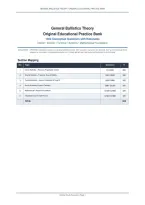
General Ballistics Theory
Original Educational Practice Bank
1920 Conceptual Questions with Rationales
Interior • Exterior • Terminal • Systems • Mathematical Foundations
DISCLAIMER – ORIGINAL educational resource on general ballistics science. NOT a solution manual for any textbook. NOT a construction guide for
weapons or ammunition. Conceptual/academic only. Comply with all laws. Use authorized textbooks for formal study.
Section Mapping
Sec Topic Questions N
1 Interior Ballistics – Pressure, Propellant & In-Bore Q1-Q320 320
2 Exterior Ballistics – Trajectory, Drag & Stability Q321-Q640 320
3 Terminal Ballistics – Impact, Penetration & Target R Q641-Q960 320
4 Gun & Ammunition System Concepts Q961-Q1280 320
5 Mathematical & Physical Foundations Q1281-Q1600 320
6 Integrated Cross-Domain Review Q1601-Q1920 320
TOTAL 1920
Original Study Resource | Page 1
, GENERAL BALLISTICS THEORY | ORIGINAL EDUCATIONAL PRACTICE BANK
Section 1: Interior Ballistics – Pressure, Propellant & In-Bore Motion
Q1: Interior ballistics primarily studies:
A. Only flight after muzzle exit
B. Processes inside the gun from ignition to projectile exit [CORRECT]
C. Only target penetration
D. Only wind
Correct Answer: B
Rationale: Covers combustion, pressure, and in-bore motion.
Q2: Peak chamber pressure depends on:
A. Only color
B. Propellant behavior, loading density, and geometry among other factors [CORRECT]
C. Only outdoor humidity
D. Nothing
Correct Answer: B
Rationale: Energetics and confinement control pressure.
Q3: In-bore acceleration force is mainly from:
A. Gravity alone
B. Gas pressure on the projectile base [CORRECT]
C. Magnetism only
D. Internal air drag
Correct Answer: B
Rationale: Combustion gases drive the projectile.
Original Study Resource | Page 2
, GENERAL BALLISTICS THEORY | ORIGINAL EDUCATIONAL PRACTICE BANK
Q4: Many propellant burn rates increase with:
A. Falling pressure only
B. Rising pressure [CORRECT]
C. No pressure effect
D. Paint color
Correct Answer: B
Rationale: Pressure-dependent burning is common.
Q5: Muzzle velocity is speed:
A. At the target
B. When leaving the muzzle [CORRECT]
C. Only at max range
D. Only in chamber
Correct Answer: B
Rationale: Key interior output.
Q6: All-burnt means:
A. Impact on target
B. Propellant fully consumed; expansion continues without new burn mass [CORRECT]
C. Gun cleaned
D. Primer only
Correct Answer: B
Rationale: Burning mass addition ends.
Q7: Barrel length affects velocity by:
A. Always reducing it
B. Changing expansion distance/time available to accelerate the projectile [CORRECT]
C. No effect
D. Color only
Correct Answer: B
Rationale: Travel distance affects work done.
Original Study Resource | Page 3
, GENERAL BALLISTICS THEORY | ORIGINAL EDUCATIONAL PRACTICE BANK
Q8: Barrel heat transfer:
A. Never happens
B. Removes gas energy and causes heating/wear concerns [CORRECT]
C. Only cools flight
D. Irrelevant
Correct Answer: B
Rationale: Thermal management matters.
Q9: Sabots can:
A. Only decorate
B. Launch sub-caliber projectiles from larger bores, then discard [CORRECT]
C. Remove all pressure
D. Only raise drag
Correct Answer: B
Rationale: Sub-caliber launch concept.
Q10: Interior models couple:
A. Only wind tables
B. Combustion, gas dynamics, and projectile motion [CORRECT]
C. Only target hardness
D. Only coatings
Correct Answer: B
Rationale: Coupled physics define the shot.
Q11: (Review 11) Interior ballistics primarily studies:
A. Only flight after muzzle exit
B. Processes inside the gun from ignition to projectile exit [CORRECT]
C. Only target penetration
D. Only wind
Correct Answer: B
Rationale: Covers combustion, pressure, and in-bore motion.
Original Study Resource | Page 4
General Ballistics Theory
Original Educational Practice Bank
1920 Conceptual Questions with Rationales
Interior • Exterior • Terminal • Systems • Mathematical Foundations
DISCLAIMER – ORIGINAL educational resource on general ballistics science. NOT a solution manual for any textbook. NOT a construction guide for
weapons or ammunition. Conceptual/academic only. Comply with all laws. Use authorized textbooks for formal study.
Section Mapping
Sec Topic Questions N
1 Interior Ballistics – Pressure, Propellant & In-Bore Q1-Q320 320
2 Exterior Ballistics – Trajectory, Drag & Stability Q321-Q640 320
3 Terminal Ballistics – Impact, Penetration & Target R Q641-Q960 320
4 Gun & Ammunition System Concepts Q961-Q1280 320
5 Mathematical & Physical Foundations Q1281-Q1600 320
6 Integrated Cross-Domain Review Q1601-Q1920 320
TOTAL 1920
Original Study Resource | Page 1
, GENERAL BALLISTICS THEORY | ORIGINAL EDUCATIONAL PRACTICE BANK
Section 1: Interior Ballistics – Pressure, Propellant & In-Bore Motion
Q1: Interior ballistics primarily studies:
A. Only flight after muzzle exit
B. Processes inside the gun from ignition to projectile exit [CORRECT]
C. Only target penetration
D. Only wind
Correct Answer: B
Rationale: Covers combustion, pressure, and in-bore motion.
Q2: Peak chamber pressure depends on:
A. Only color
B. Propellant behavior, loading density, and geometry among other factors [CORRECT]
C. Only outdoor humidity
D. Nothing
Correct Answer: B
Rationale: Energetics and confinement control pressure.
Q3: In-bore acceleration force is mainly from:
A. Gravity alone
B. Gas pressure on the projectile base [CORRECT]
C. Magnetism only
D. Internal air drag
Correct Answer: B
Rationale: Combustion gases drive the projectile.
Original Study Resource | Page 2
, GENERAL BALLISTICS THEORY | ORIGINAL EDUCATIONAL PRACTICE BANK
Q4: Many propellant burn rates increase with:
A. Falling pressure only
B. Rising pressure [CORRECT]
C. No pressure effect
D. Paint color
Correct Answer: B
Rationale: Pressure-dependent burning is common.
Q5: Muzzle velocity is speed:
A. At the target
B. When leaving the muzzle [CORRECT]
C. Only at max range
D. Only in chamber
Correct Answer: B
Rationale: Key interior output.
Q6: All-burnt means:
A. Impact on target
B. Propellant fully consumed; expansion continues without new burn mass [CORRECT]
C. Gun cleaned
D. Primer only
Correct Answer: B
Rationale: Burning mass addition ends.
Q7: Barrel length affects velocity by:
A. Always reducing it
B. Changing expansion distance/time available to accelerate the projectile [CORRECT]
C. No effect
D. Color only
Correct Answer: B
Rationale: Travel distance affects work done.
Original Study Resource | Page 3
, GENERAL BALLISTICS THEORY | ORIGINAL EDUCATIONAL PRACTICE BANK
Q8: Barrel heat transfer:
A. Never happens
B. Removes gas energy and causes heating/wear concerns [CORRECT]
C. Only cools flight
D. Irrelevant
Correct Answer: B
Rationale: Thermal management matters.
Q9: Sabots can:
A. Only decorate
B. Launch sub-caliber projectiles from larger bores, then discard [CORRECT]
C. Remove all pressure
D. Only raise drag
Correct Answer: B
Rationale: Sub-caliber launch concept.
Q10: Interior models couple:
A. Only wind tables
B. Combustion, gas dynamics, and projectile motion [CORRECT]
C. Only target hardness
D. Only coatings
Correct Answer: B
Rationale: Coupled physics define the shot.
Q11: (Review 11) Interior ballistics primarily studies:
A. Only flight after muzzle exit
B. Processes inside the gun from ignition to projectile exit [CORRECT]
C. Only target penetration
D. Only wind
Correct Answer: B
Rationale: Covers combustion, pressure, and in-bore motion.
Original Study Resource | Page 4


