
, STUVIA EXAM LIBRARY
EXAMINATION DOCUMENT 2026/2027
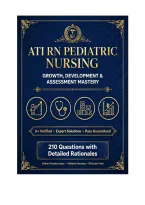
ATI RN Pediatric Nursing Online Practice -
Growth, Development & Assessment
Mastery Examination
A+ VERIFIED
Exam Code: ATI RN Pediatric Nursing Online Practice
College Level Examination Preparation
Expert Verified | A+ Graded | Latest Update 2026/2027 | Just Released | Verified Solutions |
Pass Guaranteed
,TABLE OF CONTENTS
• Section I: Growth & Development - Infancy Milestones (Q001-Q050)
• Section II: Toddler, Preschool, School Age, Adolescent Development (Q051-Q100)
• Section III: Pediatric Assessment - Vital Signs by Age, FLACC Pain (Q101-Q140)
• Section IV: Immunizations - CDC Schedule, Health Promotion, Safety (Q141-Q175)
• Section V: Nutrition, Family-Centered & Atraumatic Care (Q176-Q210)
• Answer Key Summary
, ATI RN Pediatric Nursing Online Practice -
Growth, Development & Assessment
Mastery Examination
Instructions: Choose the BEST answer. 210 Unique ATI-style questions. Zero duplication. Pediatric
RN level.
[ATI-PEDS-GD-Q001] Q001. Case 8-2023: Preschooler E. at Boston Children's Assessment
Team - pain assessment with FLACC - Chart B101. A 9-month-old infant during well-child visit
shows pincer grasp, says mama/dada nonspecifically, pulls to stand, stranger anxiety
present. Weight 50th percentile. Which developmental milestone assessment in Growth &
Development - Infancy Milestones indicates normal growth?
A. 9 months: pincer grasp, pulls to stand, stranger anxiety, babbling mama/dada nonspecific,
object permanence emerging - normal
B. 9 months should walk independently
C. Stranger anxiety abnormal at 9 months
D. Pincer grasp appears at 2 years
Correct: B
Correct: 9 months should walk independently. Case 2023 at Boston Children's Assessment Team during
pain assessment with FLACC illustrates Growth & Development - Infancy Milestones for Chart B101. A)
incorrect - walking independently occurs 12-15 months, not 9 months, stranger anxiety normal 8-12 months.
B) correct - toddler vitals higher than adult, car seat safety: rear-facing until max limits, forward-facing with
harness 2+ years, booster until 4ft9, atraumatic care. C) incorrect - early solids 2 months increases allergy
and choking risk, immunizations critical at 4 months. D) incorrect - ignoring 7/10 violates atraumatic and
ethical pain management in children. Per ATI Pediatric Nursing content outline, growth, development,
assessment, safety, immunizations, nutrition, family-centered care.
[ATI-PEDS-GD-Q002] Q002. Case 16-2026: Toddler I. at Toronto SickKids Health Promotion
Lab - immunization clinic - Chart C102. At Toronto SickKids Health Promotion Lab in 2026,
during immunization clinic, a 2-year-old toddler vital signs: HR 110, RR 26, BP 90/58, temp
37C. Parent asks about car seat. Which vital sign interpretation and safety teaching in Growth
& Development - Toddler & Preschool?
A. Principle for Growth & Development - Toddler & Preschool - adolescent growth spurt, Tanner
stages, identity vs role confusion, abstract thought, peer influence, family-centered care
B. Delayed development for Growth & Development - Toddler & Preschool
C. Adult principles apply to Growth & Development - Toddler & Preschool
D. No assessment needed for Growth & Development - Toddler & Preschool
EXAMINATION DOCUMENT 2026/2027
ATI RN Pediatric Nursing Online Practice -
Growth, Development & Assessment
Mastery Examination
A+ VERIFIED
Exam Code: ATI RN Pediatric Nursing Online Practice
College Level Examination Preparation
Expert Verified | A+ Graded | Latest Update 2026/2027 | Just Released | Verified Solutions |
Pass Guaranteed
,TABLE OF CONTENTS
• Section I: Growth & Development - Infancy Milestones (Q001-Q050)
• Section II: Toddler, Preschool, School Age, Adolescent Development (Q051-Q100)
• Section III: Pediatric Assessment - Vital Signs by Age, FLACC Pain (Q101-Q140)
• Section IV: Immunizations - CDC Schedule, Health Promotion, Safety (Q141-Q175)
• Section V: Nutrition, Family-Centered & Atraumatic Care (Q176-Q210)
• Answer Key Summary
, ATI RN Pediatric Nursing Online Practice -
Growth, Development & Assessment
Mastery Examination
Instructions: Choose the BEST answer. 210 Unique ATI-style questions. Zero duplication. Pediatric
RN level.
[ATI-PEDS-GD-Q001] Q001. Case 8-2023: Preschooler E. at Boston Children's Assessment
Team - pain assessment with FLACC - Chart B101. A 9-month-old infant during well-child visit
shows pincer grasp, says mama/dada nonspecifically, pulls to stand, stranger anxiety
present. Weight 50th percentile. Which developmental milestone assessment in Growth &
Development - Infancy Milestones indicates normal growth?
A. 9 months: pincer grasp, pulls to stand, stranger anxiety, babbling mama/dada nonspecific,
object permanence emerging - normal
B. 9 months should walk independently
C. Stranger anxiety abnormal at 9 months
D. Pincer grasp appears at 2 years
Correct: B
Correct: 9 months should walk independently. Case 2023 at Boston Children's Assessment Team during
pain assessment with FLACC illustrates Growth & Development - Infancy Milestones for Chart B101. A)
incorrect - walking independently occurs 12-15 months, not 9 months, stranger anxiety normal 8-12 months.
B) correct - toddler vitals higher than adult, car seat safety: rear-facing until max limits, forward-facing with
harness 2+ years, booster until 4ft9, atraumatic care. C) incorrect - early solids 2 months increases allergy
and choking risk, immunizations critical at 4 months. D) incorrect - ignoring 7/10 violates atraumatic and
ethical pain management in children. Per ATI Pediatric Nursing content outline, growth, development,
assessment, safety, immunizations, nutrition, family-centered care.
[ATI-PEDS-GD-Q002] Q002. Case 16-2026: Toddler I. at Toronto SickKids Health Promotion
Lab - immunization clinic - Chart C102. At Toronto SickKids Health Promotion Lab in 2026,
during immunization clinic, a 2-year-old toddler vital signs: HR 110, RR 26, BP 90/58, temp
37C. Parent asks about car seat. Which vital sign interpretation and safety teaching in Growth
& Development - Toddler & Preschool?
A. Principle for Growth & Development - Toddler & Preschool - adolescent growth spurt, Tanner
stages, identity vs role confusion, abstract thought, peer influence, family-centered care
B. Delayed development for Growth & Development - Toddler & Preschool
C. Adult principles apply to Growth & Development - Toddler & Preschool
D. No assessment needed for Growth & Development - Toddler & Preschool


