
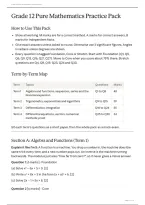
Grade 12 Pure Mathematics Practice Pack
Grade 12 Pure Mathematics Practice Pack
How to Use This Pack
Show all working. M marks are for a correct method, A marks for correct answers, B
marks for independent facts.
Give exact answers unless asked to round. Otherwise use 3 significant figures. Angles
in radians unless degrees are shown.
Every question is tagged Foundation, Core or Stretch. Start with Foundation (Q1, Q5,
Q6, Q9, Q13, Q16, Q21, Q27). Move to Core when you score about 75% there. Stretch
questions are Q4, Q8, Q19, Q23, Q26 and Q30.
Term-by-Term Map
Term Topics Questions Marks
Term 1 Algebra and functions; sequences, series and the Q1 to Q8 48
binomial expansion
Term 2 Trigonometry; exponentials and logarithms Q9 to Q15 39
Term 3 Differentiation; integration Q16 to Q24 55
Term 4 Differential equations; vectors; numerical Q25 to Q30 34
methods; proof
Sit each term's questions as a short paper, then the whole pack as a mock exam.
Section A: Algebra and Functions (Term 1)
Explain it like I'm 5: A function is a machine. You drop a number in, the machine does the
same trick every time, and a new number pops out. An inverse is the machine running
backwards. The modulus just asks "how far from zero?", so it never gives a minus answer.
Question 1 [6 marks] · Foundation
(a) Solve x² − 6x + 5 = 0. [2]
(b) Write x² + 8x + 3 in the form (x + a)² + b. [2]
(c) Solve 2x − 1 > 5x + 8. [2]
Question 2 [6 marks] · Core
Page 1 of 12
, Grade 12 Pure Mathematics Practice Pack
(a) Solve |3x − 2| = 7. [3]
(b) Solve |x − 1| < 4. [3]
Question 3 [7 marks] · Core
f(x) = 2x + 1 and g(x) = x² − 3.
(a) Find fg(x). [2]
(b) Find gf(x). [2]
(c) Find f⁻¹(x). [2]
(d) Solve fg(x) = 13. [1]
Question 4 [6 marks] · Stretch
(a) Write (5x + 1)/((x − 1)(x + 2)) in the form A/(x − 1) + B/(x + 2). [4]
(b) Hence find ∫ (5x + 1)/((x − 1)(x + 2)) dx. [2]
Question 5 [5 marks] · Foundation
The curve y = f(x) has a maximum point at (2, 5). Write down the coordinates of the
turning point on:
(a) y = f(x + 3) [1]
(b) y = 2f(x) [1]
(c) y = −f(x) [1]
(d) y = f(3x) [1]
(e) Describe the single transformation that maps y = f(x) onto y = f(x) − 4. [1]
Section B: Sequences, Series and the Binomial Expansion (Term 1)
Explain it like I'm 5: A sequence is a line of toys in order. Arithmetic means you add the
same amount each step, like stairs that are all the same height. Geometric means you
multiply each time, like a rumour that doubles as everyone tells two friends. The binomial
pattern is a shortcut for opening a bracket that is multiplied by itself many times.
Question 6 [6 marks] · Foundation
An arithmetic series has first term 4 and common difference 5.
(a) Find the 15th term. [2]
(b) Find the sum of the first 15 terms. [2]
Page 2 of 12
Grade 12 Pure Mathematics Practice Pack
How to Use This Pack
Show all working. M marks are for a correct method, A marks for correct answers, B
marks for independent facts.
Give exact answers unless asked to round. Otherwise use 3 significant figures. Angles
in radians unless degrees are shown.
Every question is tagged Foundation, Core or Stretch. Start with Foundation (Q1, Q5,
Q6, Q9, Q13, Q16, Q21, Q27). Move to Core when you score about 75% there. Stretch
questions are Q4, Q8, Q19, Q23, Q26 and Q30.
Term-by-Term Map
Term Topics Questions Marks
Term 1 Algebra and functions; sequences, series and the Q1 to Q8 48
binomial expansion
Term 2 Trigonometry; exponentials and logarithms Q9 to Q15 39
Term 3 Differentiation; integration Q16 to Q24 55
Term 4 Differential equations; vectors; numerical Q25 to Q30 34
methods; proof
Sit each term's questions as a short paper, then the whole pack as a mock exam.
Section A: Algebra and Functions (Term 1)
Explain it like I'm 5: A function is a machine. You drop a number in, the machine does the
same trick every time, and a new number pops out. An inverse is the machine running
backwards. The modulus just asks "how far from zero?", so it never gives a minus answer.
Question 1 [6 marks] · Foundation
(a) Solve x² − 6x + 5 = 0. [2]
(b) Write x² + 8x + 3 in the form (x + a)² + b. [2]
(c) Solve 2x − 1 > 5x + 8. [2]
Question 2 [6 marks] · Core
Page 1 of 12
, Grade 12 Pure Mathematics Practice Pack
(a) Solve |3x − 2| = 7. [3]
(b) Solve |x − 1| < 4. [3]
Question 3 [7 marks] · Core
f(x) = 2x + 1 and g(x) = x² − 3.
(a) Find fg(x). [2]
(b) Find gf(x). [2]
(c) Find f⁻¹(x). [2]
(d) Solve fg(x) = 13. [1]
Question 4 [6 marks] · Stretch
(a) Write (5x + 1)/((x − 1)(x + 2)) in the form A/(x − 1) + B/(x + 2). [4]
(b) Hence find ∫ (5x + 1)/((x − 1)(x + 2)) dx. [2]
Question 5 [5 marks] · Foundation
The curve y = f(x) has a maximum point at (2, 5). Write down the coordinates of the
turning point on:
(a) y = f(x + 3) [1]
(b) y = 2f(x) [1]
(c) y = −f(x) [1]
(d) y = f(3x) [1]
(e) Describe the single transformation that maps y = f(x) onto y = f(x) − 4. [1]
Section B: Sequences, Series and the Binomial Expansion (Term 1)
Explain it like I'm 5: A sequence is a line of toys in order. Arithmetic means you add the
same amount each step, like stairs that are all the same height. Geometric means you
multiply each time, like a rumour that doubles as everyone tells two friends. The binomial
pattern is a shortcut for opening a bracket that is multiplied by itself many times.
Question 6 [6 marks] · Foundation
An arithmetic series has first term 4 and common difference 5.
(a) Find the 15th term. [2]
(b) Find the sum of the first 15 terms. [2]
Page 2 of 12


