
Chapter 2: Professional Organizations (Radiologic Technology / Medical Assisting / Pharmacy Technician context)
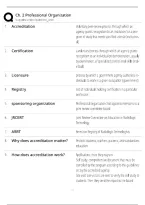
This chapter introduces students to the role of professional organizations in healthcare careers. It distinguishes between the three general classifications of organizations—accreditation, certification, and professional societies—and explains their distinct functions. Accreditation is a voluntary peer-review process through which an agency grants recognition to an educational institution for a program of study that meets specified criteria . Certification is a voluntary process through which an agency grants recognition to an individual upon demonstration, usually by examination, of specialized professional skills . Professional organizations, by contrast, are membership groups formed to advance a profession and support its practitioners through networking, continuing education, legislative advocacy, and career development resources . The chapter also covers key concepts such as registry (a listing of individuals holding certification credentials), licensure (a governmental agency granting permission to practice), and the benefits of membership in professional societies. For radiologic technology, key organizations include the ARRT (American Registry of Radiologic Technologists), which certifies individuals in radiography, and the ASRT (American Society of Radiologic Technologists), which represents the interests of radiologic technologists to the public and federal government . For medical assisting, the AAMA and AMT serve as certifying and professional bodies . For pharmacy technicians, organizations include the PTCB (Pharmacy Technician Certification Board) and the NPTA (National Pharmacy Technician Association)
Document information
- Uploaded on
- October 14, 2026
- Number of pages
- 3
- Written in
- 2026/2027
- Type
- Exam (elaborations)
- Contains
- Questions & answers


