
[STUDY GUIDE] • HIGH-YIELD PRACTICE & REVIEW EDITION
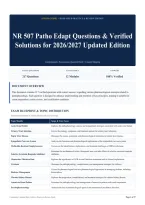
NR 507 Patho Edapt Questions & Verified
Solutions for 2026/2027 Updated Edition
Comprehensive Examination Question Bank • Concept Mapping
TOTAL QUESTIONS EXAM TOPICS ANSWERS
217 Questions 12 Modules 100% Verified
DOCUMENT OVERVIEW
This document contains 217 verified questions with correct answers regarding various pharmacological concepts related to
pathophysiology. Each question is designed to enhance understanding and retention of key principles, making it suitable for
exam preparation, course review, and certification readiness.
EXAM BLUEPRINT & TOPIC DISTRIBUTION
Systematic breakdown of subject domains and exam coverage.
Topic Module Scope & Core Focus
Acute Renal Failure Explores the pathophysiology, causes, and management strategies associated with acute renal failure.
Urinary Tract Infection Covers the etiology, symptoms, and treatment options for urinary tract infections.
Peptic Ulcer Disease Discusses the causes, symptoms, and pharmacological treatments for peptic ulcer disease.
Sympathetic Nervous System Analyzes the functions and pharmacological implications of the sympathetic nervous system.
Methicillin Resistant Staphylococcus Focuses on the identification, implications, and treatment challenges of MRSA infections.
Examines the mechanism of action, therapeutic uses, and side effects of selective serotonin reuptake
Selective Serotonin Reuptake Inhibitors inhibitors.
Glomerular Filtration Rate Explores the significance of GFR in renal function assessment and its clinical implications.
Cirrhosis Discusses the pathophysiology, complications, and management strategies for cirrhosis.
Covers the pharmacological and non-pharmacological approaches to managing diabetes, including
Diabetes Management Ketoacidosis.
Chronic Kidney Disease Explores the progression, complications, and treatment strategies for chronic kidney disease.
Anemia in Renal Failure Examines the pathophysiology and management of anemia in patients with renal impairment.
Psychopharmacology Analyzes the use of pharmacological agents in the treatment of psychiatric disorders.
Confidential • Student Study Edition • Practice & Review Guide Page 1 of 57
,STUDENT STUDY & MASTERY EDITION PRACTICE & REVIEW GUIDE
Total Exam Coverage 12 Integrated Topic Modules • 217 Examination Questions
HIGH-YIELD: QUESTIONS & VERIFIED ANSWERS
Complete Examination Questions • 217 Questions • Sequential Exam Layout
QUESTION 1
A 37-year -old female complains of a 7-month history of intermittent heart burn that occurs after
eating tomatoes. She denies any weight loss. On exam, the NP identifies epigastric tenderness. As
first line therapy for this patient, the NP should advise the patient to:
Avoid trigger foods.
Drink addition fluids with food intake.
Take an antacid prior to eating.
Use a prokinetic agent.
Answer: Avoid trigger foods.
QUESTION 2
TSH production is decreased in hypothyroidism.
True
False
Answer: False.
QUESTION 3
One of the first pathophysiological responses to the decreased GFR in acute renal failure is:
Secretion of creatine.
Reabsorption of BUN.
Activation of the renin-angiotensin-aldosterone system.
Increased urination.
Confidential • Student Study Edition • Practice & Review Guide Page 2 of 57
,STUDENT STUDY & MASTERY EDITION PRACTICE & REVIEW GUIDE
Figure Q3: Reference Image
Answer: Activation of the renin-angiotensin-aldosterone system.
QUESTION 4
Review the diagnostic tests blow and check the ones used to diagnose MS
Answer: An MRI that shows multiple CNS lesions called white matter plaque, visual evoked potential, CSF analysis.
QUESTION 5
In the active phase of schizophrenia, the individual experiences more severe delusions,
hallucinations and disorganized behavior.
True
False
Answer: True.
QUESTION 6
The anterior lobe of the pituitary produces its own hormones.
True
False
Answer: True.
Confidential • Student Study Edition • Practice & Review Guide Page 3 of 57
, STUDENT STUDY & MASTERY EDITION PRACTICE & REVIEW GUIDE
QUESTION 7
Anti-prostaglandin drugs cause gastric mucosal injury by:
Directly irritating the mucosa.
Decreasing peristalsis.
Altering the thickness of the mucosa.
Changing the stomach's pH level.
Answer: Altering the thickness of the mucosa.
QUESTION 8
There are some very well-known causes of Alzheimer's disease
Answer: False.
QUESTION 9
Match the substance to the cell from which they are secreted in the thyroid below.
Follicular Cells
Parafollicular Cells
Thyroxine (T4)
Calcitonin
Answer: Follicular Cells-Thyroxine (T4)
Parafollicular Cells-Calcitonin.
QUESTION 10
Hypoglycemia S/S
Answer: Pallor, sweating, tachycardia, hunger, restlessness, anxiety, tremors.
Confidential • Student Study Edition • Practice & Review Guide Page 4 of 57
NR 507 Patho Edapt Questions & Verified
Solutions for 2026/2027 Updated Edition
Comprehensive Examination Question Bank • Concept Mapping
TOTAL QUESTIONS EXAM TOPICS ANSWERS
217 Questions 12 Modules 100% Verified
DOCUMENT OVERVIEW
This document contains 217 verified questions with correct answers regarding various pharmacological concepts related to
pathophysiology. Each question is designed to enhance understanding and retention of key principles, making it suitable for
exam preparation, course review, and certification readiness.
EXAM BLUEPRINT & TOPIC DISTRIBUTION
Systematic breakdown of subject domains and exam coverage.
Topic Module Scope & Core Focus
Acute Renal Failure Explores the pathophysiology, causes, and management strategies associated with acute renal failure.
Urinary Tract Infection Covers the etiology, symptoms, and treatment options for urinary tract infections.
Peptic Ulcer Disease Discusses the causes, symptoms, and pharmacological treatments for peptic ulcer disease.
Sympathetic Nervous System Analyzes the functions and pharmacological implications of the sympathetic nervous system.
Methicillin Resistant Staphylococcus Focuses on the identification, implications, and treatment challenges of MRSA infections.
Examines the mechanism of action, therapeutic uses, and side effects of selective serotonin reuptake
Selective Serotonin Reuptake Inhibitors inhibitors.
Glomerular Filtration Rate Explores the significance of GFR in renal function assessment and its clinical implications.
Cirrhosis Discusses the pathophysiology, complications, and management strategies for cirrhosis.
Covers the pharmacological and non-pharmacological approaches to managing diabetes, including
Diabetes Management Ketoacidosis.
Chronic Kidney Disease Explores the progression, complications, and treatment strategies for chronic kidney disease.
Anemia in Renal Failure Examines the pathophysiology and management of anemia in patients with renal impairment.
Psychopharmacology Analyzes the use of pharmacological agents in the treatment of psychiatric disorders.
Confidential • Student Study Edition • Practice & Review Guide Page 1 of 57
,STUDENT STUDY & MASTERY EDITION PRACTICE & REVIEW GUIDE
Total Exam Coverage 12 Integrated Topic Modules • 217 Examination Questions
HIGH-YIELD: QUESTIONS & VERIFIED ANSWERS
Complete Examination Questions • 217 Questions • Sequential Exam Layout
QUESTION 1
A 37-year -old female complains of a 7-month history of intermittent heart burn that occurs after
eating tomatoes. She denies any weight loss. On exam, the NP identifies epigastric tenderness. As
first line therapy for this patient, the NP should advise the patient to:
Avoid trigger foods.
Drink addition fluids with food intake.
Take an antacid prior to eating.
Use a prokinetic agent.
Answer: Avoid trigger foods.
QUESTION 2
TSH production is decreased in hypothyroidism.
True
False
Answer: False.
QUESTION 3
One of the first pathophysiological responses to the decreased GFR in acute renal failure is:
Secretion of creatine.
Reabsorption of BUN.
Activation of the renin-angiotensin-aldosterone system.
Increased urination.
Confidential • Student Study Edition • Practice & Review Guide Page 2 of 57
,STUDENT STUDY & MASTERY EDITION PRACTICE & REVIEW GUIDE
Figure Q3: Reference Image
Answer: Activation of the renin-angiotensin-aldosterone system.
QUESTION 4
Review the diagnostic tests blow and check the ones used to diagnose MS
Answer: An MRI that shows multiple CNS lesions called white matter plaque, visual evoked potential, CSF analysis.
QUESTION 5
In the active phase of schizophrenia, the individual experiences more severe delusions,
hallucinations and disorganized behavior.
True
False
Answer: True.
QUESTION 6
The anterior lobe of the pituitary produces its own hormones.
True
False
Answer: True.
Confidential • Student Study Edition • Practice & Review Guide Page 3 of 57
, STUDENT STUDY & MASTERY EDITION PRACTICE & REVIEW GUIDE
QUESTION 7
Anti-prostaglandin drugs cause gastric mucosal injury by:
Directly irritating the mucosa.
Decreasing peristalsis.
Altering the thickness of the mucosa.
Changing the stomach's pH level.
Answer: Altering the thickness of the mucosa.
QUESTION 8
There are some very well-known causes of Alzheimer's disease
Answer: False.
QUESTION 9
Match the substance to the cell from which they are secreted in the thyroid below.
Follicular Cells
Parafollicular Cells
Thyroxine (T4)
Calcitonin
Answer: Follicular Cells-Thyroxine (T4)
Parafollicular Cells-Calcitonin.
QUESTION 10
Hypoglycemia S/S
Answer: Pallor, sweating, tachycardia, hunger, restlessness, anxiety, tremors.
Confidential • Student Study Edition • Practice & Review Guide Page 4 of 57


