
[STUDY GUIDE] • HIGH-YIELD PRACTICE & REVIEW EDITION
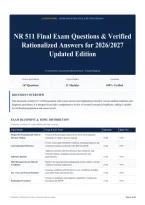
NR 511 Final Exam Questions & Verified
Rationalized Answers for 2026/2027
Updated Edition
Comprehensive Examination Question Bank • Concept Mapping
TOTAL QUESTIONS EXAM TOPICS ANSWERS
167 Questions 11 Modules 100% Verified
DOCUMENT OVERVIEW
This document contains 167 verified questions with correct answers and explanations related to various medical conditions and
diagnostic procedures. It is designed to provide a comprehensive review of essential concepts in healthcare, making it suitable
for certification preparation and course review.
EXAM BLUEPRINT & TOPIC DISTRIBUTION
Systematic breakdown of subject domains and exam coverage.
Topic Module Scope & Core Focus Questions Share (%)
Diagnostic Reasoning and Clinical Focuses on the principles and processes involved in diagnostic
Decision Making reasoning and clinical decision-making. 16 Qs 9.6%
Covers various gastrointestinal conditions, including diagnosis and
Gastrointestinal Disorders treatment strategies for disorders like IBS and GERD. 16 Qs 9.6%
Addresses common infectious diseases, their symptoms, and
treatment options, including streptococcal infections and
Infectious Diseases gastroenteritis. 15 Qs 9.0%
Pain Management and Chronic Explores the assessment and management of pain related to chronic
Conditions conditions and their implications. 15 Qs 9.0%
Examines conditions affecting the ear, nose, and throat, including
Ear, Nose, and Throat Disorders acute otitis media and hearing loss. 15 Qs 9.0%
Focuses on techniques and diagnostic capabilities of endoscopic
Endoscopic Procedures procedures like ERCP. 15 Qs 9.0%
Confidential • Student Study Edition • Practice & Review Guide Page 1 of 48
,STUDENT STUDY & MASTERY EDITION PRACTICE & REVIEW GUIDE
Covers neurological conditions associated with pain, including
Neuroscience and Pain Disorders chronic pain syndromes and diagnostic tests. 15 Qs 9.0%
Discusses thyroid function, common disorders, and their systemic
Thyroid Disorders effects. 15 Qs 9.0%
Examines the implications of obesity and related metabolic
Obesity and Metabolic Disorders disorders on health. 15 Qs 9.0%
Addresses health concerns specific to pediatric populations,
Pediatric and Adolescent Health including common illnesses and preventive care. 15 Qs 9.0%
Covers conditions affecting the musculoskeletal system, including
Musculoskeletal Disorders joint inflammation and injuries. 15 Qs 9.0%
Total Exam Coverage 11 Integrated Topic Modules 167 Qs 100.0%
TOPIC 1: DIAGNOSTIC REASONING AND CLINICAL DECISION MAKING
16 Questions • 9.6% of Exam • Focuses on the principles and processes involved in diagnostic reasoning and clinical decision-making.
QUESTION 1
Define Diagnostic Reasoning
Answer: To solve problems, to promote health, and to screen for disease or illness. All require a sensitivity to complex
stories, to contextual factors, and to sense of probability and uncertainty.
Can be seen as a kind of critical thinking.
QUESTION 2
Discuss and identify subjective data
Answer: Reports, complaints of , replies to provider questions, includes ROS, CC, HPI.
QUESTION 3
Discuss and identify objective data
Answer: What you can see, hear, or feel as part of a clinical exam. Also includes laboratory data and test results.
Confidential • Student Study Edition • Practice & Review Guide Page 2 of 48
,STUDENT STUDY & MASTERY EDITION PRACTICE & REVIEW GUIDE
QUESTION 4
Elements needed when developing a plan
Answer: Acknowledge the list, negotiate what to cover, be honest, make a follow up.
QUESTION 5
Correctly order the E&M office visits based on complexity from least to most complex
Answer: 99212-99214.
QUESTION 6
Explain what a well rounded clinical experience is
Answer: Includes both children from birth through young adult visits for well child and acute visits, as well as wellness,
acute, and routine visits of adults.
QUESTION 7
Identify and explain each part of the acronym SNAPPS
Answer: S-summarize, N-narrow, A-analyze, P-probe, P-plan-S-self-directing learning.
QUESTION 8
Assessing for prior antibiotic use is a critical part of the history in patients with presenting with
_______________ due to_________________
Answer: Diarrhea/CDiff.
Confidential • Student Study Edition • Practice & Review Guide Page 3 of 48
, STUDENT STUDY & MASTERY EDITION PRACTICE & REVIEW GUIDE
QUESTION 9
Discuss clinical findings and PFTs for asthma
Answer: O Subjective: c/o breathlessness, unable to talk, short sentences, profuse sweating, c/o air hunger. In patients
who are severely obstructed, there may be no wheezing and only cough may be present.
Wheezing, persistent and recurrent cough, difficulty breathing, tightness in chest, endurance problems during exercise.
Symptoms are usually worse at night. o Objective: Nasal discharge, mucosal swelling, frontal tenderness, nasal polyps,
and allergic "shiners" (dark discoloration beneath both eyes). Allergic rhinitis and eczema often accompany the dx of
asthma.
- Asthma PFTs o Mild intermittent asthma- FEV1: >80%, PFT >20% o Mild persistent asthma- FEV1: >80%, PFT
20%-30% o Moderate persistent asthma- FEV1: 60%-80%, PFT >30% o Severe persistent asthma- <60%, PFT >30%.
QUESTION 10
Identify the virus that causes warts
Answer: HPV (Human papilloma virus)
QUESTION 11
Chemical injury is associated with the most damage and highest risk to vision los
Answer: Alkali injuries (moderate or severe) cause permanent scarring and vision loss.
QUESTION 12
Discuss how the Phren sign can differentiate between testicular torsion and epididymitis
Answer: Epididymis characteristic is relief of discomfort with elevation of testis. Positive Prehn's sign = pain relief.
Testicular torsion elevation of the affected testicle does NOT relieve the pain (Negative Prehn's sign = pain is NOT
relieved) Epididymis Positive Prehn's sign = pain relief. Neg = no pain relief = testicular torsion).
Confidential • Student Study Edition • Practice & Review Guide Page 4 of 48
NR 511 Final Exam Questions & Verified
Rationalized Answers for 2026/2027
Updated Edition
Comprehensive Examination Question Bank • Concept Mapping
TOTAL QUESTIONS EXAM TOPICS ANSWERS
167 Questions 11 Modules 100% Verified
DOCUMENT OVERVIEW
This document contains 167 verified questions with correct answers and explanations related to various medical conditions and
diagnostic procedures. It is designed to provide a comprehensive review of essential concepts in healthcare, making it suitable
for certification preparation and course review.
EXAM BLUEPRINT & TOPIC DISTRIBUTION
Systematic breakdown of subject domains and exam coverage.
Topic Module Scope & Core Focus Questions Share (%)
Diagnostic Reasoning and Clinical Focuses on the principles and processes involved in diagnostic
Decision Making reasoning and clinical decision-making. 16 Qs 9.6%
Covers various gastrointestinal conditions, including diagnosis and
Gastrointestinal Disorders treatment strategies for disorders like IBS and GERD. 16 Qs 9.6%
Addresses common infectious diseases, their symptoms, and
treatment options, including streptococcal infections and
Infectious Diseases gastroenteritis. 15 Qs 9.0%
Pain Management and Chronic Explores the assessment and management of pain related to chronic
Conditions conditions and their implications. 15 Qs 9.0%
Examines conditions affecting the ear, nose, and throat, including
Ear, Nose, and Throat Disorders acute otitis media and hearing loss. 15 Qs 9.0%
Focuses on techniques and diagnostic capabilities of endoscopic
Endoscopic Procedures procedures like ERCP. 15 Qs 9.0%
Confidential • Student Study Edition • Practice & Review Guide Page 1 of 48
,STUDENT STUDY & MASTERY EDITION PRACTICE & REVIEW GUIDE
Covers neurological conditions associated with pain, including
Neuroscience and Pain Disorders chronic pain syndromes and diagnostic tests. 15 Qs 9.0%
Discusses thyroid function, common disorders, and their systemic
Thyroid Disorders effects. 15 Qs 9.0%
Examines the implications of obesity and related metabolic
Obesity and Metabolic Disorders disorders on health. 15 Qs 9.0%
Addresses health concerns specific to pediatric populations,
Pediatric and Adolescent Health including common illnesses and preventive care. 15 Qs 9.0%
Covers conditions affecting the musculoskeletal system, including
Musculoskeletal Disorders joint inflammation and injuries. 15 Qs 9.0%
Total Exam Coverage 11 Integrated Topic Modules 167 Qs 100.0%
TOPIC 1: DIAGNOSTIC REASONING AND CLINICAL DECISION MAKING
16 Questions • 9.6% of Exam • Focuses on the principles and processes involved in diagnostic reasoning and clinical decision-making.
QUESTION 1
Define Diagnostic Reasoning
Answer: To solve problems, to promote health, and to screen for disease or illness. All require a sensitivity to complex
stories, to contextual factors, and to sense of probability and uncertainty.
Can be seen as a kind of critical thinking.
QUESTION 2
Discuss and identify subjective data
Answer: Reports, complaints of , replies to provider questions, includes ROS, CC, HPI.
QUESTION 3
Discuss and identify objective data
Answer: What you can see, hear, or feel as part of a clinical exam. Also includes laboratory data and test results.
Confidential • Student Study Edition • Practice & Review Guide Page 2 of 48
,STUDENT STUDY & MASTERY EDITION PRACTICE & REVIEW GUIDE
QUESTION 4
Elements needed when developing a plan
Answer: Acknowledge the list, negotiate what to cover, be honest, make a follow up.
QUESTION 5
Correctly order the E&M office visits based on complexity from least to most complex
Answer: 99212-99214.
QUESTION 6
Explain what a well rounded clinical experience is
Answer: Includes both children from birth through young adult visits for well child and acute visits, as well as wellness,
acute, and routine visits of adults.
QUESTION 7
Identify and explain each part of the acronym SNAPPS
Answer: S-summarize, N-narrow, A-analyze, P-probe, P-plan-S-self-directing learning.
QUESTION 8
Assessing for prior antibiotic use is a critical part of the history in patients with presenting with
_______________ due to_________________
Answer: Diarrhea/CDiff.
Confidential • Student Study Edition • Practice & Review Guide Page 3 of 48
, STUDENT STUDY & MASTERY EDITION PRACTICE & REVIEW GUIDE
QUESTION 9
Discuss clinical findings and PFTs for asthma
Answer: O Subjective: c/o breathlessness, unable to talk, short sentences, profuse sweating, c/o air hunger. In patients
who are severely obstructed, there may be no wheezing and only cough may be present.
Wheezing, persistent and recurrent cough, difficulty breathing, tightness in chest, endurance problems during exercise.
Symptoms are usually worse at night. o Objective: Nasal discharge, mucosal swelling, frontal tenderness, nasal polyps,
and allergic "shiners" (dark discoloration beneath both eyes). Allergic rhinitis and eczema often accompany the dx of
asthma.
- Asthma PFTs o Mild intermittent asthma- FEV1: >80%, PFT >20% o Mild persistent asthma- FEV1: >80%, PFT
20%-30% o Moderate persistent asthma- FEV1: 60%-80%, PFT >30% o Severe persistent asthma- <60%, PFT >30%.
QUESTION 10
Identify the virus that causes warts
Answer: HPV (Human papilloma virus)
QUESTION 11
Chemical injury is associated with the most damage and highest risk to vision los
Answer: Alkali injuries (moderate or severe) cause permanent scarring and vision loss.
QUESTION 12
Discuss how the Phren sign can differentiate between testicular torsion and epididymitis
Answer: Epididymis characteristic is relief of discomfort with elevation of testis. Positive Prehn's sign = pain relief.
Testicular torsion elevation of the affected testicle does NOT relieve the pain (Negative Prehn's sign = pain is NOT
relieved) Epididymis Positive Prehn's sign = pain relief. Neg = no pain relief = testicular torsion).
Confidential • Student Study Edition • Practice & Review Guide Page 4 of 48


