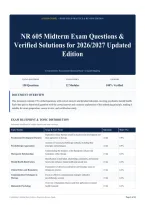
[STUDY GUIDE] • HIGH-YIELD PRACTICE & REVIEW EDITION
NR 605 Midterm Exam Questions &
Verified Solutions for 2026/2027 Updated
Edition
Comprehensive Examination Question Bank • Concept Mapping
TOTAL QUESTIONS EXAM TOPICS ANSWERS
158 Questions 12 Modules 100% Verified
DOCUMENT OVERVIEW
This document contains 158 verified questions with correct answers and detailed rationales covering psychiatric mental health.
Each item pairs a board-style question with the correct answer and a concise explanation of the underlying principle, making it
suitable for exam preparation, course review, and certification study.
EXAM BLUEPRINT & TOPIC DISTRIBUTION
Systematic breakdown of subject domains and exam coverage.
Topic Module Scope & Core Focus Questions Share (%)
Exploration of key theories related to psychosocial development and
Psychosocial Development Theories their application in therapy. 14 Qs 8.9%
Analysis of various psychotherapy methods, including their
Psychotherapy Approaches principles and techniques. 14 Qs 8.9%
Understanding the dynamics of the therapeutic alliance and
Therapeutic Relationships boundaries within therapy. 13 Qs 8.2%
Identification of individual, relationship, community, and societal
Mental Health Risk Factors factors that influence mental health and suicide risk. 13 Qs 8.2%
Examination of ethical considerations and boundary issues in
Clinical Ethics and Boundaries therapeutic practice. 13 Qs 8.2%
Communication Techniques in Focus on effective communication strategies utilized in
Therapy psychotherapy sessions. 13 Qs 8.2%
Overview of humanistic theories and their application in mental
Humanistic Psychology health treatment. 13 Qs 8.2%
Confidential • Student Study Edition • Practice & Review Guide Page 1 of 54
,STUDENT STUDY & MASTERY EDITION PRACTICE & REVIEW GUIDE
Best practices and theoretical frameworks for conducting
Psychiatric Interviewing psychiatric interviews. 13 Qs 8.2%
Coping Mechanisms and Defense Discussion of various coping strategies and defense mechanisms
Strategies used in response to psychological distress. 13 Qs 8.2%
Investigation of different therapeutic modalities and their
Treatment Modalities effectiveness in treating mental health issues. 13 Qs 8.2%
Understanding how cultural factors influence mental health
Cultural Considerations in Therapy perceptions and treatment. 13 Qs 8.2%
Distinction between progress notes and process notes in clinical
Progress and Process Notes documentation. 13 Qs 8.2%
Total Exam Coverage 12 Integrated Topic Modules 158 Qs 100.0%
TOPIC 1: PSYCHOSOCIAL DEVELOPMENT THEORIES
14 Questions • 8.9% of Exam • Exploration of key theories related to psychosocial development and their application in therapy.
QUESTION 1
Kathy is a 32-year-old who has been in court-mandated therapy for two months after her
children were removed from the home by Child Protective Services for suspected physical abuse
and neglect. The social worker has requested copies of her progress notes as a part of the
investigation. Is the therapist obligated to provide the progress notes?
Yes, no client authorization necessary
Yes with written authorization from the client No
Answer: Yes, no client authorization necessary.
Rationale: Because the notes were requested for a health and human services investigation, the therapist may release the notes without
client authorization.
Confidential • Student Study Edition • Practice & Review Guide Page 2 of 54
,STUDENT STUDY & MASTERY EDITION PRACTICE & REVIEW GUIDE
QUESTION 2
Shakina, a 19-year-old transgender female, has been referred to the PMHNP from primary care.
The PMHNP reviews the primary provider's note and identifies symptoms of bipolar I disorder.
The PMHNP completes a comprehensive assessment and prescribes medications for the client.
provide the appropriate CPT code
Answer: 99245.
Rationale: The client has been referred (24), has complex medical decision-making needs (5) based on one undiagnosed new problem
with an uncertain prognosis, required review of referral notes, and requires prescription drug management. No psychotherapy provided.
QUESTION 3
Reimbursement
Answer: Clinical procedural terminology (CPT) codes
-standardized codes used to communicate services completed to Medicare and other insurance companies for
reimbursement
-PMHNPs can bill for stand-alone psychotherapy using psychiatry specialty codes
• if the encounter includes diagnosing and/or prescribing medications, a medical evaluation and management (E/M) base
code should be used with an add-on psychotherapy procedure code.
QUESTION 4
Humanistic theory
Answer: View personality with a focus on the potential for healthy personal growth towards self-actualization
• Abraham Maslow's hierarchy of needs
-Who am I
-free will
-people are inherently good
-conscious
-self motivated to improve
-Carl Rogers
• self-actualization nurtured in a growth-promoting climate
• genuine
• acceptance
-Fritz Perls
• Gestalt therapy, wholeness of ind's experience.
Confidential • Student Study Edition • Practice & Review Guide Page 3 of 54
, STUDENT STUDY & MASTERY EDITION PRACTICE & REVIEW GUIDE
QUESTION 5
Sigmund Freud
Answer: Considered to be the father of psychoanalytic psychotherapy
-ID'd three levels of awareness:
• preconscious
• conscious
• unconscious
-theory postulates that all actions are based on unconscious sexual or aggressive drives
-Psychological symptoms result from conflicts between three parts of the mind:
• id
• ego
• superego.
QUESTION 6
Self-actualized person
Answer: Is self-fulfilled
-Qualities exhibited by the self-actualized person include independence, autonomy, creativity, and maturity.
QUESTION 7
Mateo is a 19-year-old transgender male who presents for therapy. He states that his gender
identity is incongruent with his sex assigned at birth. He has transitioned to dressing as a man,
goes by Mateo, his chosen name, and uses he/him pronouns at school and home. He states that he
becomes very angry when people use his "dead" name or wrong pronoun. He states that he tries
to correct the person, but he gets very frustrated when he must correct the same person
repeatedly. The psychiatric mental
Answer: "It's ok if you are angry when people use your dead name." "I accept your gender identity and I understand
that it is difficult when you interact with people who don't accept who you are." "It sounds like when people repeatedly
use your dead name, you feel like they do not respect you.".
Rationale: Accurate empathic understanding helps the client to value their experiencing and increase their confidence in pursuing a
course of action. The therapist can express genuineness, or congruence, towards the client. As the psychotherapist openly expresses
feelings, thoughts, and reactions with the client, trust will be generated, and therapy will occur. During client-centered therapy, the
therapist should refrain from offering extensive advice and allow the client to drive the therapy session but may paraphrase the client's
statements and repeat them to help the client clarify feelings and actions.
Confidential • Student Study Edition • Practice & Review Guide Page 4 of 54